Keeping a municipality’s billing operations running smoothly starts with choosing the right utility billing system and implementing it correctly. A properly deployed platform helps municipal managers track precise usage, generate accurate invoices and streamline customer service workflows.
Modern systems can automate tasks like billing, exception handling and meter reading, reducing the risk of manual errors. Many platforms also track consumption trends over time, giving utilities clear data for more informed decision-making.
A smooth rollout protects both revenue and resident trust, setting municipal billing teams up for long-term success.
What Are Best Practices for a Smooth Utility Billing System Implementation?
Incorporating a new utility billing system calls for structured planning, clean data and phased execution to prevent downtime and customer confusion. These best practices can help utilities manage a smoother transition.
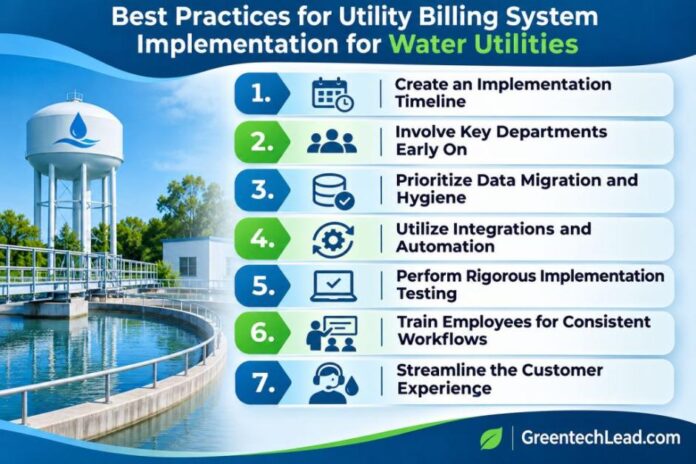
- Create an Implementation Timeline
Before integrating billing software, municipalities should set a realistic timeline and clear success metrics. Then, they should assign roles across IT, finance, customer service and field teams. A phased rollout can help reduce operational risk.
- Involve Key Departments Early On
From the initial planning stages, municipal managers should communicate implementation plans with customer service, IT and finance staff. Organizationwide collaboration can surface requirements that might otherwise be missed during configuration.
- Prioritize Data Migration and Hygiene
Billing accuracy and transparency are central to resident trust and sound municipal utility management. Improper data cleaning and migration can increase the risk of billing errors after go-live. As such, utility teams should audit and clean all pricing, meter and customer data before implementation.
- Utilize Integrations and Automation
Municipalities should consider connecting billing platforms with smart meters, financial software and geographic information system (GIS) mapping. Automation can reduce redundant data entry and keep records consistent across departments.
- Perform Rigorous Implementation Testing
Running a few tests with an implementation partner can help catch anomalies early on. Leaders can create sample invoices before go-live to ensure that rate calculations, tax codes and formatting are accurate. Involving end users in acceptance testing can further build implementation confidence.
- Train Employees for Consistent Workflows
Municipal managers should provide role-based training around specific jobs, from cashiering to accountant duties. Hands-on training can help teams become familiar with a new billing system. These procedures should be documented to maintain consistent workflows.
- Streamline the Customer Experience
One survey found that 71% of Americans doubt that their electricity charges are accurate, and nearly 70% are confused about how their bill is calculated. When implementing a new billing system, municipalities should provide transparent deposit policies and self-service portals with auto-pay to ease the transition for residents. Early communication can help reduce bill shock and support customer satisfaction.
What Are the Best Implementation Services for Utility Billing Systems?
The utility billing software market is projected to grow from $6.23 billion in 2025 to $9.82 billion by 2031, with cloud-native platforms and API-centered integrations driving adoption. However, a successful rollout is key for protecting revenue, customer trust and regulatory compliance. These four providers take unique approaches to implementation support.
Muni-Link
Muni-Link is a cloud-based utility billing and customer information system (CIS) designed for North American water and wastewater utilities. Implementation moves a utility from legacy or manual billing onto the cloud platform, covering data conversion, configuration, integrations and staff training.
Key Features
- Dedicated implementation team: A specialized onboarding team manages each project from contract through operational handoff.
- Structured data conversion: Support staff transfers legacy account and meter data through multiple reconciliation runs.
- Role-based training: Billing clerks, customer service representatives and management staff receive hands-on, role-specific training before go-live.
Red Clay
Red Clay is a systems integrator rather than a stand-alone billing software provider. It’s a certified Oracle partner that implements and optimizes Oracle Utilities platforms for water, gas and other public utilities.
Key Features
- Oracle Utilities expertise: Red Clay implements Oracle platforms such as Customer Care and Billing (CC&B), Customer to Meter (C2M) and Customer Cloud Service (CCS).
- Proprietary methodology: The company’s approach guides requirements gathering, system design and complex data conversions.
- Full life cycle support: The team offers support through user acceptance testing, production migration and managed services through implementation.
Sciens Consulting
Sciens Consulting is a management and technology consulting firm headquartered in McKinney, Texas, that serves North American government agencies. It helps local governments modernize their utility billing and enterprise resource planning (ERP) systems.
Key Features
- Strategy and system selection: Sciens Consulting conducts readiness assessments and vendor evaluations, including pricing analysis.
- End-to-end implementation support: Project teams handle automated billing, rate structuring and advanced metering infrastructure (AMI) integration.
- ERP coordination: The firm integrates finance, human resources and public works systems alongside billing platforms.
Tamazari
Tamazari is a U.S.-based technology modernization consultancy that helps water, gas and public-sector utilities implement complex billing platforms. It offers a variety of services.
Key Features
- Rate and program alignment: Tamazari clarifies complex rate structures so bills remain accurate and explainable.
- Systems integration: The company connects billing platforms with meter data management and ERP systems to minimize manual reentry.
- Testing and governance: Tamazari validates the full meter-to-cash pipeline and coordinates teams through go-live.
Frequently Asked Questions
Municipal managers evaluating a new utility billing system may have similar questions about scope, timeline and support.
How long does utility billing system implementation take?
Municipal implementations may take several months, depending on utility size, rate structure complexity and how much legacy data needs migration.
What data does a municipality need before migrating?
Utilities typically need clean customer records, meter data, billing history and current rate structures ready for review before conversion begins.
Can staff keep working during the transition?
Yes, implementation partners often support phased rollouts and parallel testing. This allows staff to continue billing operations on the legacy system until the new platform is fully integrated.
What support is available after go-live?
Ongoing technical support and check-ins are standard after launch, and reviewing implementation case studies can help managers understand what post-launch support looks like in practice.
Setting Utility Billing Systems up for Success
Implementing a utility billing system requires clear goal-setting, careful data migration and a strong focus on customer experience. Municipalities that invest time in structured planning and role-based training can help prevent the costly setbacks that come with rushed rollouts.
Evaluating implementation partners based on their onboarding process, integration capabilities and post-launch support helps utilities choose a system built for long-term reliability and resident trust.