
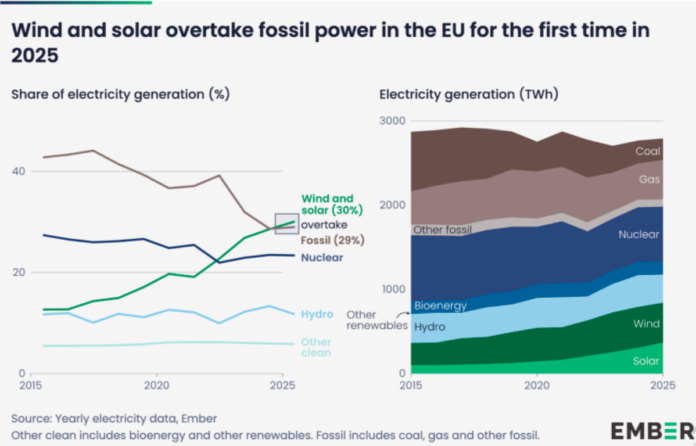
In 2025, the EU achieved a historic milestone as wind and solar power generated more electricity (30.1 percent, or 841 TWh) than all fossil sources combined (29.0 percent, or 809 TWh) for the first time. This marks a decade-long upward trend for renewables, accelerating sharply over the past five years — from 19.7 percent in 2020 to 30.1 percent in 2025 — while fossil power fell from 36.7 percent to 29.0 percent. Hydro and nuclear remained stable or slightly declined.
Wind and solar now dominate in 14 of 27 EU countries, with newcomers Netherlands (solar +31 percent YoY) and Croatia (solar +57 percent, wind +19 percent YoY) crossing the tipping point. Coal-reliant nations like Greece, Bulgaria, and Slovenia are nearing the threshold, driven by robust solar growth, Ember report said.
EU solar generation hit a record 369 TWh in 2025 — more than double 2020’s 145 TWh — fueling the renewables milestone with a 62 TWh (+20.1 percent) surge over 2024, equivalent to three French nuclear plants’ annual output. This capped five years of explosive 21 percent average annual growth, outpacing all other sources and underscoring solar’s pivotal role in Europe’s clean energy shift, Beatrice Petrovich, Ember, said.
EU solar capacity exploded by 65.1 GW in 2025 (+19 percent YoY), split evenly between utility-scale and rooftop installs, driving generation to a 13 percent share — double the global average (8.8 percent). All 27 countries grew solar output, with Hungary, Cyprus, Greece, Spain, and Netherlands exceeding 20 percent; seven EU nations rank in the global top 10. Solar briefly became the largest source in June 2025.
Renewables held steady at 47.7 percent (1,331 TWh) despite weather challenges: low wind (-23 percent speeds, -18 percent Q1 output) and hydro dips from dry conditions (+3-4°C North Atlantic warmth, -33 percent Northern rain) were offset by sunny boosts (+6 percent irradiation), adding 7 TWh to solar growth. Wind rebounded to 16.9 percent (edging gas at 16.7 percent), aided by 5.3 GW new capacity. Solar perfectly timed summer heatwave peaks (+14 percent AC demand), as total EU demand stagnated (+0.6 percent YoY, -4 percent vs. 2019).
EU gas generation rose 8 percent (+34 TWh) to 466 TWh in 2025 — the first uptick after five years of decline from 2019’s 569 TWh peak — but stayed 18 percent below that high and trailed wind (16.9 percent) for the third year. This drove a 16 percent hike in fossil gas import costs to €32 billion (+5.6 percent prices), led by Italy and Germany. Gains occurred in 15 of 27 countries, with Spain (+19 percent, +9.7 TWh), Italy (+5.5 percent), and Germany (+5.4 percent) accounting for 60 percent, mainly offsetting hydro shortfalls domestically and via reduced imports from France, Switzerland, and Austria.
In Germany, gas filled gaps during low solar/wind hours; in Spain, it supported grid services post-April blackout (temporary, as clean alternatives gain access from Jan 2026 via new rules).
EU coal power hit a historic low in 2025 at 9.2 percent (257 TWh) — down from 24.6 percent (705 TWh) a decade ago and well below the global average (33.1 percent) — edging closer to phase-out. It’s now marginal in 19 countries (zero or <5 percent share; +2 from 2024), with Ireland quitting in June and Finland effectively phasing out early (wind hit record 27 percent share).
Over 10 years, coal cuts in all 22 former coal-using nations weren’t replaced by gas or fossils. Remaining output concentrates in Germany (103 TWh, -3.2 percent YoY) and Poland (87 TWh, -6.6 percent YoY), comprising 74 percent of EU total — both at all-time lows.
BABURAJAN KIZHAKEDATH
