
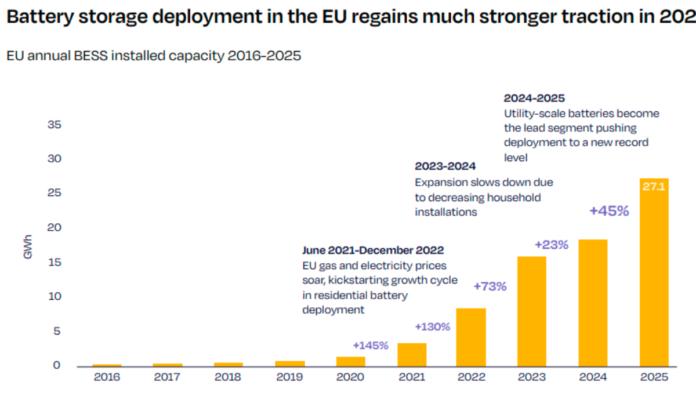
The European Union installed a record 27.1 GWh of new battery energy storage systems (BESS) in 2025, marking the 12th consecutive year of growth since SolarPower Europe began tracking the market in 2013. The latest additions lifted total operational battery storage capacity in the EU to 77.3 GWh by the end of 2025, confirming a sharp rebound after the temporary slowdown seen in 2024.
Annual installations rose by 45 percent year on year in 2025, with a fundamental shift in market structure. Utility-scale battery projects emerged as the main engine of growth, accounting for 55 percent of all new capacity added during the year. Improved market conditions and stronger policy support enabled large-scale systems to reach record deployment levels, while distributed battery segments continued to face structural barriers.
For the first time, behind-the-meter battery systems contributed less than half of annual additions. Growth in the commercial and industrial segment was not sufficient to offset a continued decline in residential battery installations, which fell for the second consecutive year. Residential deployments dropped by 6 percent to 9.8 GWh, largely due to lower electricity prices and reduced support schemes across key markets.
Outside the EU, the United Kingdom recorded a strong recovery in 2025, installing 5 GWh of new battery capacity and nearing 16 GWh of total installed storage. Supported by a stable policy framework and favourable market conditions, Europe’s largest grid-scale battery market made significant progress towards its 2030 energy flexibility targets.
Within the EU, Germany and Italy once again led the battery storage market in 2025. Bulgaria emerged as the fastest-growing market, climbing to third place, followed by the Netherlands and Spain to complete the top five. Entry into the top tier now requires substantial grid-scale deployments, as reaching the GWh level alone is no longer sufficient.
Germany maintained its leadership through record utility-scale installations, resilient growth in the commercial and industrial segment, and a more moderate decline in residential batteries. Italy saw a fall in annual additions despite stable grid-scale expansion, driven by a sharp drop in residential installations. Bulgaria recorded a breakthrough year, supported by strong incentives and a surge in large-scale projects. The Netherlands benefited from balanced growth across residential, commercial and utility-scale segments as policy and market conditions improved. Spain strengthened its position by officially recognising energy storage as a strategic asset for the energy transition and enhancing its regulatory framework to accelerate deployment.
Collectively, the top five EU markets accounted for 63 percent of total battery capacity installed in 2025, compared with nearly 80 percent in the previous year. While the market share of leading countries declined, deployment remains highly concentrated geographically.
SolarPower Europe’s latest report highlights that the EU has expanded its battery fleet tenfold since 2021, growing from 7.8 GWh to 77.3 GWh. To meet energy system flexibility needs by 2030, the bloc will need to repeat this expansion, scaling total battery storage capacity to around 750 GWh by the end of the decade.
Walburga Hemetsberger, CEO of SolarPower Europe, said Europe’s rapid battery deployment is delivering urgently needed flexibility to the power system. She noted that the strong uptake of utility-scale batteries in 2025 demonstrates investor confidence, technological maturity and clear system benefits, while stressing the need for a dramatic acceleration in deployment to support EU security and competitiveness.
The report also assesses the state of EU battery manufacturing, noting that Europe has built a solid midstream industrial base with 252 GWh of nominal battery cell production capacity in 2025. However, structural gaps remain across the value chain. While the EU has strong capabilities in electrolyte and separator production, cathode and anode active material manufacturing is limited, and more than 90 percent of existing cell capacity is dedicated to electric vehicles rather than stationary storage. Project delays and relatively high production costs continue to challenge competitiveness.
To scale battery storage effectively, SolarPower Europe outlines three priority areas for EU action. These include accelerating deployment by simplifying permitting, prioritising grid-friendly projects and removing tariff barriers; building affordable and resilient supply chains through targeted investment, access to raw materials and recycling, and diversified global partnerships; and strengthening quality, safety and sustainability through harmonised safety standards, improved recycling rules and robust carbon footprint disclosure.
Antonio Arruebo, lead author of the report and market analyst at SolarPower Europe, said the data shows the EU storage market is gaining momentum again, particularly in large-scale systems. He added that the decline in distributed batteries highlights the need for clearer policy support to unlock investment from businesses and households, while accelerated deployment across all segments will be essential to achieving Europe’s energy transition goals.
BABURAJAN KIZHAKEDATH
