
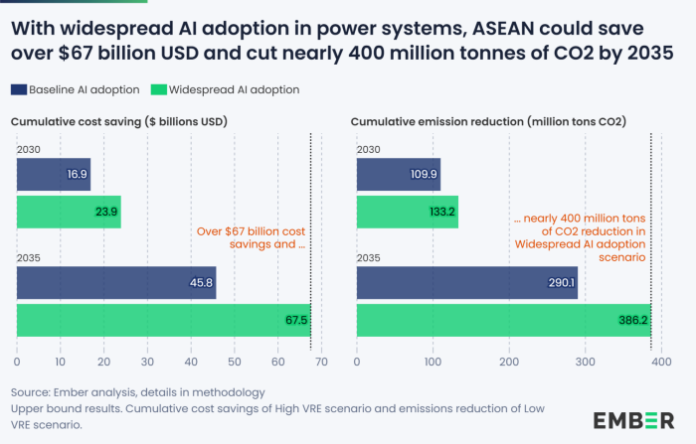
Integrating artificial intelligence into power systems across ASEAN could generate cumulative cost savings of up to $67 billion between 2026 and 2035, while reducing as much as 386 million tonnes of CO2 emissions, according to a new report by Ember.
Rising Renewable Energy Driving Grid Complexity in ASEAN
ASEAN’s electricity systems are entering a more complex phase of the energy transition. Solar and wind power have expanded from 2.3 percent of electricity supply in 2020 to around 5 percent in 2025. Long-term projections suggest variable renewable energy could account for 42 to 47 percent of total generation by 2045, with some scenarios exceeding 60 percent.
As renewable penetration increases, grid operators must manage higher variability, forecasting uncertainty, congestion risks and more intensive balancing requirements. This structural shift is reshaping how power systems are planned and operated across Southeast Asia.
AI Applications Already Delivering Measurable Results
The report highlights that AI technologies are already deployed in global power markets with measurable success. Key applications include:
Short-term renewable energy forecasting
Predictive maintenance of generation and grid assets
Dispatch optimisation
Real-time grid control systems
Dynamic line rating for transmission efficiency
These tools enhance operational efficiency and system reliability, particularly in markets with rising shares of solar and wind generation.
Under a widespread adoption scenario, AI integration could reduce annual generation costs significantly, delivering cumulative savings of between $45 billion and $67 billion by 2035. The highest economic benefits are observed in high-renewable scenarios, where improved forecasting accuracy and system optimisation generate greater financial returns.
Over the same period, AI-enabled efficiency improvements could reduce emissions by approximately 290 million to 386 million tonnes of CO2.
Lam Pham, Data Analyst at Ember, noted that while AI-driven data centres may initially increase electricity demand, advanced AI applications have the potential to accelerate the energy transition and offset energy consumption through efficiency gains.
ASEAN’s Digital Economy Supports AI Deployment
ASEAN demonstrates strong structural readiness for broader AI adoption. The region’s digital economy is currently valued at around $300 billion and is projected to approach $1 trillion by 2030. Data centre capacity is expanding rapidly, and major electricity markets including Indonesia, Viet Nam, Thailand, Malaysia and the Philippines perform above the global average on AI readiness indicators.
Utilities in these countries have already launched AI-driven initiatives focused on renewable forecasting, predictive maintenance and operational optimisation.
However, deployment remains fragmented. AI is often implemented at the asset level rather than embedded into system-wide planning, dispatch frameworks or regional coordination mechanisms. Moving from pilot projects to integrated, grid-wide solutions will be critical to unlocking full economic and environmental benefits.
Governance, Cybersecurity and Regulatory Challenges
The report cautions that AI integration into power systems introduces technical and governance risks that must be carefully managed. Power grids are traditionally engineered for deterministic reliability, while AI models are probabilistic in nature. This creates challenges around validation, explainability and liability, especially when AI tools influence forecasting or dispatch decisions.
In many ASEAN markets, power system data remains fragmented or non-standardised, raising risks of biased outputs or unpredictable behavior during rare but critical grid events.
Cybersecurity also emerges as a key concern. As power systems become increasingly digitalised and interconnected, particularly with distributed energy resources and cross-border electricity trade, the attack surface expands. AI systems themselves may be vulnerable to data manipulation or model exploitation without strong safeguards.
Dr. Pol Torres, Head of Energy and Agrifood AI Solutions at EURECAT, emphasized that AI deployment in energy systems must follow ethical principles and trustworthy AI frameworks. Transparency and explainability are essential to ensure accountability and regulatory compliance.
AI as a Strategic Enabler of ASEAN’s Energy Transition
The report concludes that AI represents a commercially available toolkit capable of enhancing operational efficiency and supporting higher renewable penetration across ASEAN power systems. The scale of economic savings and emissions reductions will ultimately depend on the speed of renewable expansion and whether AI adoption evolves from isolated pilots into coordinated, system-wide implementation.
If implemented strategically, AI could become a central enabler of ASEAN’s low-carbon transition, delivering billions in cost savings while significantly reducing power sector emissions over the next decade.
BABURAJAN KIZHAKEDATH
