
In a shift for Europe’s energy transition, batteries started competing with gas power in 2025, according to the latest Ember report.
As wind and solar dominated daytime generation, pulling wholesale electricity prices down, gas-heavy morning and evening hours drove sharp spikes — creating ideal economics for battery storage to arbitrage clean energy. This fueled a record battery pipeline, signaling accelerated deployment amid EU battery storage growth exceeding 10 GW (double 2023’s 4 GW), Ember’s Beatrice Petrovich said.
Wholesale Prices Surge in Gas-Dependent Hours
Electricity prices rose in 21 EU countries in 2025 vs. 2024 (3-22 percent annually), primarily from peaks during high-gas periods. Gas generation costs averaged €101-112/MWh, pushing prices 11 percent higher in those hours — vs. 3 percent rises in solar-rich midday slots (7am-4pm). Germany exemplified this: +19 percent in gas hours, but only +8 percent during peak solar.
Renewable abundance hours proliferated, with wind + solar >70 percent in at least one hour across 19 countries (up from 2 in 2020). Nine nations (Denmark, Estonia, Germany, Greece, Lithuania, Luxembourg, Netherlands, Portugal, Spain) saw renewables >50 percent for a third of all hours.
Battery Economics and Rapid Deployment
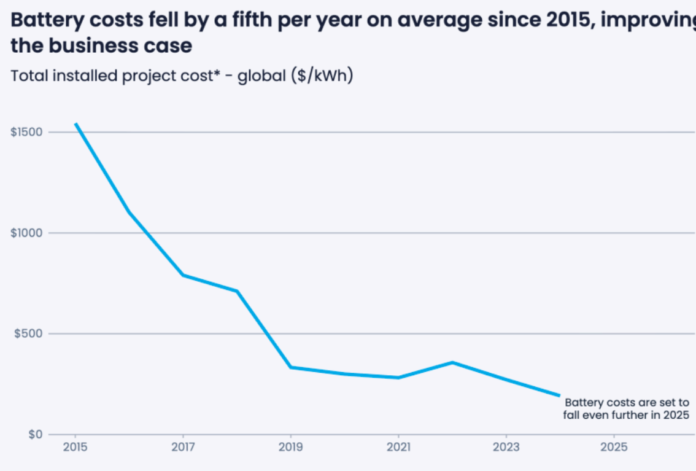
Battery costs fell 20 percent annually over the decade, amplifying intraday price spreads and making storage projects highly profitable. EU grid-scale batteries hit 10+ GW in 2025, with Italy and Germany hosting nearly half — but momentum spread bloc-wide.
A record pipeline emerged: Greece, Spain, Poland ramping up from low bases; Germany, Poland, Italy leading. If realized, it could surpass 40 GW (10x 2023 levels), less concentrated geographically. Surging Chinese battery imports (+ big jump in Jan-Nov 2025) underscore pipeline strength.
Italy’s Battery Boom: Displacing Gas and Cutting EU Energy Costs in 2025
Italy leads EU battery storage with 1.9 GW of large-scale capacity (20 percent of EU total), surging +0.7 GW (+40 percent) from Jan-Oct 2025. A massive 10 GW pipeline (construction, permitted, announced by Dec 2025) positions Italy to reduce gas reliance during peak evening hours — mirroring California’s rapid scale-up and promising lower wholesale electricity prices.
Batteries Tackle Peak Gas Demand in Italy
In Sep 2025, Italian batteries discharged 1.1 GW avg (7-8pm), covering 3 percent of demand vs. fossils’ 52 percent. Pipeline delivery could 6x capacity, slashing expensive gas imports. Gas costs €111/MWh avg in 2025; stored solar/wind via batteries? Just €64/MWh — outcompeting gas, curbing price spikes, and eroding suppliers’ market power.
California Case Study: Italy’s Blueprint
California’s grid batteries matched Italy’s 2 GW in 2021, then exploded to 13 GW by 2025. Evening peaks shifted: fossils fell from 44 percent (Sep 2021) to 34 percent (Sep 2025); batteries rose from 3 percent to 22 percent. Italy could replicate this, displacing gas power and stabilizing EU battery storage growth.
Curbing Waste: Batteries vs. Renewables Curtailment
As solar installations boom across Europe, batteries capture curtailed clean power — avoiding grid limits and negative prices (hit 5 percent+ hours in 7 EU countries). Germany curtailed 9.6 TWh wind/solar (4 percent total; solar 3.1 percent, wind 4.8 percent avg) — up from 2024.
If Germany’s 10.5 GW/26.3 GWh pipeline absorbed it:
Avoided 1/3 curtailment, saving €0.8B (€613M redispatch + €219M gas).
Cut gas generation 3.7 percent (3 TWh).
Investment payback: €145M/year over lifetime—strong ROI, plus grid services.
Grid Interconnections and Batteries: The Dual Solution
Europe’s interconnected grid already curbs spikes by shifting power efficiently. New cross-border transmission lines — targeting demand hubs, Nordics, and Eastern Europe — promise further relief. Pairing this with scalable batteries for renewable storage positions them as gas rivals, slashing price volatility and fossil reliance.
BABURAJAN KIZHAKEDATH
