
Whyalla Steel is increasingly at the center of a global debate on industrial decarbonisation, capital allocation, and the future of steel production. Analysis from the Institute for Energy Economics and Financial Analysis (IEEFA) highlights that a transition pathway anchored in natural gas risks locking the asset into a high-emissions trajectory at a time when global steelmakers are rapidly shifting toward hydrogen-based green iron production.
For investors and policymakers, the issue is no longer about incremental emissions reduction. It is about whether long-term capital is being deployed into future-ready infrastructure or potentially stranded fossil-linked assets in a decarbonising global economy, IEEFA’s Simon Nicholas said in the report.
Gas-Based Steelmaking: Transitional Logic, Structural Investment Limits
Natural gas-based direct reduced iron (DRI) is often positioned as a transitional solution between coal-heavy steelmaking and hydrogen-based production. While it can reduce emissions compared to blast furnace routes, it does not eliminate carbon dependency.
From an investment perspective, this creates a structural challenge because gas-based steel assets remain exposed to long-term fuel price volatility in global LNG markets, increasing carbon compliance costs across export destinations, and policy-driven decarbonisation pressure in industrial supply chains. This combination reduces the predictability of long-term cash flows for capital-intensive steel infrastructure, particularly in markets moving toward net-zero alignment.
Gas Price Volatility Undermines “Cheap Transition Fuel” Narrative
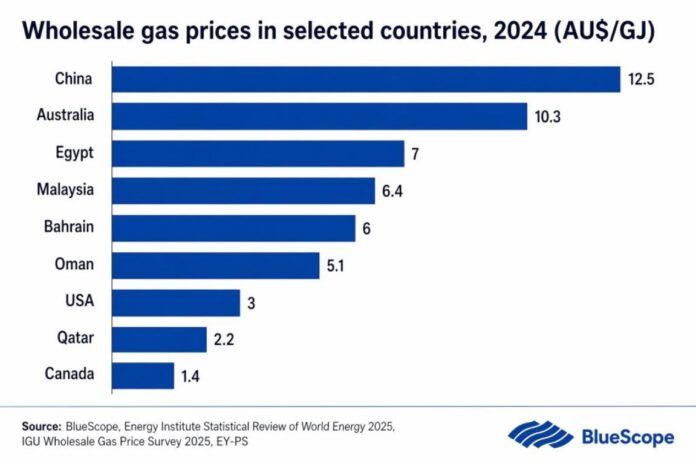
A weakness in the economic justification for gas-based steelmaking is global price volatility. Wholesale gas pricing across major economies shows significant divergence, which directly impacts industrial cost structures.
This wide pricing dispersion highlights that gas is not a structurally stable global feedstock. Instead, it introduces long-term cost uncertainty for energy-intensive industries such as steelmaking. For Australia, relatively higher gas prices compared to North American benchmarks further weaken the economic logic of locking industrial transformation into gas-dependent pathways.
From an investment perspective, this reinforces the risk that gas-based direct reduced iron (DRI) facilities may face structurally higher and more volatile operating costs compared to hydrogen-based systems powered by declining renewable electricity prices.
Global Steel Sector Shift: Hydrogen Becomes the Core Capital Allocation Theme
The global steel industry is undergoing a structural shift in capital allocation toward hydrogen-based and renewable-powered production systems. This is no longer experimental but is increasingly becoming a competitive positioning strategy among leading steel producers.
SSAB is advancing fossil-free steel production through its HYBRIT initiative, targeting hydrogen-based iron reduction using renewable electricity at industrial scale.
ArcelorMittal is investing in hydrogen pilot projects and low-carbon steel pathways across its European operations as part of a long-term decarbonisation strategy.
Tata Steel is integrating hydrogen-based steel trials and transition technologies across its European asset base.
POSCO is developing hydrogen steelmaking capabilities in South Korea, aligning with national industrial decarbonisation targets.
Across the global steel value chain, capital is increasingly shifting toward electrolyser manufacturing capacity, renewable energy integration for industrial use, hydrogen production and storage infrastructure, and green iron export-oriented production hubs.
Whyalla’s Structural Advantage: A Green Iron Conversion Platform, Not a Gas Transition Asset
Whyalla Steelworks holds a strategically significant position due to its existing integrated steel infrastructure, proximity to high-grade magnetite resources, and access to South Australia’s strong renewable energy base.
These fundamentals create a potential foundation for a green iron export hub, particularly targeting Asia’s growing demand for low-carbon industrial materials. However, the investment outcome depends entirely on the technology pathway chosen. If aligned with hydrogen-based direct reduced iron systems, Whyalla could transition into a globally competitive low-carbon steel exporter. If aligned with gas-based systems, it risks long-term misalignment with emerging global demand standards.
Hydrogen Economics: The Central Driver of Long-Term Steel Competitiveness
The economics of green steel are increasingly being defined by hydrogen production costs and renewable electricity pricing rather than traditional fossil fuel benchmarks.
South Australia’s high renewable energy penetration provides a structural advantage in reducing long-term hydrogen production costs. As renewable generation scales and electrolyser costs decline, hydrogen-based steelmaking is expected to move closer to cost competitiveness.
However, early-stage challenges still exist, including high upfront capital intensity for hydrogen infrastructure, scaling constraints in electrolyser deployment, and storage and logistics limitations for hydrogen transport. Despite these constraints, long-term cost trajectories are increasingly favorable for hydrogen-based steel production compared to fossil gas-dependent alternatives.
Carbon Regulation and Trade Policy: Structural Pressure on High-Emission Steel
Global policy frameworks are becoming a key determinant of steel competitiveness. Instruments such as the European Union’s Carbon Border Adjustment Mechanism (CBAM) are expected to materially impact carbon-intensive steel exports.
This introduces a structural shift where carbon intensity is becoming a pricing and market access variable rather than a voluntary sustainability metric. For Whyalla, this means that gas-based steel production may face increasing friction in accessing premium export markets, particularly in Europe and other carbon-regulated economies.
Demand-Side Transformation: Industrial Buyers Accelerating the Green Steel Shift
A major but often underestimated driver of the transition is demand-side pressure from global industrial buyers.
Automotive manufacturers, infrastructure developers, and industrial equipment producers are increasingly committing to low-carbon supply chains. This is translating into long-term procurement contracts for green steel, premium pricing for low-emissions materials, and supplier exclusion risks for high-carbon producers.
Stranded Asset Risk: The Core Capital Allocation Challenge
The most significant investment risk associated with gas-based steel pathways is the potential for stranded assets. As hydrogen-based technologies scale and carbon constraints tighten, gas-dependent infrastructure risks reduced economic lifespan, lower asset valuation over time, and limited alignment with future industrial demand.
For long-duration industrial investments, this creates a mismatch between asset life cycles and global decarbonisation timelines.
Global Competition: Whyalla in a Rapidly Expanding Green Steel Landscape
Whyalla is not operating in isolation. Competing green steel hubs are emerging across Europe, Asia, and the Middle East, many supported by state-backed hydrogen and renewable energy investments.
This is creating a global race for low-carbon steel export leadership, hydrogen infrastructure dominance, and industrial decarbonisation supply chain control. In this environment, early strategic positioning becomes a decisive factor in long-term competitiveness.
Investment Outlook: A Structural Choice Between Two Industrial Futures
The Whyalla Steel decision reflects a broader global investment inflection point. A gas-based transition pathway may offer lower near-term transition complexity but comes with higher long-term carbon and regulatory exposure, elevated stranded asset risk, and reduced alignment with global green steel demand.
A hydrogen-based green iron pathway, by contrast, requires higher upfront capital but offers strong alignment with global decarbonisation trends, lower long-term regulatory risk, and access to emerging premium green steel markets.
Conclusion: Why Gas Is Losing Its Investment Case in Global Steel Decarbonisation
The global steel industry is undergoing a structural capital reallocation toward hydrogen-based production systems driven by policy pressure, demand-side transformation, and long-term cost convergence in renewable energy and hydrogen technologies.
IEEFA’s assessment of Whyalla Steel reflects a broader investment reality where gas may appear as a transitional option but increasingly represents a misaligned pathway in a rapidly decarbonising global industrial system.
FASNA SHABEER
