
The renewable energy industry is playing an increasingly critical role in helping global mobile operators reduce carbon emissions, lower energy costs, and achieve ambitious net-zero commitments.
According to the GSMA’s Mobile Net Zero 2026 report, renewable electricity has become the single largest driver of emissions reductions across the telecom sector, creating significant opportunities for renewable energy developers, battery storage providers, solar companies, and clean energy investors.
Renewable Electricity Becomes the Main Driver of Telecom Decarbonization
Mobile network operators purchased and generated around 70 TWh of renewable electricity in 2024, more than doubling the renewable share of their electricity consumption from 10 percent in 2019 to 24 percent in 2024.
The telecom industry consumed approximately 300 TWh of electricity in 2024, representing around 1 percent of global electricity consumption. Operators spent approximately $50 billion on energy during the year, making renewable energy procurement and energy efficiency increasingly important for reducing both operating costs and carbon emissions.
Telecom Industry Cuts Carbon Emissions Despite Rising Data Demand
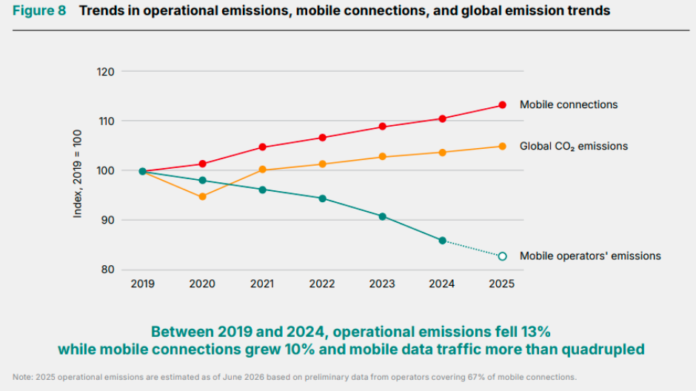
Global mobile operators reduced operational carbon emissions by 5 percent in 2024, twice the average annual decline achieved during the previous four years.
Between 2019 and 2024, operators lowered operational emissions by 13 percent, even as mobile connections increased by 10 percent and mobile data traffic expanded by more than four times. Preliminary estimates indicate another 3 percent reduction during 2025.
The industry’s operational emissions totaled approximately 115 million tonnes of CO₂ equivalent (MtCO₂e) in 2024, representing about 0.2 percent of global greenhouse gas emissions. Operational emissions account for roughly 27 percent of the telecom sector’s carbon footprint, while 73 percent originates from Scope 3 emissions across supply chains and customers.
Europe Leads Renewable Energy Adoption
Renewable electricity adoption varies significantly by region.
European mobile operators sourced approximately 70 percent of their electricity from renewable energy in 2024, the highest globally.
North American operators generated 50 percent of their electricity from renewable sources, while Latin American operators reached 45 percent renewable electricity.
For instance, T-Mobile US matched 100 percent of their electricity use with renewable energy, leading to a 95 percent reduction in operational emissions. AT&T and Verizon also achieved strong reductions due to progress on energy efficiency and renewable energy
Algar Telecom, Telefonica (Brazil, Chile, and Peru) and TIM Brazil have achieved 100 percent renewable electricity.
Greater China recorded its first decline in telecom emissions in 2024, with emissions falling by a record 7 percent, supported by rapid renewable energy deployment.
Among operators in the Middle East and North Africa, Turkcell had the largest reduction in emissions among operators in the region thanks to their renewable energy purchases.
In Sub-Saharan Africa, operational emissions per connection fell by nearly half between 2019 and 2024, led by substantial reductions from Vodacom, Safaricom and MTN.
Diesel Replacement Creates Major Opportunity for Solar and Battery Storage
Despite growing renewable adoption, telecom operators still consumed approximately 2.5 billion litres of diesel and gasoline during 2024, particularly in markets where reliable grid electricity remains limited.
The report highlights growing investment in solar photovoltaic systems, battery energy storage, and hybrid energy solutions for telecom towers. Early adopters have reported fuel cost savings of around 30 percent, demonstrating the financial benefits of replacing diesel generators with renewable energy systems.
Telecom Sector Strengthens Climate Commitments
As of June 2026, 81 mobile operators have adopted near-term Science Based Targets (SBTs), representing nearly half of the industry by mobile connections and more than two-thirds by revenue.
Among them, 77 operators have validated science-based targets, while 50 operators have committed to net-zero emissions and 46 of those commitments have already been validated. Half of the validated net-zero targets aim to achieve net zero by 2040 or earlier.
Renewable Energy Market to Benefit from Telecom Investments
The GSMA says the telecom industry remains off track to achieve the required 45 percent emissions reduction by 2030 under the Science Based Targets pathway. Current trends indicate emissions would decline by only 33 percent by 2030, highlighting the need for faster renewable energy deployment and greater annual emissions reductions of around 7 percent globally.
For the renewable energy industry, this creates significant long-term opportunities across utility-scale renewable power, corporate power purchase agreements (PPAs), distributed solar, battery energy storage systems (BESS), microgrids, and clean energy infrastructure. As mobile operators continue to modernize networks and expand digital connectivity, renewable electricity is expected to remain central to lowering emissions, reducing operating costs, and supporting global net-zero ambitions.
SHAFANA FAZAL
