
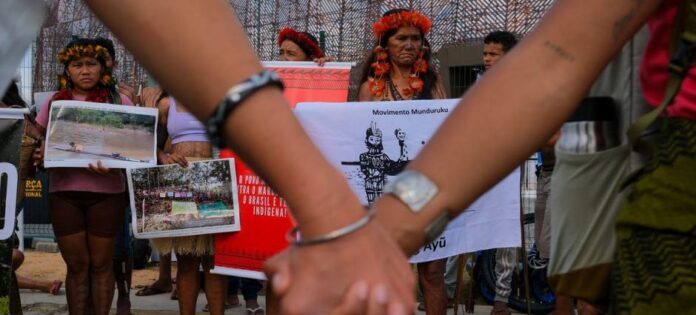
Nearly 90 members of the Munduruku Indigenous community carried out a peaceful protest on Friday at COP30 in Belém, blocking the main entrance to the Blue Zone for about an hour. The restricted area is reserved for climate negotiators, and the temporary blockade prompted the army to reinforce security at the venue.
The Munduruku people, who live across the Amazon states of Amazonas, Mato Grosso and Pará, are calling for an end to development projects and extractive activities that threaten their territories. Their concerns are focused on the Tapajós and Xingu River basins, regions that have faced increasing pressure from infrastructure and mining interests.
Government acknowledges Indigenous demands
COP30 Executive Director Ana Toni described the demonstration as a legitimate expression of Indigenous concerns and confirmed that officials are engaging directly with the protesters. Representatives were directed to meet with Sônia Guajajara, Minister of Indigenous Peoples, and Marina Silva, Minister of the Environment and Climate Change.
Ms. Toni noted that COP30 has registered more than nine hundred Indigenous participants, a major increase from the three hundred who attended the previous conference in Baku, Azerbaijan. She said Brazil’s democratic environment allows people to express different forms of protest inside and outside the event, and added that hosting COP30 in the Amazon was intended to elevate Indigenous perspectives.
Youth voices highlight urgency
For young Indigenous activists, the protest demonstrates both the urgency of their demands and the importance of participating in a global climate forum.
Amanda Pankará, from the Pankará community in Pernambuco, told UN News that COP30 gives Indigenous issues visibility that is often lacking. She said Indigenous peoples want a stronger presence in decision making and added that their demands focus on basic rights such as land security and protection of life.
She said being at the conference is a way to represent those unable to attend and to remind negotiators that Indigenous communities play a vital role in protecting forests and ecosystems.
Leaders reaffirm climate commitments
During a meeting on Thursday, Indigenous leaders described COP30 as the most inclusive climate conference they have joined. Emiliano Medina, a Mapuche youth from Chile, said participants reaffirmed their commitment to addressing the climate emergency. He added that peaceful demonstrations like the one held on Friday help highlight where policies fall short and reflect the broader struggles of communities impacted by climate change worldwide.
Amazon location strengthens Indigenous participation
According to Ms. Toni, hosting the summit in Belém has enabled broader participation from Indigenous groups compared to conferences held in major cities like Rio de Janeiro, São Paulo or Brasília. She said their statements are being heard and that more demonstrations are expected as COP30 continues.
She added that the core purpose of holding the climate conference in the Amazon is to listen closely to Indigenous voices and ensure their demands are part of the global climate agenda.
Baburajan Kizhakedath
