
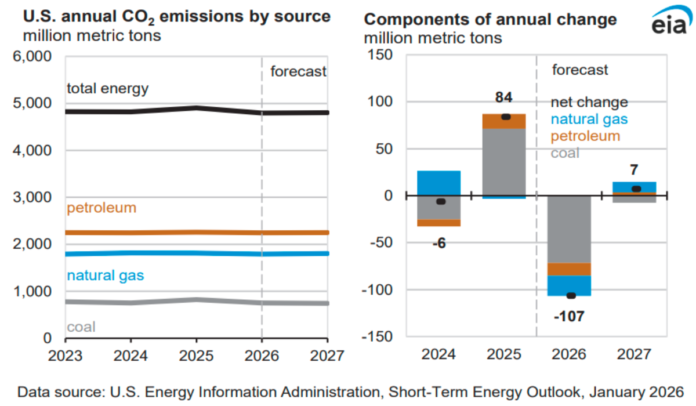
The U.S. Energy Information Administration (EIA) has projected that U.S. energy-related carbon dioxide emissions will decline by 2.2 percent in 2026 compared with 2025 and remain largely unchanged in 2027, reflecting shifting fuel use across the power, industrial and transportation sectors.
According to the EIA outlook, the emissions reduction in 2026 is driven by modest declines in the consumption of coal, natural gas and petroleum products. These changes are closely linked to evolving electricity generation trends, lower heating demand and reduced fuel use in transportation.
Coal decline drives emissions reduction
Coal remains the largest contributor to the projected emissions decline. The EIA said lower coal-related emissions in 2026 are primarily associated with a decrease in coal-fired electricity generation. After coal generation increased sharply in 2025 due to more competitive fuel costs compared with natural gas, the trend is expected to reverse.
Coal-fired power generation is forecast to fall by 9 percent in 2026 and remain relatively flat in 2027. Despite delays in some planned coal plant retirements, total U.S. coal generating capacity is expected to decline by nearly 8 percent, or about 13 gigawatts, over the next two years.
Natural gas and petroleum emissions edge lower
Natural gas emissions are also expected to decline in 2026 as consumption falls in the residential and commercial sectors, particularly for space heating. Lower natural gas use in industrial production further contributes to the reduction. Although natural gas prices are forecast to remain close to or above 2025 levels, natural gas generation is expected to remain mostly unchanged during the forecast period.
Petroleum-related emissions are projected to decline slightly in 2026, largely due to lower consumption of motor gasoline. In 2027, minor increases in natural gas and petroleum product use are expected, but these gains are largely offset by a continued decline in coal consumption, keeping overall emissions flat year over year.
Electricity generation continues to rise
Total electricity generation by the U.S. electric power sector increased by 2.5 percent in 2025, reaching nearly 4,300 billion kilowatt-hours. The EIA expects generation to rise by 1 percent in 2026 and accelerate to 3 percent in 2027, reflecting growing electricity demand across the economy.
Natural gas-fired generation declined by 4 percent, or 69 billion kilowatt-hours, in 2025, mainly due to higher fuel prices. With prices expected to stay elevated, natural gas generation is forecast to remain broadly stable through 2027.
Solar, wind and nuclear support cleaner power mix
Renewable energy continues to gain momentum. Solar power is expected to lead total generation growth in both 2026 and 2027, with generation forecast to increase by more than 20 percent each year, following a 33 percent surge in 2025 as new capacity comes online.
Wind generation is projected to rise by 6 percent, or about 28 billion kilowatt-hours, annually in 2026 and 2027. The forecast accounts for the announced pause on selected offshore wind projects.
Nuclear power generation is expected to increase by 2 percent, or about 15 billion kilowatt-hours, in 2026 compared with 2025, largely due to the restart of the Palisades Nuclear Station. Nuclear output is forecast to remain unchanged in 2027.
Coal consumption and production continue to fall
Lower demand from the electric power sector is expected to be the main driver of coal market trends over the next two years. In 2025, the power sector consumed an estimated 418 million short tons of coal. Consumption is forecast to fall by about 10 percent in 2026 to 376 million short tons and decline by a further 1 percent in 2027 to 372 million short tons.
The reduction reflects increased electricity generation from renewable energy sources, particularly in the Midwest, along with scheduled coal plant retirements. Coal stocks held by the electric power sector began 2026 at an estimated 102 million short tons and are expected to grow by 15 percent to 117 million short tons by the end of 2026, remaining at that level in 2027 as supply continues to exceed demand.
U.S. coal production totaled 533 million short tons in 2025, up 4 percent from 2024. The EIA forecasts production will decline by 4 percent in 2026 to 512 million short tons and by another 3 percent in 2027 to 497 million short tons. The steepest production declines are expected in the Western region, where output is projected to fall by 6 percent in 2026 and 2 percent in 2027 due to lower demand for Powder River Basin coal.
Coal exports rise despite domestic slowdown
While domestic coal demand weakens, U.S. coal exports are expected to continue rising, driven largely by metallurgical coal shipments. The EIA forecasts coal exports will increase from 95 million short tons in 2025 to 99 million short tons in 2026 and 101 million short tons in 2027.
Overall, the EIA outlook points to a gradual decoupling of U.S. electricity growth from carbon emissions, supported by falling coal use, steady natural gas generation and rapid expansion of renewable energy capacity.
BABURAJAN KIZHAKEDATH
