
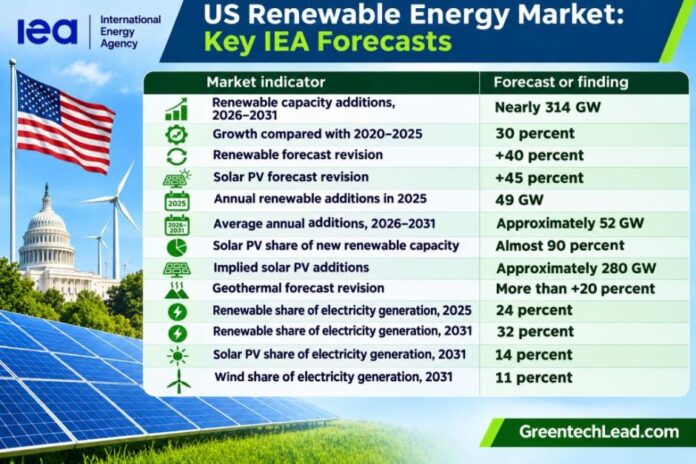
The United States renewable energy market is projected to add nearly 314 gigawatts (GW) of renewable power capacity between 2026 and 2031, representing 30 percent growth compared with installations during 2020–2025, according to the International Energy Agency’s (IEA) Renewables 2026 report.
IEA’s Renewables 2026 report indicated there will be an increase in its US renewable energy capacity growth forecast by 40 percent compared with its previous outlook, driven by stronger solar photovoltaic (PV) deployment, growing electricity demand from AI data centers and an expanding pipeline of utility-scale solar projects.
Solar PV is expected to account for almost 90 percent of new renewable capacity installations during 2026–2031, while wind, geothermal and hydropower contribute smaller shares.
The US renewable energy market is also undergoing significant policy changes as federal tax incentives expire or phase down, increasing the importance of state-level renewable energy policies, corporate power purchase agreements and energy storage investments.
1. US Renewable Energy Capacity to Expand by 314 GW by 2031
The United States is expected to install nearly 314 GW of renewable power capacity during 2026–2031, compared with approximately 242 GW during the previous six-year period.
Annual renewable capacity additions reached 49 GW in 2025 and are forecast to average approximately 52 GW during 2026–2031.
The IEA expects strong renewable capacity additions in the near term, followed by slower growth as federal tax incentives decline.
The expansion reflects increasing demand for electricity generation capacity, particularly from data centers, industrial facilities and commercial electricity consumers.
2. IEA Raises US Renewable Energy Forecast by 40 Percent
The IEA has increased its forecast for US renewable capacity expansion by approximately 40 percent compared with its previous report.
The revision primarily reflects stronger utility-scale solar PV deployment and a larger pipeline of financed projects seeking to qualify for federal tax credits.
The IEA has separately raised its US solar PV forecast by 45 percent, supported by projects targeting tax incentive eligibility deadlines.
Solar PV and battery storage can be deployed faster than several conventional electricity generation technologies, making them attractive options for meeting rapidly increasing power demand.
The forecast upgrade also reflects delays in gas turbine availability caused by supply-chain constraints.
3. Solar PV to Account for Nearly 90 Percent of US Renewable Capacity Additions
Solar PV will dominate the US renewable energy market during 2026–2031, contributing almost 90 percent of total renewable capacity additions.
Based on the IEA’s 314 GW renewable expansion forecast, this implies approximately 280 GW of solar PV installations during the six-year period.
Utility-scale solar projects will remain the principal growth driver, supported by federal tax incentives, corporate electricity procurement and improving project economics.
Residential solar installations are also benefiting from projects completed ahead of expiring federal incentives.
Commercial and industrial solar demand is expected to remain supported by corporate electricity purchasing strategies and the economics of distributed solar generation.
4. AI Data Centers Become Major Drivers of US Solar and Battery Storage Demand
The rapid expansion of AI infrastructure and data centers is creating significant additional electricity demand across the United States.
The IEA identifies data centers as a major reason for the stronger US renewable energy outlook.
Solar PV projects can be developed relatively quickly, while battery storage can improve electricity availability and help manage variations in solar generation.
The growing pipeline of solar-plus-storage projects also reflects developers’ efforts to reduce exposure to declining wholesale electricity prices during periods of high solar output.
Corporate power purchase agreements from data center operators and large industrial consumers are expected to provide additional revenue certainty for renewable energy developers.
5. US Wind Energy Growth to Slow After 2027
The IEA has slightly improved its US wind energy forecast following a substantial downward revision in its previous outlook.
Near-term wind installations will benefit from projects that qualify for existing federal tax incentives.
However, annual wind capacity additions are expected to moderate after 2027 as federal incentives phase down or expire.
Permitting challenges and project development delays remain important constraints on US wind energy investment.
The offshore wind market faces additional uncertainty because of the temporary halt on new federal leasing, permitting and approvals.
As a result, solar PV is expected to capture a substantially larger share of US renewable energy capacity growth than wind during the forecast period.
6. Federal Tax Credit Changes Reshape US Renewable Energy Investment
Federal tax incentive deadlines are influencing the timing of solar and wind project development across the United States.
The IEA reports that a larger-than-expected pipeline of financed utility-scale solar projects is seeking to qualify for tax credits before the 2027 phaseout.
A federal court decision restoring the 5 percent cost-based safe-harbour provision as an alternative to the physical-work test provides an additional opportunity for qualifying wind and large solar projects.
This mechanism enables eligible projects to seek the 30 percent investment tax credit or production tax credit under the applicable rules and deadlines.
However, Foreign Entity of Concern requirements, trade restrictions and uncertainty over tax credit implementation could affect investment decisions after 2027.
7. US Geothermal Energy Forecast Raised by More Than 20 Percent
The IEA has raised its US geothermal energy capacity growth forecast by more than 20 percent, reflecting an expanding project pipeline and stronger interest in enhanced geothermal systems.
The United States is expected to be among the leading markets for geothermal capacity additions through 2031, alongside Indonesia.
Enhanced geothermal systems offer opportunities to develop geothermal resources beyond conventional locations.
Hydropower investment, meanwhile, is expected to focus primarily on refurbishment and modernization of existing generating facilities.
The IEA expects some US bioenergy electricity generation capacity to be retired during the forecast period.
8. US Renewable Electricity Share to Reach 32 Percent by 2031
Renewable energy is expected to account for 32 percent of US electricity generation by 2031, compared with 24 percent in 2025.
Solar PV’s share of electricity generation is forecast to increase from 8 percent in 2025 to 14 percent in 2031.
Solar PV is also expected to overtake wind power as the largest individual renewable electricity generation source in the United States.
Wind power is projected to account for approximately 11 percent of electricity generation by 2031.
The changing electricity generation mix reflects rapid solar deployment, growing electricity demand and the increasing importance of storage and grid flexibility.
9. Grid Connection Delays and Import Tariffs Challenge Renewable Projects
Long grid interconnection queues and insufficient transmission capacity remain major obstacles for US renewable energy developers.
The IEA identifies transmission constraints, lengthy project approvals and rising development costs as significant barriers to commissioning new solar and wind projects.
Import tariffs on solar equipment and supply-chain compliance requirements could increase project costs and limit equipment availability.
The growing share of solar generation is also putting downward pressure on daytime wholesale electricity prices, increasing the risk of negative-price periods.
Battery storage and long-term electricity offtake agreements are becoming more important for maintaining renewable project revenues and securing financing.
10. State Renewable Energy Policies and Corporate PPAs Gain Importance
As federal renewable energy incentives decline, state renewable portfolio standards, clean-energy standards and procurement programs are expected to become more important.
Corporate power purchase agreements will remain an important mechanism for supporting renewable energy investments, particularly among data center operators and large industrial electricity consumers.
The IEA identifies faster transmission development, streamlined interconnection procedures, shorter permitting timelines and expanded battery storage deployment as opportunities to accelerate renewable energy growth beyond its main forecast.
The agency’s accelerated scenario projects significantly higher renewable capacity additions, with the largest potential gains coming from solar PV, followed by wind and geothermal.
Outlook for the US Renewable Energy Market
The US renewable energy industry is entering a period of strong solar-led expansion despite uncertainty surrounding federal energy policies.
The IEA’s forecast of nearly 314 GW of renewable capacity additions during 2026–2031 indicates significant opportunities for solar developers, battery storage companies, transmission infrastructure providers and geothermal technology suppliers.
The 40 percent upward revision in the renewable energy forecast highlights the growing importance of electricity demand from AI data centers and industrial facilities.
However, the expected slowdown in annual installations after 2027, combined with tax incentive changes, import tariffs and grid connection delays, could influence project profitability and investment decisions. The ability of renewable energy developers to secure corporate power purchase agreements, integrate battery storage and accelerate project commissioning will be increasingly important for the US renewable energy market through 2031.
BABURAJAN KIZHAKEDATH
