
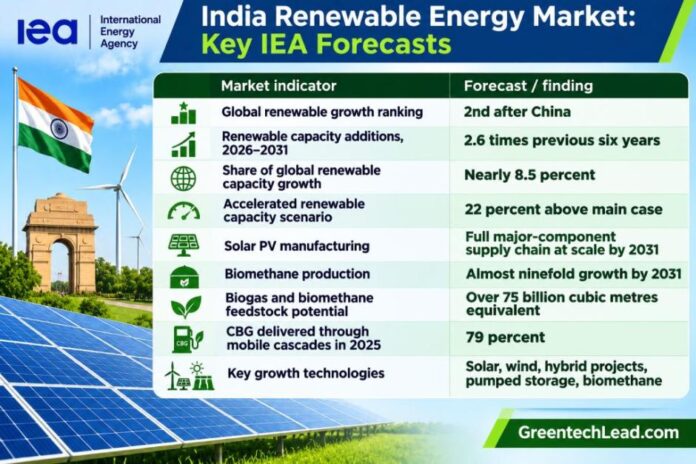
India’s renewable energy market is set for significant growth between 2026 and 2031, with new capacity additions projected to be 2.6 times higher than during the previous six years, according to the International Energy Agency’s (IEA) Renewables 2026 report.
India will emerge as the world’s second-largest renewable energy growth market after China, accounting for nearly 8.5 percent of global renewable capacity expansion, almost double its contribution during 2020–2025.
IEA’s Renewables 2026 report forecasts that there will be nearly 4,800 gigawatts (GW) of renewable capacity additions worldwide during 2026–2031, driven by solar PV, wind power, energy storage and supportive government policies.
India’s growth is supported by utility-scale solar projects, rooftop solar programmes, hybrid renewable energy auctions, pumped-storage hydropower and investments in domestic solar manufacturing.
The report also identifies challenges involving electricity distribution companies, power purchase agreements, grid connectivity and renewable energy project execution.
1. India to Become Second-Largest Renewable Energy Growth Market
India’s renewable capacity additions during 2026–2031 are expected to be 2.6 times the capacity installed during 2020–2025.
The country’s contribution to global renewable capacity growth will increase to nearly 8.5 percent, supported by government policies and expanding solar and wind investments.
China will remain the largest market, accounting for approximately 53 percent of global renewable capacity growth.
The IEA identifies India as one of the principal markets compensating for slower renewable energy deployment in China.
2. Solar Power to Drive India’s Renewable Capacity Expansion
Utility-scale solar PV will remain a major contributor to India’s renewable energy growth.
The IEA has raised its solar power forecast for India following stronger-than-expected deployment and a substantial pipeline of auction-awarded and open-access projects.
Large solar projects, commercial and industrial installations, and distributed solar systems will contribute to the expansion.
The outlook also benefits from improving solar PV economics and continued policy support.
3. PM Surya Ghar and PM-KUSUM Support Rooftop Solar Growth
India’s distributed solar PV market is expected to expand through government programmes including PM Surya Ghar: Muft Bijli Yojana and PM-KUSUM solar energy programme.
The IEA identifies these programmes, improving project economics and stronger-than-expected recent installations as factors supporting its higher solar PV forecast for India.
Residential rooftop solar, commercial and industrial solar installations, and agricultural solar applications will contribute to distributed generation growth.
The expansion of distributed solar also provides opportunities for solar equipment suppliers, engineering companies, installation contractors and financing providers.
4. India’s Solar Manufacturing Industry to Challenge China’s Dominance
India is expected to become the only country besides China capable of manufacturing every major component of the solar PV supply chain at scale by 2031.
The IEA identifies India as an important market for diversifying global solar manufacturing supply chains.
China currently dominates manufacturing across polysilicon, wafers, cells and modules, but its industry faces substantial financial pressure.
More than 90 percent of major Chinese solar PV manufacturers reported losses in 2026, while over 70 companies have filed for bankruptcy since 2024.
India’s expanding manufacturing capabilities could strengthen its position as an alternative source of solar equipment for domestic and international markets.
5. Wind Power and Hybrid Renewable Projects Gain Momentum
India’s wind energy market is expected to benefit from hybrid auction programmes combining wind power, solar PV and battery storage.
The IEA identifies India’s hybrid auction schemes as an important factor supporting faster onshore wind expansion during 2026–2031.
Hybrid renewable systems combining solar PV, wind and batteries can deliver electricity at costs below $75 per megawatt-hour in many regions.
India is among the principal markets using hybrid renewable procurement to improve electricity supply flexibility, reduce curtailment and support more reliable renewable power delivery.
6. Pumped-Storage Hydropower Creates New Investment Opportunities
India is expected to become one of the important markets for pumped-storage hydropower as renewable electricity generation increases.
Global pumped-storage hydropower capacity is forecast to expand by approximately 74 GW during 2026–2031, with China accounting for about two-thirds of additions.
India follows China in the IEA’s assessment, although at a considerably smaller scale.
The IEA has revised India’s pumped-storage hydropower outlook upward because of growing demand for electricity storage and grid flexibility.
However, delays in conventional hydropower projects have resulted in a modest downward revision to India’s conventional hydropower forecast.
7. India Renewable Capacity Could Exceed Main Forecast by 22 Percent
India’s renewable capacity additions could be approximately 22 percent higher than the IEA’s main-case forecast under an accelerated deployment scenario.
The largest additional gains would come from utility-scale solar PV, followed by distributed solar PV, onshore wind and pumped-storage hydropower.
Achieving this higher growth requires more frequent renewable energy auctions, faster project procurement, quicker power purchase agreement signing and improved grid infrastructure.
The IEA identifies the financial health of electricity distribution companies as another important factor influencing renewable energy investment.
8. Renewable Energy Auctions and Grid Connectivity Remain Challenges
India’s renewable energy market faces challenges involving project auctions, electricity procurement, grid infrastructure and financial risks.
The IEA reports that renewable energy auction awards slowed considerably during 2025 and early 2026 after record allocations in 2024.
Delays in signing power purchase agreements can affect project financing and commissioning schedules.
Improving the financial position of distribution companies could reduce offtaker risks, lower financing costs and accelerate project execution.
India has also introduced stricter grid connection rules and queue management reforms to remove less viable renewable energy projects and prioritise projects with stronger development prospects.
Faster battery adoption, transmission expansion and fewer barriers for open-access consumers would support additional renewable capacity growth.
9. India’s Biomethane Production to Increase Almost Ninefold
India’s biomethane production is forecast to increase almost ninefold by 2031, supported by government policies and growing demand for compressed biogas (CBG).
The IEA estimates that India has technical biogas and biomethane feedstock potential exceeding 75 billion cubic metres equivalent, mainly from agricultural residues and animal manure.
In 2025, approximately 79 percent of India’s CBG production was delivered through pressurised cylinders transported by trucks.
Injection into gas networks, particularly city gas distribution systems, is also developing.
The IEA expects India’s biomethane market to benefit from blending requirements, expanding gas infrastructure and commercialisation of agricultural waste feedstocks.
10. India’s Renewable Energy Market Offers Growth Across Solar, Wind, Storage and Biogas
The IEA’s forecast indicates opportunities across India’s renewable energy value chain, including solar manufacturing, project development, wind turbines, battery storage, pumped-storage hydropower and biomethane production.
India’s projected 2.6-fold increase in renewable capacity additions will require continued investment in electricity transmission, storage systems and renewable project development.
The country is also expected to strengthen its position in global solar manufacturing while expanding domestic renewable electricity generation.
The outlook suggests that the pace of growth will increasingly depend on implementation of renewable energy auctions, project financing, power purchase agreements and grid infrastructure development.
Outlook for India’s Renewable Energy Industry
The IEA’s Renewables 2026 report positions India as a major growth market in the global energy transition through 2031.
The country’s expanding renewable energy capacity, strengthening solar manufacturing industry and growing storage requirements are expected to create opportunities for developers, equipment manufacturers, technology suppliers and investors.
However, India’s ability to achieve the accelerated growth scenario will depend on resolving financial and regulatory challenges, particularly delayed power purchase agreements, distribution company finances and grid connection constraints.
BABURAJAN KIZHAKEDATH
