
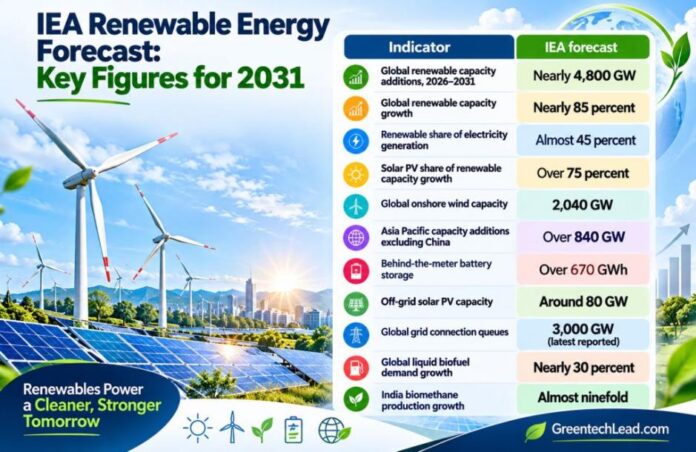
Global renewable energy capacity is forecast to increase by nearly 4,800 gigawatts (GW) between 2026 and 2031, representing 57 percent higher growth than in the previous six years, according to the International Energy Agency’s (IEA) Renewables 2026 report.
IEA’s Renewables 2026 report forecasts that solar power, wind energy, battery storage, biofuels and renewable heating will gain momentum as countries strengthen energy security, reduce fossil fuel imports and respond to rising electricity demand.
India is expected to become the world’s second-largest renewable energy growth market after China, while the United States, Southeast Asia, Africa and the Middle East are also positioned for significant expansion.
Here are the 10 major findings from the IEA Renewables 2026 report, focusing on capacity additions, investments, market developments and energy security.
1. Global Renewable Energy Capacity to Expand by 4,800 GW
Global renewable electricity capacity is projected to increase by almost 85 percent between 2025 and 2031, supported by growing demand for solar PV and wind power.
Renewable capacity additions during 2026–2031 will be 57 percent higher than during 2020–2025.
Emerging and developing economies outside China are expected to match advanced economies in renewable capacity growth for the first time.
Renewables are also strengthening energy security. Without renewable energy expansion since 2010, global fossil fuel demand would have been approximately 8 percent higher in 2025.
Renewables have displaced natural gas consumption equivalent to 11 percent of global demand, reducing dependence on imported fuels.
2. India Becomes World’s Second-Largest Renewable Energy Growth Market
India is projected to become the second-largest renewable energy growth market globally after China during 2026–2031.
Renewable capacity additions across Asia Pacific, excluding China, are forecast to exceed 840 GW, more than double the additions recorded during 2020–2025.
The IEA has increased its renewable capacity growth forecast for this region by 15 percent, reflecting stronger solar PV deployment in India and Southeast Asia.
India is also emerging as a major manufacturing alternative to China. By 2031, India is expected to be the only country besides China capable of manufacturing all major components of the solar PV supply chain at scale.
India’s renewable energy expansion is supported by competitive auctions, hybrid renewable projects, battery storage and growing domestic manufacturing capabilities.
3. Solar PV to Account for More Than 75 Percent of Renewable Capacity Growth
Solar photovoltaic technology will dominate renewable electricity expansion, contributing more than three-quarters of global renewable capacity additions through 2031.
Global onshore wind capacity is forecast to increase by more than 70 percent to reach 2,040 GW by 2031.
China’s share of global renewable capacity growth is expected to decline from more than 60 percent in 2025 to 53 percent during 2026–2031.
China recorded an almost 55 percent year-on-year decline in solar PV capacity additions during the first nine months of 2026 following its transition from fixed tariffs to competitive auctions.
Consequently, the IEA reduced China’s renewable capacity growth forecast by 13 percent, equivalent to nearly 116 GW.
The United States renewable capacity growth forecast has been revised upward by almost 40 percent, driven primarily by solar PV deployment and electricity demand from data centres.
4. Africa and Middle East Renewable Energy Markets Accelerate
Renewable capacity additions across Southeast Asia, the Middle East and Africa are forecast to almost triple during 2026–2031.
The IEA has raised its renewable capacity expansion forecast for sub-Saharan Africa by 54 percent, with solar PV representing more than 80 percent of additional capacity.
Renewable power capacity in the Middle East and North Africa is expected to more than double during the forecast period.
Latin America’s solar PV installed capacity is projected to exceed hydropower capacity by the end of the decade.
However, hydropower will remain Latin America’s largest renewable electricity generation source, with its share of total electricity generation declining from 40 percent in 2025 to 35 percent in 2031.
Europe’s renewable capacity growth during 2026–2031 is expected to be 40 percent higher than during the preceding six years.
5. Renewable Electricity Share to Reach 45 Percent by 2031
Renewable energy is forecast to generate almost 45 percent of global electricity by 2031, compared with 33 percent in 2025.
Combined electricity generation from solar PV and wind is expected to more than double, accounting for over 28 percent of global power generation in 2031.
Solar PV electricity generation is projected to surpass hydropower in 2029, becoming the world’s largest renewable electricity generation source.
However, renewable energy integration is becoming a major challenge.
In 17 countries, variable renewable electricity is forecast to represent more than 50 percent of the power mix by 2031.
Technical curtailment of solar and wind generation reached almost 200 terawatt-hours (TWh) in 2025 and could exceed 800 TWh by 2031, equivalent to nearly 8 percent of variable renewable electricity generation.
6. Battery Storage Capacity and Hybrid Renewable Projects Gain Momentum
Battery energy storage is becoming important as solar and wind capacity expands.
Behind-the-meter battery storage capacity is expected to increase almost sixfold to more than 670 gigawatt-hours (GWh) by 2031.
More than one-third of residential solar PV systems are expected to include battery storage by 2031.
Hybrid renewable projects combining solar PV, wind and battery storage can already deliver electricity at costs below $75 per megawatt-hour in many regions.
India is among the leading markets promoting hybrid renewable energy projects through auctions and procurement programmes.
Global grid connection queues for advanced-stage renewable energy projects increased by 60 percent over the past year to 3,000 GW.
Battery storage and hybrid renewable projects accounted for the entire increase in advanced-stage connection queues.
7. Rooftop Solar Improves Electricity Access for 70 Million Households
Consumer-driven rooftop solar installations are becoming an important component of renewable energy growth, particularly in developing economies.
The IEA estimates that additional rooftop solar capacity has improved electricity access and services for at least 70 million households since 2022.
Off-grid solar PV capacity is forecast to increase 2.5 times to approximately 80 GW by 2031.
Pakistan, sub-Saharan Africa and Southeast Asia are expected to lead off-grid solar expansion.
Higher electricity prices, unreliable grid supply and declining solar module costs are encouraging households and small businesses to invest in rooftop solar systems.
8. Global Biofuel Demand to Increase Nearly 30 Percent by 2031
Global liquid biofuel demand is projected to expand by nearly 30 percent by 2031 as governments strengthen energy security and reduce dependence on imported oil.
The IEA has increased its liquid biofuel production growth forecast by 40 percent compared with its previous report.
Biofuel consumption in Southeast Asia is expected to increase by 11 percent between 2025 and 2026, compared with average global growth of 7 percent.
Renewable energy consumption in transport is forecast to increase by 60 percent during 2026–2031, raising renewables’ share of global transport energy demand to 6 percent.
Renewable electricity used by electric vehicles will account for almost half of this growth.
China and Europe together are expected to contribute 80 percent of the increase in EV-related renewable electricity consumption.
Global feedstock demand for liquid biofuel production is projected to increase by 30 percent by 2031.
9. Renewable Heating Share to Reach 19 Percent by 2031
Modern renewables are expected to meet 19 percent of global heating demand by 2031, compared with 15 percent in 2025.
Renewable electricity consumption for heating, including heat pumps and industrial electrification, is forecast to increase by more than 50 percent.
Electrification will contribute approximately two-thirds of the growth in modern renewable heating demand.
Direct renewable heating from modern bioenergy, solar thermal and geothermal technologies accounted for approximately 60 percent of modern renewable heat consumption in 2025.
However, these technologies are expected to contribute only around one-quarter of additional renewable heating demand through 2031.
Renewables currently supply just 7 percent of global district heating, highlighting substantial opportunities for investment in renewable heat infrastructure.
10. India’s Biomethane Production to Grow Ninefold by 2031
Global biogas production is forecast to increase by almost 20 percent by 2031, driven entirely by growth in biomethane.
Global biomethane production is expected to nearly double, increasing its share of total biogas production from 22 percent to 35 percent by 2031.
India’s biomethane production is forecast to increase almost ninefold by 2031, making it one of the fastest-growing emerging markets.
Europe is expected to remain the world’s largest biomethane producer, followed by the United States.
Brazil, China and India are introducing policies to support biomethane production and consumption.
Domestic biogas and biomethane production is already reducing dependence on natural gas imports by 22 percentage points in Sweden, 10 percentage points in Germany and 8 percentage points in France.
Renewable Energy Outlook: Global Capacity Target Still Faces Challenges
The IEA forecasts global renewable electricity capacity reaching approximately 9,710 GW by 2030, equivalent to 2.6 times the installed capacity in 2022.
This remains below the COP28 commitment to triple global renewable capacity by 2030.
However, accelerated implementation of competitive auctions, grid investments, battery storage deployment and permitting reforms could increase renewable capacity growth by 20 percent compared with the main forecast.
Under this accelerated scenario, the world could achieve the tripling target in 2031, one year later than the original commitment.
The IEA outlook identifies India, the United States, Southeast Asia and Africa as major contributors to future renewable energy expansion, while grid infrastructure, battery storage and financing remain important factors influencing deployment.
BABURAJAN KIZHAKEDATH
