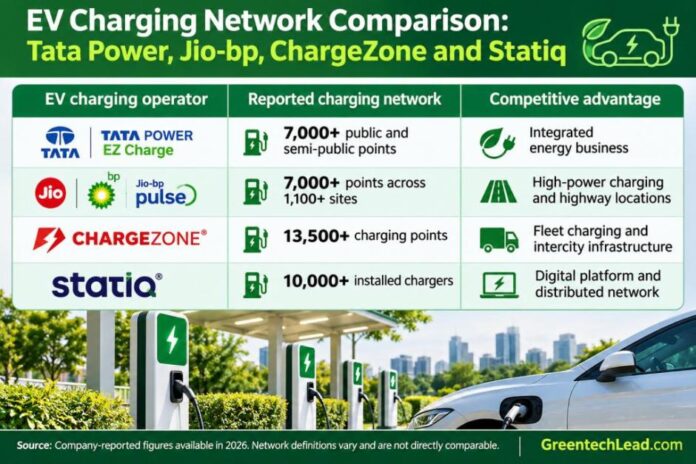
India’s electric vehicle (EV) charging industry is entering a new phase of competition as Tata Power, Jio-bp, ChargeZone and Statiq expand their networks to capture rising demand from electric cars, buses, trucks and commercial fleets.
The competition is shifting from charger installations to network utilisation, charging speed, electricity pricing, operational efficiency and profitability. Operators capable of delivering reliable charging services while generating higher energy sales per station are likely to emerge as market leaders.
Tata Power benefits from its integrated electricity business, Jio-bp focuses on high-power charging and mobility infrastructure, ChargeZone targets commercial fleets and intercity transport, while Statiq emphasizes digital connectivity and distributed charging networks.
The figures include different combinations of installed, operational, public, semi-public and fleet-dedicated charging infrastructure.
An independent September 2026 mapping exercise identified 1,883 Tata Power, 1,746 Statiq, 626 ChargeZone and 491 Jio-bp public car-charging points. These figures represent mapped infrastructure rather than complete operator networks.
Tata Power: Integrated Energy Business Creates Competitive Advantage
Tata Power has emerged as a major EV charging infrastructure provider by combining electricity generation, renewable energy, distribution and charging services.
According to its FY2026 annual report, Tata Power installed more than 7,000 public and semi-public charging points, including over 1,200 electric bus charging points.
The company also reported more than 200,000 home-charger installations and over 500,000 registered EZ Charge users across more than 700 cities and towns.
Tata Power’s EV business generated revenue of ₹192 crore in FY2026, compared with ₹168 crore in FY2025, representing growth of approximately 14.3 percent.
This revenue includes the broader EV business and should not be interpreted as public charging revenue alone.
Its integrated electricity operations provide opportunities to manage power procurement, renewable energy sourcing and charging infrastructure development.
However, profitability depends on electricity sales, charging station utilisation, operating expenses and infrastructure investment.
Jio-bp: High-Power EV Charging and Highway Expansion
Jio-bp, the mobility joint venture between Reliance Industries and bp, is expanding its pulse EV charging network across highways, urban centres and mobility stations.
By October 2026, Jio-bp reported more than 7,000 charging points across over 1,100 locations in more than 300 cities.
Its DC charging infrastructure supports power ratings ranging from 60 kW to 480 kW, positioning the company to serve electric passenger vehicles and customers requiring faster charging.
Jio-bp also reported network uptime of 96 percent, an important operational indicator for customers planning long-distance journeys.
The company’s access to mobility locations offers advantages in visibility, accessibility and customer amenities.
However, higher charging capacity requires substantial investment in electrical connections, equipment and grid infrastructure.
A 480 kW charger does not automatically generate higher revenue unless compatible vehicles use the equipment frequently enough.
Jio-bp’s long-term success will depend on converting its expanding infrastructure into consistent charging demand and profitable energy sales.
ChargeZone: Fleet Charging Contracts Could Drive Revenue Growth
ChargeZone is pursuing a differentiated strategy focused on commercial vehicles, electric buses, trucks and intercity charging infrastructure.
The company reports more than 13,500 charging points across over 350 cities and 26 states, with DC charging systems offering capacity up to 360 kW.
In September 2026, ChargeZone announced long-term energy contracts valued at more than $1 billion for intercity electric bus and truck fleets.
The company also disclosed $25 million in debt funding and plans to raise another $100 million during FY2027.
Its expansion strategy includes increasing charging capacity from 120 MW to 300 MW.
However, the $1 billion contract value represents announced long-term commitments rather than revenue already generated.
ChargeZone targets approximately 700 GWh of annual energy delivery and average infrastructure utilisation of 30 percent at full deployment.
Its reported current utilisation is approximately 14 percent.
The fleet-focused model offers an important advantage because commercial vehicles generally require predictable charging schedules and recurring electricity purchases.
However, project execution, fleet deployment schedules, customer concentration and electricity procurement costs remain significant risks.
Statiq: Digital Charging Platform and Network Expansion
Statiq is developing a technology-driven EV charging ecosystem connecting vehicle owners, charging operators, property owners and automobile manufacturers.
The company reports more than 10,000 installed chargers across over 1,000 cities and more than 12 million cumulative charging sessions.
Its digital platform allows customers to discover charging stations, check availability, initiate charging sessions and make payments.
Statiq’s strategy emphasizes network accessibility and digital convenience rather than relying exclusively on high-power charging installations.
Partnerships with charging infrastructure owners and property operators can support expansion without requiring Statiq to own every charging location.
However, installed charger numbers and cumulative charging sessions do not reveal current electricity sales, average utilisation or profitability.
Statiq will need to demonstrate stronger recurring revenue and operational efficiency as competition intensifies.
EV Charging Profitability: Utilisation Is the Key Metric
India’s EV charging market faces a major challenge: installed infrastructure does not necessarily translate into profitable operations.
According to an industry analysis of India’s EV charging infrastructure, network expansion has outpaced utilisation at many locations.
A hypothetical 120 kW charger operating at 20 percent utilisation could deliver approximately 210,240 kWh annually.
At ₹22 per kWh, annual gross charging revenue would reach approximately ₹46.25 lakh.
After illustrative variable costs of ₹9 per kWh, the contribution would be ₹27.33 lakh before rent, maintenance, financing, depreciation and taxes.
This demonstrates why operators must prioritize electricity throughput, repeat customers and capital efficiency over charger counts.
Which EV Charging Operator Will Lead India?
Tata Power appears best positioned for diversified, long-term growth, supported by its integrated electricity business, nationwide charging presence and disclosed EV revenue.
Jio-bp has a strong competitive position in highway and high-power charging, supported by mobility locations and fast-charging infrastructure.
ChargeZone offers a compelling fleet-focused business model, with contracted demand potentially supporting higher utilisation and recurring energy revenue.
Statiq stands out for digital accessibility and network reach, although greater financial transparency would help assess its competitive strength.
India’s EV charging market is unlikely to have a single winner across every segment. The strongest operators will be those that convert charging infrastructure into reliable services, higher electricity sales and sustainable returns on investment.
SHAFANA FAZAL