CATL, Sungrow, Tesla and BYD are leading the global battery energy storage system market in 2026, but their leadership differs significantly across battery shipments, system integration, software, regional market share and mega-project execution.
Battery storage has become one of the fastest-growing parts of global power infrastructure as utilities add batteries to integrate solar and wind, manage peak demand, provide grid flexibility and improve energy security.
Global battery storage additions reached 108 GW in 2025, up 40 percent, according to the International Energy Agency. Installed capacity is now 11 times higher than in 2021. Around 80 percent of new capacity was utility-scale, while lithium iron phosphate, or LFP, accounted for approximately 90 percent of deployments.
China represented around 60 percent of global additions, followed by the United States and Europe.
Growth accelerated further in 2026. SNE Research reported global lithium-ion ESS battery shipments of 461.3 GWh in H1 2026, up 71 percent from 269.7 GWh a year earlier. Markets outside China accounted for 258.7 GWh, or 56 percent, exceeding half of global shipments for the first time.
The global battery storage market is therefore moving rapidly beyond China, even though Chinese manufacturers continue to dominate battery-cell production and system integration.
Which Company Is the World’s Largest Battery Storage Supplier?
There is no single answer because the industry uses different measurements.
CATL is the world’s largest ESS battery-cell supplier by H1 2026 shipments, delivering 125 GWh and capturing 27.1 percent of the global market.
Sungrow ranks first in Wood Mackenzie’s 2026 Global BESS Integrator Comprehensive Ranking, which evaluates companies across technology, safety, R&D, supply chains, vertical integration, financial strength and other criteria.
Tesla remains particularly strong in North America, while BYD combines cell manufacturing, system integration and large-scale project execution.
The distinction matters because battery-cell manufacturing and BESS integration are different businesses.
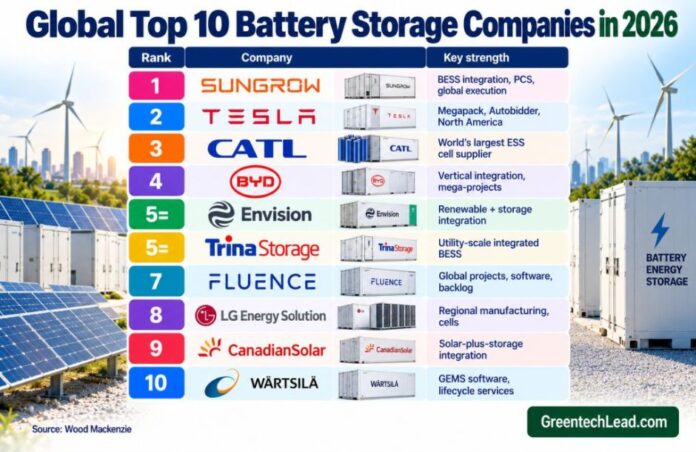
Global Top 10 Battery Storage Companies in 2026
Wood Mackenzie’s comprehensive 2026 BESS integrator ranking places the companies in the following order:
The ranking demonstrates why BESS procurement is moving beyond battery price toward efficiency, safety, financial strength and lifetime performance.
1. Sungrow: World’s Top BESS Integrator
Sungrow ranks first in Wood Mackenzie’s 2026 comprehensive assessment.
Its advantage comes from combining battery systems with power conversion systems, controls and global project-integration capabilities.
That is important because PCS efficiency, thermal management, grid-forming capability and system controls directly affect lifetime project economics.
Sungrow also leads Europe’s BESS integrator market and has established a particularly strong position in the Middle East.
2. Tesla: Megapack and Software Create a Different Model
Tesla ranks second globally in the comprehensive assessment and remains the leading BESS integrator in North America.
Its Megapack strategy combines utility-scale battery hardware with Autobidder software, which can optimize battery participation in electricity markets.
Tesla’s strength demonstrates why the storage battle extends beyond battery chemistry.
Software capable of determining when to charge, discharge and participate in energy or ancillary-services markets can directly influence project revenue.
3. CATL: 125 GWh Makes It the ESS Battery-Cell Leader
CATL dominates when measured by battery-cell shipments.
The company shipped 125 GWh of ESS batteries during H1 2026, up 81 percent year over year, increasing its market share from 25.6 percent to 27.1 percent.
For comparison, second-ranked EVE Energy shipped 48 GWh, while Hithium delivered 46.2 GWh.
CATL therefore shipped more ESS batteries than the next two suppliers individually by a very wide margin.
Its huge LFP manufacturing scale provides significant cost advantages, while continued investment in alternative technologies including sodium-ion could broaden its future storage portfolio.
4. BYD: Vertical Integration Meets Mega-Scale Storage
BYD combines battery-cell manufacturing, electronics and complete storage-system integration.
Its H1 2026 ESS cell shipments reached 35.7 GWh, giving it 7.7 percent global share.
Its project footprint is equally important.
BYD’s total contracted battery volume with Grenergy for Chile’s Oasis de Atacama project has reached 6.5 GWh across project phases.
BYD is also gaining ground in Europe, where it moved from fifth to second among integrators.
In the Middle East, BYD and Sungrow together captured 87 percent of the BESS market in 2025, demonstrating the scale of Chinese supplier expansion.
5. Envision Energy: Combining Renewables, Storage and Digital Control
Envision and Trina Storage share fifth position in Wood Mackenzie’s comprehensive global ranking.
Envision’s strategy extends beyond batteries because the company participates across renewable generation, storage and digital energy management.
It ranked third in Asia-Pacific behind CRRC and HyperStrong.
Combining wind, solar, storage and digital optimization could become valuable as utilities move toward integrated renewable-energy projects rather than procuring individual technologies separately.
6. Trina Storage: Utility-Scale Integration
Trina Storage has developed its BESS position around the Elementa platform and utility-scale LFP projects.
The company’s integration with the broader Trina Solar ecosystem also creates opportunities in solar-plus-storage.
For developers, greater system density can reduce land requirements and some balance-of-system costs, while integrated battery and power-electronics design can improve project efficiency.
7. Fluence: 163.7 GWh Pipeline Highlights Future Scale
Fluence illustrates why existing deployments are only one measure of BESS market strength.
At June 30, 2026, Fluence reported 7.4 GW/19.3 GWh of deployed storage, alongside 12.6 GW of contracted product backlog.
Its pipeline reached 45.6 GW representing 163.7 GWh.
Fluence combines hardware integration with digital optimization, services and lifecycle support, creating potential recurring revenue after a battery project enters operation.
8. LG Energy Solution: Alternative Supply Chain Gains Importance
LG Energy Solution is strategically important as North American and European customers diversify supply chains.
Its ESS battery shipments increased 357 percent year over year during H1 2026, according to SNE Research.
Regional manufacturing is becoming particularly important because trade rules, local-content requirements, financing and supply security influence project procurement.
That means suppliers do not necessarily need the industry’s lowest cell price to win contracts.
9. Canadian Solar: Solar and Storage Converge
Canadian Solar benefits from the rapid convergence between utility-scale solar and battery storage through its e-STORAGE business.
Solar-plus-storage allows developers to move electricity from periods of high solar production into evening demand, reduce renewable curtailment and make better use of existing grid connections.
As four-hour batteries become more common, this relationship between solar generation and storage should strengthen.
10. Wartsila: Software and Lifecycle Optimization
Wartsila differentiates itself through energy-system integration and its GEMS digital energy-management platform.
It was the only European-headquartered supplier in Wood Mackenzie’s global comprehensive top ten.
Its strength lies in coordinating storage with renewable generation and other flexible power assets rather than competing primarily through battery-cell manufacturing.
China Controls 76% of Global BESS Integration Market
China’s influence extends far beyond CATL.
Wood Mackenzie estimates that Chinese integrators captured 76 percent of the global BESS integration market in 2025, with eight of the top ten suppliers headquartered in China.
But regional leaders differ substantially.
Tesla leads North America. Sungrow leads Europe. CRRC leads Asia-Pacific. BYD and Sungrow dominate the Middle East.
The regional differences reflect tariffs, local-content policies, bankability requirements, grid standards and supply-chain considerations.
The global BESS competitive landscape is becoming regionalized even as Chinese companies retain overwhelming global scale.
19 GWh UAE Project Shows How Large BESS Is Becoming
Storage projects themselves are entering a new scale.
The UAE is developing a project combining 5.2 GW of solar PV with 19 GWh of battery storage, designed to deliver up to 1 GW of continuous renewable power.
Saudi Arabia’s two BESS tender rounds covered a combined 5 GW/20 GWh, while BYD’s contracted volume for Chile’s Oasis de Atacama reaches 6.5 GWh.
These projects change supplier economics.
A battery company winning a single multi-GWh contract can secure enormous volumes, but it also assumes greater responsibility for engineering, commissioning, safety, degradation, warranties and decades of operational support.
LFP Controls Around 90% of Battery Storage Deployments
Technology competition is becoming more focused as LFP consolidates its position.
The IEA estimates that LFP accounted for approximately 90 percent of global battery-storage deployments in 2025, compared with well below 50 percent only five years earlier.
LFP generally offers attractive cost, safety and cycle-life characteristics for stationary applications.
Storage duration is also increasing. While many projects remain around two hours, the IEA says a growing number now provide four hours or more as grids require greater flexibility.
The IEA’s global battery storage analysis identifies storage as the world’s fastest-growing power technology.
Battery Price Alone Will Not Determine the Winners
The next phase of competition will revolve around lifetime economics.
Wood Mackenzie found that six of its global top ten integrators have more than a decade of integration experience.
Eight exceeded its benchmarks for system efficiency and lifetime-cycle performance, while nine invested more than 4 percent of annual revenue in R&D during 2025. Nine were also profitable.
Developers need to evaluate round-trip efficiency, degradation, augmentation requirements, warranties, safety, availability, grid-forming capability and software performance alongside upfront $/kWh.
A cheaper battery can ultimately cost more if it degrades faster, operates less efficiently or requires earlier augmentation.
Who Is the World’s Largest Battery Storage Company in 2026?
The answer depends on the measurement.
CATL is the world’s largest ESS battery-cell supplier, shipping 125 GWh in H1 2026 and capturing 27.1 percent market share.
Sungrow is No. 1 in Wood Mackenzie’s comprehensive BESS integrator ranking. Tesla ranks second and remains the North American integration leader, while BYD combines substantial cell manufacturing with strong integration and mega-project execution.
The larger trend is clear. Global ESS battery shipments reached 461.3 GWh in only six months, while annual battery-storage installations exceeded 100 GW for the first time in 2025.
As projects move from hundreds of MWh toward multi-GWh and even 20-GWh-scale procurement, manufacturing capacity alone will not determine the winners.
The strongest battery storage companies will be those capable of combining cell scale, system efficiency, power electronics, software, safety, bankability, local manufacturing and long-term lifecycle services.
Battery storage is becoming critical power infrastructure — and the competition is shifting from who can manufacture the cheapest battery to who can deliver the lowest-risk and most valuable storage asset over its entire operating life.
SHAFANA FAZAL