
KONE strengthened its sustainabilityl performance in 2025 by reducing operational emissions, expanding renewable electricity, electrifying its vehicle fleet and linking executive compensation directly to measurable environmental and social outcomes.
The elevator and escalator company – headed by CEO Philippe Delorme — has embedded sustainability into its Rise strategy for 2025–2030.
KONE aims to achieve carbon-neutral operations by 2030, primarily through direct emissions reductions before offsetting any remaining operational emissions. Its longer-term decarbonisation roadmap extends to 2050, while a detailed transition plan aligned with the European Sustainability Reporting Standards and the latest Science Based Targets initiative framework is scheduled for publication in 2026, KONE Sustainability Report 2025 indicated.
KONE Targets 50 Percent Reduction in Scope 1 and Scope 2 Emissions
KONE’s climate strategy supports the Paris Agreement objective of limiting global warming to 1.5 degrees Celsius.
The company’s science-based targets cover 100 percent of Scope 1 emissions, 100 percent of market-based Scope 2 emissions and almost 99 percent of relevant Scope 3 emissions arising from purchased goods and services and the use of sold products.
KONE aims to reduce Scope 1 and Scope 2 greenhouse gas emissions by 50 percent by 2030 compared with its 2018 baseline.
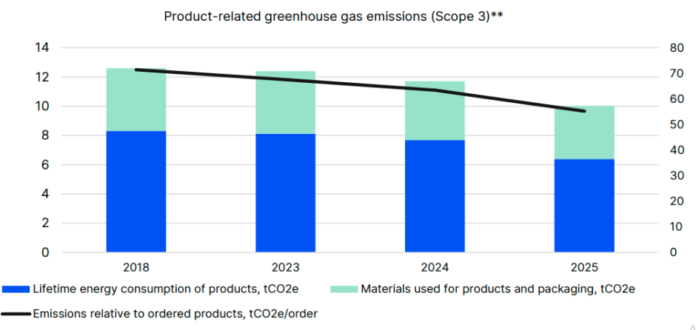
The company is also targeting a 40 percent reduction by 2030 in Scope 3 emissions associated with product materials and electricity consumed by products during their operating lives. The Scope 3 target is measured relative to orders received.
Product Electricity Consumption Generates 62 Percent of Emissions
The use of sold products and their lifetime electricity consumption represented 62 percent of KONE’s greenhouse gas emissions profile.
Purchased goods and services, including materials used to manufacture elevators, escalators and other equipment, accounted for another 35 percent.
Scope 1 emissions from the company’s facilities and vehicle fleet represented approximately 1 percent, while upstream transportation and distribution contributed another 1 percent.
The figures show that approximately 97 percent of KONE’s reported carbon footprint is connected to product electricity consumption and purchased materials. This makes energy-efficient equipment, renewable power, low-carbon materials and supplier collaboration central to the company’s climate strategy.
KONE is working to reduce these emissions through more energy-efficient elevator and escalator technologies, extended product lifetimes, modernisation services, digital monitoring, circular design and greater use of lower-carbon materials.
Manufacturing Emissions Fall 86 Percent from 2018
KONE’s 10 global manufacturing facilities achieved an 86 percent reduction in net Scope 1 and Scope 2 greenhouse gas emissions by the end of 2025, compared with the 2018 baseline.
The result improved from an 82 percent reduction in 2024, representing an additional 4-percentage-point improvement during 2025.
All KONE manufacturing units have sourced 100 percent renewable electricity since early 2023.
Solar panels were operating at six of the company’s 10 manufacturing facilities, meaning solar generation was deployed at 60 percent of the manufacturing network. Two facilities, equivalent to 20 percent of the total, used green district heating.
The company replaced diesel and liquefied petroleum gas forklifts with electric alternatives and improved heating, ventilation, air conditioning and lighting systems. Investments in robotics and automation supported both energy efficiency and more productive use of materials.
Renewable Electricity Reaches 99.6 Percent
Renewable sources accounted for 99.6 percent of KONE’s electricity consumption in 2025, placing the company close to its target of using 100 percent renewable electricity by 2030.
More than 99 percent of the energy included within KONE’s Scope 2 reporting consisted of renewable electricity.
Approximately 23 percent of purchased renewable electricity was secured through energy contracts bundled with renewable attributes. The remaining 77 percent was supported through unbundled energy attribute certificates.
Market-based Scope 2 emissions totalled 1,100 metric tons of CO₂ in 2025. Approximately half of these emissions originated from non-renewable electricity, while the remaining half was linked to district heating.
KONE continues to increase renewable electricity and renewable heat while expanding on-site solar generation and green district heating across its operational footprint.
Total Energy Consumption Falls 4 Percent in 2025
KONE’s energy consumption decreased 4 percent in 2025 compared with 2024, reflecting operational efficiency measures and continued energy management improvements.
However, total energy consumption remained 4 percent above the 2018 baseline of 507,900 MWh. This indicates that KONE consumed approximately 528,000 MWh of energy in 2025.
The company is addressing energy demand by electrifying equipment, improving manufacturing processes, optimising buildings and using automation to reduce unnecessary energy and material consumption.
Digitalisation contributes to KONE’s sustainability performance. Remote monitoring and connected services can reduce unnecessary maintenance journeys, improve service planning, extend equipment life and help customers understand product-level environmental performance.
Vehicle Fleet Produces 96 Percent of Operational Emissions
KONE’s vehicle fleet was responsible for approximately 96 percent of its combined Scope 1 and Scope 2 greenhouse gas emissions in 2025, up from 92 percent in 2024.
Fleet emissions declined 2 percent and were 5 percent below the 2018 level of 109,000 metric tons of CO₂ equivalent.
A 5 percent reduction from the baseline indicates fleet emissions of approximately 103,550 metric tons of CO₂ equivalent in 2025.
By the end of the third quarter of 2025, 16 percent of KONE’s global vehicle fleet had been electrified.
The company is expanding the use of electric vehicles, installing charging infrastructure and encouraging employees and operating units to select lower-emission vehicles. Fleet electrification will be particularly important for achieving carbon-neutral operations because vehicles now account for almost all of KONE’s remaining Scope 1 and Scope 2 emissions.
Executive Incentives Link Pay to Carbon Reduction
KONE has connected executive compensation directly to sustainability performance, strengthening accountability for climate and ESG results.
Sustainability represents 20 percent of the total weighting in the company’s long-term incentive plan.
A 10 percent weighting is linked to reductions in Scope 1, Scope 2 and Scope 3 greenhouse gas emissions. The remaining 10 percent is linked to diversity and inclusion, safety improvement and cybersecurity performance.
The incentive structure means one-fifth of long-term executive rewards depend on sustainability-related outcomes, demonstrating that ESG performance is treated as a core business objective rather than a separate corporate programme.
KONE Integrates Sustainability into Rise Strategy
KONE launched its Rise strategy for the 2025–2030 period with sustainability positioned as both a strategic ambition and a driver of profitable growth.
One of the strategy’s four principal shifts is Cut Carbon, which focuses on accelerating greenhouse gas reductions across KONE’s direct operations and wider value chain.
The programme covers energy-efficient technologies, low-carbon materials, renewable energy, fleet electrification, supplier collaboration, circularity, digitalisation and product-life extension.
KONE also monitors progress through an internal Sustainability Index containing indicators related to emissions reductions, safety, diversity and inclusion, and cybersecurity.
Four Manufacturing Sites Located in High Water-Stress Regions
Four of KONE’s 10 manufacturing facilities are located in regions classified as experiencing high water stress.
This means 40 percent of its manufacturing sites are situated in areas facing elevated water-related pressure.
KONE considers the direct operational impact limited because its manufacturing processes require relatively little water. The company nevertheless continues to monitor water-related risks and broader environmental impacts across its operations and supply chain.
KONE also stated that its highly automated manufacturing systems and assembly lines do not produce material levels of pollution in water or soil. Emissions of nitrogen oxides, sulphur oxides and volatile organic compounds are considered minimal within its own operations.
KONE President and CEO Philippe Delorme has emphasised that KONE intends to take an active role in shaping more sustainable cities rather than simply responding to future changes.
KONE Moves Closer to Carbon-Neutral Operations
KONE’s 2025 sustainability performance demonstrates strong progress in areas it can directly control. Manufacturing Scope 1 and Scope 2 emissions were 86 percent below the 2018 baseline, renewable electricity reached 99.6 percent, and total energy consumption declined 4 percent year-on-year.
The company’s main remaining operational challenge is its vehicle fleet, which generated 96 percent of combined Scope 1 and Scope 2 emissions despite achieving a 2 percent annual reduction and a 5 percent decline from 2018. Fleet electrification had reached 16 percent by the end of the third quarter of 2025.
With targets to reduce Scope 1 and Scope 2 emissions by 50 percent, cut relevant Scope 3 emissions by 40 percent, use 100 percent renewable electricity, achieve carbon-neutral operations by 2030 and follow a climate roadmap extending to 2050, KONE is integrating climate performance into technology, manufacturing, mobility, executive incentives and long-term value creation.
SHAFANA FAZAL
