
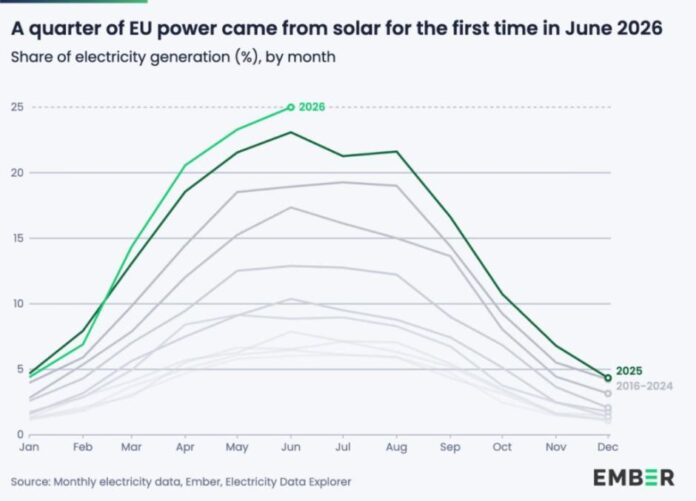
The European Union achieved a historic clean energy milestone in June 2026, with solar power becoming the bloc’s largest electricity source for the first time in a single month, according to new analysis from Ember.
Solar has generated a record 52 TWh of electricity during June, accounting for 25 percent of total EU power generation, surpassing all other energy sources and highlighting the rapid acceleration of Europe’s renewable energy transition.
The record output exceeded the previous monthly high of 47 TWh and a 23 percent share recorded in May 2026. June 2026 marked only the third month in which solar became the EU’s largest electricity source, following June 2025 and May 2026.
Solar overtook every other electricity source in the EU’s power mix during June. It accounted for 25 percent of generation, ahead of nuclear (21 percent), gas (15 percent), wind (14 percent), hydro (12 percent), while coal contributed only 8 percent.
According to Ember Senior Analyst Chris Rosslowe, solar has transformed from a relatively small contributor into an essential pillar of Europe’s electricity system within just a few years, supported by governments and consumers seeking affordable, domestically produced renewable energy.
Solar generation doubles in five years
The latest achievement reflects the extraordinary pace of solar expansion across Europe. In June 2021, solar generated only 21 TWh, representing 10 percent of EU electricity. By June 2026, generation had increased to 52 TWh, with its market share rising to 25 percent.
Ember noted that solar generation has expanded by more than one-fifth annually across the European Union between 2021 and 2025, making it the fastest-growing electricity source in the region.
This rapid expansion has been driven by aggressive capacity additions. EU countries installed 65.1 GW of new solar capacity during 2025, significantly increasing the availability of renewable electricity.
Heatwaves increase demand while solar supports grid stability
The record solar generation coincided with relatively high electricity demand across Europe during summer. Record-breaking heatwaves increased electricity consumption for cooling, while solar generation helped maintain grid reliability during periods when some conventional power sources faced operational challenges caused by hot and still weather conditions.
The strong daytime output from solar reduced dependence on fossil fuels while supporting electricity supplies during peak demand periods.
Spain, Germany and Poland achieve new solar milestones
Solar growth is accelerating across individual EU member states. During 2026, 18 EU countries have already recorded new monthly records for the share of electricity generated from solar.
Spain crossed a major milestone in June 2026, with solar supplying 34 percent of national electricity generation for the first time. Ember noted that Spain’s renewable energy policies have accelerated solar deployment while helping households avoid approximately €10 per month in electricity costs during the energy crisis that followed the US-Israel war with Iran.
Germany also reached new records, with solar accounting for 33 percent of electricity generation in May 2026 before climbing further to 36 percent in June.
Poland generated 24 percent of its electricity from solar during June 2026, despite remaining one of Europe’s largest coal-consuming countries. The country added more than 20 GW of solar capacity between 2020 and 2025, making it one of the fastest-growing solar markets in the European Union.
EU solar market outlook
The latest figures underline how rapidly solar power has become a cornerstone of Europe’s energy transition. With installations continuing at record levels and solar capacity expanding across both mature and emerging markets, the EU is steadily reducing dependence on fossil fuels while strengthening energy security. As more member states break national generation records, solar is expected to play an even larger role in supporting electricity demand, reducing emissions, and lowering long-term energy costs across Europe.
Europe’s leading solar power companies are significantly expanding investments in solar generation, battery storage, electricity grids, and renewable energy infrastructure as the European Union accelerates its clean energy transition. The latest investment announcements highlight continued growth in utility-scale solar projects, grid modernization, and integrated renewable energy portfolios.
Iberdrola (Spain)
Iberdrola remains one of Europe’s largest renewable energy investors. The company has expanded its long-term investment strategy, focusing on renewable generation and electricity networks. Recent announcements include major grid investments through its subsidiary Neoenergia, including €1.56 billion in Pernambuco and €660 million in Rio Grande do Norte, alongside investments in smart grids, energy storage, and solar generation projects. Iberdrola has also committed €58 billion in investments through 2028 under its updated strategic plan.
Enel Green Power (Italy)
Enel continues to be among Europe’s largest renewable energy developers. Under its 2026-2028 Strategic Plan, Enel plans to invest approximately €20 billion in renewable energy projects, adding around 15 GW of new renewable capacity by 2028. The investment spans solar, onshore wind, dispatchable renewable technologies, and energy storage, with the goal of increasing total renewable capacity to more than 80 GW.
RWE (Germany)
RWE continues expanding its European solar and battery portfolio through investments in utility-scale solar farms, hybrid renewable projects, and battery energy storage systems across Germany, the UK, Spain, Italy, and other European markets. The company is prioritizing integrated solar-plus-storage developments to strengthen renewable electricity supply and grid flexibility.
EDP Renewables (Portugal)
EDP Renewables (EDPR) remains one of Europe’s leading solar and wind developers, investing heavily in utility-scale solar projects, hybrid renewable plants, and long-term power purchase agreements across Southern Europe. The company continues expanding its renewable asset pipeline while supporting Europe’s decarbonization strategy.
Neoen (France)
French renewable energy developer Neoen continues expanding its European solar portfolio following its acquisition by Brookfield. Recent milestones include commissioning Portugal’s largest solar complex (272 MWp Rio Maior and 68 MWp Torre Bela), Sweden’s largest 100 MWp solar farm, construction of new solar projects in Italy and Ireland, and continued battery storage investments. Neoen aims to add another 10 GW of renewable capacity by 2030.
Statkraft (Norway)
Statkraft continues investing across Europe’s renewable energy sector with an increasing focus on large-scale solar parks combined with battery storage and flexible energy systems. The company is expanding its solar development pipeline in Germany, Spain, Italy, and the UK while integrating solar with hydropower and wind assets to improve system flexibility.
European solar market continues rapid expansion
The broader European solar industry remains on a strong growth trajectory. According to SolarPower Europe:
EU solar PV installations reached 66.8 GW annually.
Cumulative EU solar PV capacity is forecast to reach 718 GW by 2030.
Solar PV has already helped Europe avoid €18.9 billion in gas imports since the beginning of the 2026 Middle East conflict.
The European Commission estimates EU solar PV capacity reached approximately 406 GW in 2025, surpassing the earlier 380 GW target.
BABURAJAN KIZHAKEDATH
