
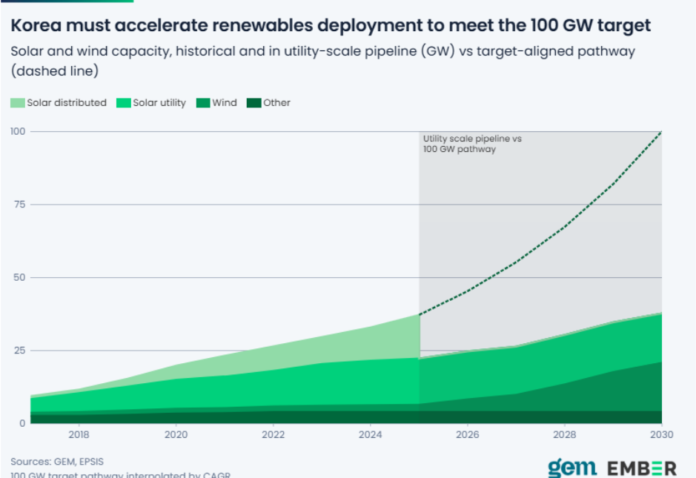
South Korea’s plan to expand renewable energy capacity to 100 GW by 2030 could reduce the country’s annual fossil fuel power bill by nearly half, lowering costs to approximately $13 billion, according to new research from Ember and Global Energy Monitor (GEM).
The study highlights the growing economic value of renewable energy as geopolitical tensions continue to disrupt global energy markets. Following the conflict involving Iran and the closure of the Strait of Hormuz, global gas prices have risen 41 percent year-on-year. Against this backdrop, South Korea’s existing wind and solar assets are expected to save the country around $4.7 billion in fossil fuel import costs during 2026 alone.
South Korea remains one of the world’s most import-dependent energy economies. The country spends a larger share of its GDP on fossil fuel imports than 94 percent of the global population. According to Ember, renewable energy expansion offers a long-term solution to reduce exposure to volatile oil and gas markets while improving energy security.
Since 2010, wind and solar facilities in South Korea have generated a cumulative 283 TWh of electricity. Had the same amount of power been produced using imported liquefied natural gas (LNG), it would have cost approximately $25 billion over the last 16 years. At current 2026 spot market prices, South Korea’s total fossil fuel imports across the entire energy sector are estimated to be worth $133 billion annually – nearly six times the nation’s yearly debt repayments, 3.5 times food imports, and almost three times defense expenditure.
The government is expected to formalize its 100 GW renewable energy target in June through the Green Great Transformation Strategy. Achieving this goal would nearly triple South Korea’s existing renewable capacity of 37 GW. Current projections suggest the country could reach 92 GW through continued solar growth and the commissioning of 14 GW of planned wind projects, leaving only a modest gap to close.
Offshore wind is expected to play a critical role, accounting for 11.3 GW of the 14.4 GW wind capacity planned through 2030. At the same time, solar energy deployment is likely to accelerate through rooftop installations, floating solar projects, agricultural solar developments, and community-scale generation. GEM estimates South Korea possesses nearly 11 GW of floating solar potential, while the Korea Rural Community Corporation has already set a target of developing 3 GW of floating solar capacity in agricultural reservoirs by 2030.
The renewable energy strategy is closely linked to South Korea’s broader decarbonization agenda. The country aims to significantly reduce coal-fired power generation by 2040 while electrifying sectors such as heating, which currently accounts for around 48 percent of final energy consumption. Policymakers are promoting electric heat pumps and renewable district heating systems as alternatives to conventional gas-based heating.
Grid infrastructure remains one of the biggest challenges. Renewable generation is concentrated in regions such as Honam and Yeongnam, while electricity demand is growing rapidly around Seoul due to semiconductor manufacturing investments and expanding AI data center infrastructure. Existing transmission lines currently carry only 4.5 GW of power from Honam to the capital region, creating a major bottleneck.
To address this issue, South Korea is developing a high-voltage direct current (HVDC) energy highway and expanding battery storage, pumped hydro projects, and AI-enabled digital grid technologies. The country plans to deploy up to 10 GW of pumped hydro storage by 2030 while also increasing grid-scale battery installations.
Industry experts note that South Korea is well positioned to capitalize on the transition. The country has globally competitive solar panel, battery, transformer, grid-forming inverter, and vehicle-to-grid technology industries. Much of the investment required to achieve the 100 GW target would support domestic manufacturing and create new economic opportunities.
The report concludes that South Korea has the technology, industrial capability, and economic incentive to reach its renewable energy goals. However, achieving the target will require accelerated project development, grid modernization, supportive market reforms, and policies that encourage large-scale deployment of wind, solar, storage, and smart grid technologies.
BABURAJAN KIZHAKEDATH
