
The 2025 sustainability report of Ahlstrom has revealed it reinforced sustainability as a core business driver in 2025, combining strong financial performance with measurable environmental and social progress. The company reported net sales of €2.9 billion alongside a 16.1 percent comparable EBITDA margin, with its “Safe and Sustainable by Design” strategy now contributing two-thirds of total global revenue.
This integration of sustainability into financial metrics has helped Ahlstrom maintain its EcoVadis Platinum rating and secure a CDP Climate score of A-, placing it among the top one percent of industrial peers for climate performance, Helen Mets, CEO of Ahlstrom, said in the annual report 2025.
Decarbonization Progress Backed by Science-Based Targets
Ahlstrom delivered a 23 percent absolute reduction in Scope 1 and 2 emissions compared to its 2021 baseline, marking a significant step toward its target under the Science Based Targets initiative to reduce operational emissions by 42 percent by 2030 and achieve net-zero by 2050. In absolute terms, the company reported Scope 1 emissions of 1,093 thousand tons of CO2, Scope 2 emissions of 353 thousand tons, and Scope 3 emissions of 2,693 thousand tons.
While total Scope 3 emissions saw a marginal increase due to higher production volumes, Ahlstrom achieved a 16 percent reduction in emissions intensity across key Scope 3 categories, reflecting improved efficiency in procurement and logistics. This decoupling of growth from carbon intensity is central to the company’s long-term climate roadmap.
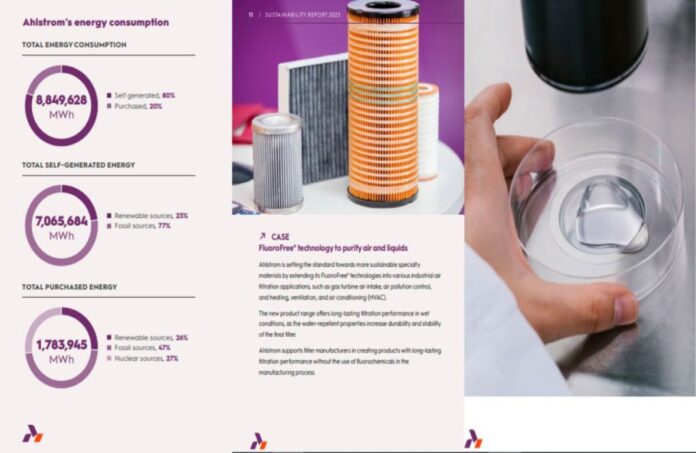
Energy optimization has also played a key role, with total energy consumption reaching approximately 9.98 million MWh. Of this, around 3.2 million MWh was sourced from renewable energy, representing 32 percent of the total energy mix.
Asset Optimization and Low-Carbon Operations
Ahlstrom’s decarbonization strategy has been supported by targeted asset optimization, including the restructuring of its Mosinee facility in the United States. By phasing out carbon-intensive legacy operations and shifting toward energy-efficient systems, the company has reduced its exposure to carbon costs while improving operational efficiency. This approach reflects a broader effort to align industrial processes with low-carbon technologies and regulatory expectations.
Circular Economy and Waste Reduction Strategy
The company continues to advance its circularity goals, generating 295.5 thousand tons of total waste in 2025, of which 94 thousand tons was sent to landfill. Non-recycled waste accounted for 32 percent, highlighting both progress and the scale of opportunity as Ahlstrom moves toward its target of zero waste to landfill by 2030.
Circularity is further reinforced through product design and material use, with sustainability embedded at the earliest stages of innovation. A proprietary EcoDesign Tool ensures that 100 percent of new product developments are evaluated for environmental impact before receiving capital approval, strengthening lifecycle accountability.
Sustainable Products Driving Growth
Sustainable innovation remains a key growth engine, with 66 percent of Ahlstrom’s offerings now classified as Safe and Sustainable by Design, up from 56 percent in 2024. The company is targeting an 80 percent share by 2030, supported by ongoing investments in advanced fiber-based technologies.
Innovation performance is reflected in a product vitality rate of 31 to 33 percent, meaning nearly one-third of total sales come from products introduced or significantly improved within the past three years. These innovations focus heavily on PFAS-free and plastic-free solutions, particularly in packaging and life sciences applications, replacing fossil-based materials with renewable alternatives.
Responsible Sourcing and Material Efficiency
Ahlstrom has achieved full traceability and sustainability in its raw material sourcing, with 100 percent of wood fiber and 98 percent of natural fiber certified. Renewable fibers account for 94 percent of total fiber usage, reinforcing the company’s commitment to a bio-based materials strategy.
Supplier engagement is also a priority, with ESG clauses now included in 100 percent of supplier contracts. Compliance with the Supplier Code of Conduct stands at 79 percent, reflecting ongoing efforts to strengthen sustainability performance across the value chain.
Workforce, Safety and Social Impact
The company reported strong progress in workplace safety, achieving a 20 percent improvement in Total Recordable Incident Rate, which declined to 0.91 in 2025. This milestone was supported by significant investment in workforce training, with employees and contractors completing an average of 19.81 hours of safety training annually.
From a social perspective, Ahlstrom continues to invest in employee well-being and engagement. The company reported an Employee Net Promoter Score of 39, while offering healthcare coverage to 100 percent of its global workforce. Employee turnover stood at 11 percent, and the company reported zero cases of child or forced labor across its operations.
Governance, Transparency and ESG Leadership
Ahlstrom’s sustainability governance is aligned with leading global frameworks, including GRI Standards and the CSRD framework, with a double materiality approach. A total of 52 ESG indicators have been independently assured by KPMG, reinforcing the credibility and transparency of its disclosures.
The company remains actively engaged with the World Business Council for Sustainable Development, contributing to initiatives focused on circular bioeconomy development and standardized sustainability reporting for fiber-based materials.
Sustainability Outlook: Scaling Circular Bioeconomy Leadership
Ahlstrom’s 2025 performance demonstrates a clear trajectory toward a low-carbon, circular economy model. With strong emissions reductions, high renewable fiber usage, expanding sustainable product share and top-tier ESG ratings, the company is advancing steadily toward its 2030 and 2050 climate targets.
By embedding sustainability into financial performance, product innovation and supply chain management, Ahlstrom is positioning itself as a leader in next-generation specialty materials, aligned with global regulatory trends and accelerating demand for sustainable solutions.
FASNA SHABEER
