
The Sustainability Data Book 2025 from Toyota Motor outlines a detailed transition from a traditional automaker to a diversified mobility company, driven by its “multi-pathway” strategy. This approach combines electrification, hydrogen technologies, and hybrid systems to meet global carbon neutrality goals while maintaining strong environmental, social, and governance standards.
Carbon Neutrality Targets and Emissions Progress
Toyota, as part of its sustainability goals, has set a target of achieving full carbon neutrality across the entire vehicle lifecycle by 2050. As part of this roadmap, the company is targeting a 100 percent reduction in Scope 1 and Scope 2 emissions from global manufacturing plants by 2035 compared to 2013 levels.
Significant progress has already been recorded. Toyota reduced average new vehicle CO2 emissions by 32 percent compared to 2010 levels, exceeding its 30 percent target ahead of schedule. Manufacturing plant CO2 emissions declined by 34 percent versus 2013, also surpassing the 30 percent reduction goal. Life cycle emissions dropped by 19 percent compared to 2013, beating the 18 percent target.
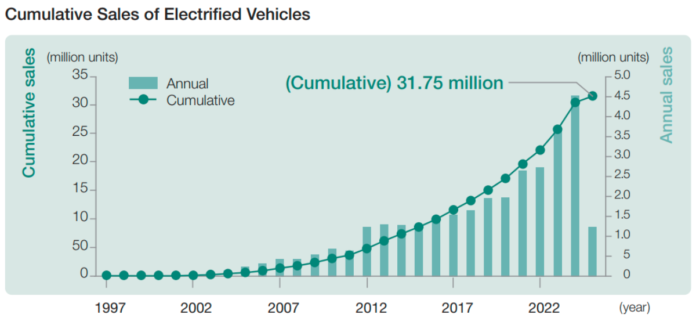
Scope 3 emissions, particularly from the use of sold products, remain the largest contributor to Toyota’s carbon footprint, reinforcing the importance of its electrification strategy. Electrified vehicles now account for a major share of its portfolio, with cumulative global sales reaching 31.75 million units, exceeding the 30 million target earlier than planned.
Electrification and Multi-Pathway Strategy
Toyota’s multi-pathway strategy integrates Battery Electric Vehicles, Hybrid Electric Vehicles, Plug-in Hybrid Electric Vehicles, and Fuel Cell Electric Vehicles to address varying regional energy ecosystems. By 2030, Toyota aims to establish production systems capable of supporting 3.5 million BEV sales annually and plans to scale fuel cell production to 100,000 units per year.
In North America, 83 percent of Toyota’s models already offer electrified options, demonstrating steady progress in reducing tailpipe emissions.
Energy Efficiency and Renewable Adoption
Toyota is advancing toward carbon-neutral manufacturing through renewable energy adoption and operational efficiency. The company achieved a 36 percent global renewable electricity usage rate, exceeding its 25 percent target. Notably, all plants in Europe and South America already operate on 100 percent renewable electricity.
Looking ahead, Toyota aims to increase renewable electricity usage to 80 percent globally by 2030. The company is also introducing innovative technologies such as hydrogen-based heating systems and energy-efficient paint processes to reduce industrial emissions.
Circular Economy and Resource Management
Toyota has exceeded several circular economy targets ahead of schedule. The company achieved a 75 percent reduction in single-use plastics in specific operations and reduced packaging materials by 31 percent compared to 2018 levels, surpassing its 25 percent goal.
Water efficiency also improved significantly, with an 11 percent reduction in water usage per production unit compared to 2013, far exceeding the 3 percent target. In addition, Toyota expanded its end-of-life vehicle recycling infrastructure to 20 facilities, surpassing the target of 15.
The company is advancing closed-loop recycling systems for batteries, recovering critical materials such as lithium, cobalt, and nickel to reduce dependence on virgin resources. It is also increasing the use of recycled and bio-based materials in vehicle production.
Supply Chain, Logistics, and Dealer Engagement
Toyota is extending sustainability efforts across its value chain. Logistics emissions in Japan were reduced by 11 percent compared to 2018 levels, exceeding the 7 percent target. The company has also engaged 114 dealerships in environmental initiatives, achieving a 20 percent reduction in non-renewable electricity consumption among participating dealers.
Water, Biodiversity, and Environmental Stewardship
Toyota continues to invest in long-term environmental sustainability through biodiversity and water management initiatives. The company has established multiple “Plant in Harmony with Nature” sites, including six in Japan and four overseas.
In water-stressed regions, Toyota is implementing net water positive initiatives using advanced treatment and rainwater harvesting systems, ensuring improved water quality returned to ecosystems.
Social Responsibility and ESG Recognition
Toyota’s sustainability performance is reinforced by strong ESG recognition. The company remains included in leading global indices such as the FTSE4Good Index and MSCI ESG indices. It has also received high ratings from CDP, including an A score for climate and a B score for water security.
2030 and 2050 Sustainability Targets
Under its 8th Environmental Action Plan starting in 2026, Toyota has set clear 2030 targets. These include a 47 percent reduction in Scope 1 and Scope 2 emissions compared to 2020 levels and a 30 percent reduction in lifecycle greenhouse gas emissions per vehicle.
By 2035, Toyota aims to reduce emissions from new vehicle operations by at least 50 percent and cut business-related emissions by 68 percent compared to 2019 levels, while achieving carbon neutrality at global production plants.
The ultimate goal remains complete carbon neutrality across all operations, vehicles, and lifecycle emissions by 2050 under the Toyota Environmental Challenge 2050.
Conclusion
Toyota’s Sustainability Data Book 2025 highlights strong progress across emissions reduction, electrification, renewable energy adoption, and circular economy initiatives. The company has exceeded several mid-term targets ahead of schedule, particularly in emissions, plastics reduction, and renewable energy usage.
While long-term goals such as full lifecycle carbon neutrality remain in progress, Toyota’s multi-pathway strategy and measurable achievements position it as a key player in the global transition toward sustainable mobility.
FASNA SHABEER
