
The Bayer Impact Report 2025 presents a comprehensive and forward-looking strategy to align global healthcare and agriculture operations with ambitious environmental goals. Under the leadership of Bill Anderson, Bayer is advancing a “transition and transformation” model that aims to decouple business growth from environmental impact while accelerating sustainability innovation.
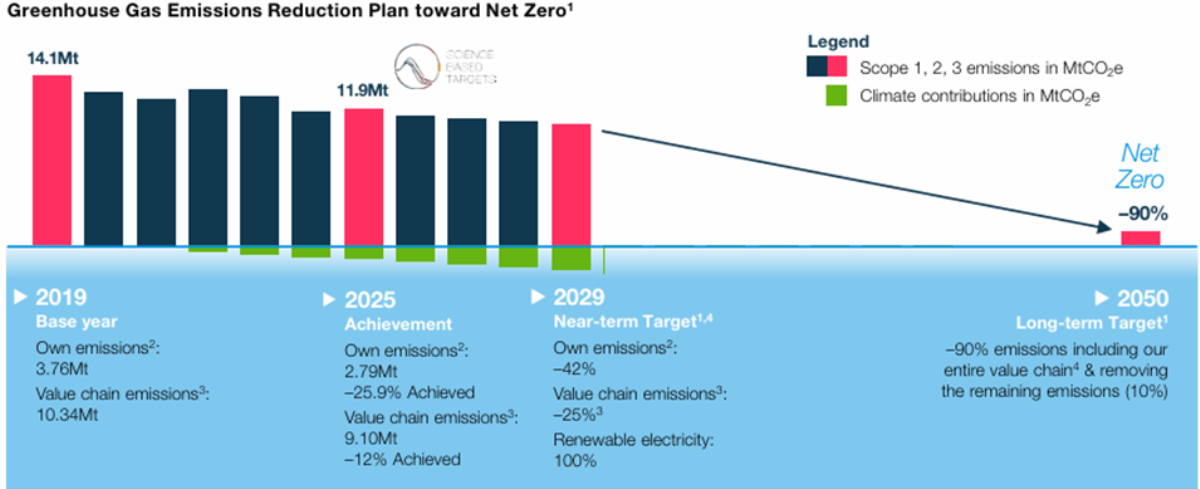
A key milestone highlighted in 2025 is a 25.9 percent reduction in absolute Scope 1 and Scope 2 emissions compared to 2019 levels. This achievement reinforces Bayer’s pathway toward its interim target of a 42 percent reduction by 2029 and long-term ambition of achieving net zero emissions by 2050.
Strong ESG Governance and Carbon Pricing Strategy
Bayer’s environmental management is anchored in a robust global Health, Safety, and Environment framework. A notable feature is the internal carbon pricing mechanism set at 100 Euros per metric ton, which directs investments toward low-carbon technologies. Oversight is maintained by a dedicated ESG function reporting directly to the Board of Management, ensuring sustainability remains central to corporate decision-making.
Accelerating Climate Action and Net Zero Targets
Bayer’s greenhouse gas reduction roadmap, validated by the Science Based Targets initiative, outlines a clear trajectory toward net zero. The company aims for a 90 percent reduction across its value chain by 2050.
Scope 1 and 2 emissions declined from 3.76 million metric tons in 2019 to 2.79 million metric tons in 2025
Scope 3 emissions fell from 10.34 million metric tons to 9.10 million metric tons during the same period
Renewable electricity usage reached 51.2 percent globally, with a goal of 100 percent by 2029
These initiatives reflect Bayer’s commitment to large-scale decarbonization supported by clean energy adoption.
Advanced Air Emissions Monitoring and Industrial Safety
Bayer has implemented a sophisticated air emissions monitoring system to ensure compliance and reduce environmental impact. The system combines:
Real-time online monitoring of temperature, flow rates, and concentration levels
Offline laboratory analysis of pollutants such as nitrogen dioxide, sulfur dioxide, and hydrogen chloride
This integrated approach enabled measurable reductions in volatile organic compound emissions in 2025 through improved gas treatment technologies.
Global Water Stewardship and Efficient Resource Use
Water management remains a critical sustainability pillar, particularly in Bayer’s Crop Science division. The company introduced a Global Water Balance model to enhance efficiency and transparency.
Total water withdrawal reached approximately 52 million cubic meters
Internal recycling volumes were around 380 million cubic meters
Water consumption stood at about 21 million cubic meters
Treated discharge totaled roughly 30 million cubic meters
Beyond operations, Bayer aims to improve water productivity for smallholder farmers by 25 percent by 2030, with a strong focus on sustainable rice cultivation in water-stressed regions.
Advancing Circular Economy and Waste Reduction
Bayer is accelerating its transition toward a circular economy with a zero-waste-to-landfill ambition. Key initiatives include:
Increased recycling and recovery of hazardous and non-hazardous waste
100 percent recycle-ready packaging target for the Consumer Health division by 2030
A 30 percent reduction in environmental impact from Crop Science products through biodegradable solutions and precision agriculture technologies
These efforts demonstrate Bayer’s commitment to minimizing waste and optimizing resource efficiency across its value chain.
Strategic Outlook: Scaling Sustainable Innovation
Looking ahead, Bayer is leveraging its research and development strengths to expand regenerative agriculture and sustainable healthcare solutions. By integrating data-driven decarbonization, advanced monitoring systems, and circular resource management, Bayer is positioning itself as a leader in sustainable transformation.
FASNA SHABEER
