
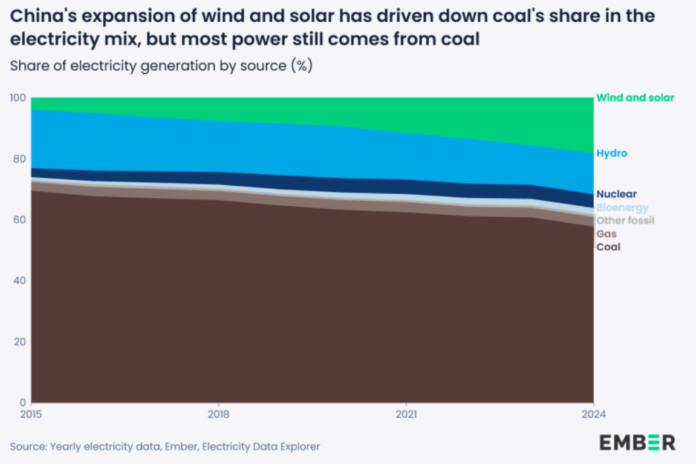
China is accelerating a major transformation of its power sector, shifting coal-fired power plants from traditional baseload generation to system flexibility support as renewable energy expands rapidly. According to a new Ember report, the country is on track to retrofit its entire coal fleet for flexible operations by 2027, marking a critical milestone ahead of its 2030 carbon peaking target.
Coal’s role evolving in China’s power system
As China enters the 15th Five-Year Plan period, the final planning cycle before the country aims to peak carbon emissions by 2030, the energy transition is entering a decisive stage. Rapid growth in wind and solar capacity is reshaping the power system and reducing coal’s strategic importance as a baseload power source, Biqing Yang Energy Analyst, Asia, Ember, said.
Government strategies, mandates and financial incentives over the past decade have repositioned coal as a provider of system stability and flexibility rather than continuous generation. This shift is designed to help balance the grid while renewable energy becomes dominant.
Coal power currently delivers about 70 percent of China’s load regulation capacity, making it the main source of grid flexibility as renewable energy grows. The country is therefore using its existing coal fleet to provide system support while gradually shifting coal away from baseload generation as part of a long-term transition to reduce coal dependence.
China’s approach aligns with global trends, as countries such as Germany, the United States, Denmark and India have also pursued coal plant retrofits to improve flexibility.
A major policy step came in November 2021, when China’s National Development and Reform Commission and the National Energy Administration introduced the “three integrated retrofits” strategy. This plan focuses on improving energy efficiency, enabling heating applications and enhancing flexibility, with a target to retrofit 200 GW of coal capacity between 2021 and 2025. Under the policy, retrofitted coal units must operate at lower minimum load levels, allowing them to ramp up and down more easily to support the grid.
China’s 14th Five-Year Plan strengthened these goals by raising the retrofit target to more than 200 GW and aiming for flexible power sources to account for 24 percent of regulatory capacity by 2025. In February 2024, new policy guidance further increased ambition, calling for the entire coal fleet to be upgraded for flexibility as much as possible by 2027 while improving load regulation and smart dispatch capabilities.
Entire coal fleet expected to be flexible by 2027
China has made rapid progress retrofitting coal plants to operate flexibly. Around 360 GW of coal power capacity had already completed upgrades by the third quarter of 2024, surpassing earlier targets. Based on current momentum, the full fleet is expected to achieve maximum flexibility by 2027.
However, these upgrades also mean that the available flexibility from existing coal plants will soon be fully utilized. Coal operators continue to face financial pressure due to upfront retrofit investments, lower utilisation rates and reduced electricity sales.
Coal utilisation declining as renewables grow
China’s coal utilisation rate has fallen by more than 20 percent over the past two decades. After a temporary rise following the pandemic, utilisation has resumed its downward trend and now shows greater seasonal variability. This pattern signals an early structural shift toward a renewable-dominant power system.
Clean flexibility must scale rapidly
Ember warns that coal retrofits alone cannot sustain the energy transition. Clean flexibility technologies, especially battery energy storage, offer better technical performance and are essential to prevent new coal capacity from being added.
China already accounts for nearly half of global battery energy storage installations and has demonstrated strong growth in this sector. Continued expansion of storage and other clean flexibility solutions will be vital to maintaining grid stability as renewable deployment accelerates.
Market reforms critical for renewable integration
Ongoing power market reforms and improved system operations are key to unlocking remaining flexibility potential. The 15th Five-Year Plan period will be crucial for building a unified national power market capable of supporting large-scale renewable integration.
If clean flexibility does not keep pace with renewable growth, China risks relying on additional coal capacity, potentially locking in emissions beyond 2030, Dr Muyi Yang Senior Energy Analyst, Asia, Ember, said.
Long-term outlook for coal in China
China’s coal fleet is moving from being the backbone of electricity generation to serving as a residual flexibility and stability provider. As battery storage and market reforms mature, reliance on coal for balancing the grid is expected to decline further, paving the way for a cleaner and more flexible power system in the long term.
BABURAJAN KIZHAKEDATH
