
The IEA forecasts that renewables and nuclear energy will together generate around half of the world’s electricity by 2030, as renewable output overtakes coal. Renewable generation rose sharply in 2025, nearly matching coal despite weaker hydropower and wind conditions. Through 2030, renewable output is expected to grow by about 1,000 terawatt-hours annually, with solar PV contributing more than 600 TWh and total renewable generation expanding at about 8 percent per year.
Nuclear power reached record output in 2025 and is set to grow steadily, driven by reactor restarts in Japan, higher production in France and new capacity in China and India. Emerging economies will lead nuclear expansion, with China expected to account for around 40 percent of global growth, while advanced economies increasingly support reactor life extensions and new projects.
Coal generation remained broadly flat in 2025 but showed diverging regional trends, declining in China and India while rising in the United States due to higher gas prices. Between 2026 and 2030, renewables, gas and nuclear are expected to meet all additional electricity demand, gradually displacing coal. Gas-fired generation is projected to grow about 2.6 percent annually, driven by rising US demand and fuel switching in the Middle East. By 2030, renewables are expected to provide the largest share of global electricity generation, even though coal will remain the single largest fuel source.
Power sector emissions
Global power sector emissions are expected to plateau through 2030 as renewables and nuclear take a larger share of electricity generation. Emissions from electricity remained stable in 2025 after rising at an average of 1.4 percent annually between 2022 and 2024. Despite electricity generation remaining the largest source of energy-related emissions at about 13,900 million tonnes of CO2 per year, the carbon intensity of electricity has already fallen 14 percent over the past decade and is projected to decline faster through 2030 as low-emission power expands.
Electricity demand
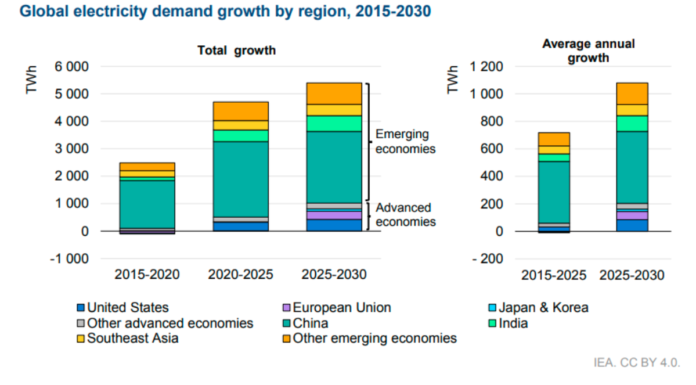
IEA forecasts global electricity demand will rise at an average annual rate of 3.6 percent between 2026 and 2030, supported by increasing use in industry, electric vehicles, air conditioning and data centres. Demand grew 3 percent in 2025 after a 4.4 percent rise in 2024, and future growth is expected to be about 50 percent higher than the previous decade’s average. Electricity demand is set to expand at least 2.5 times faster than overall energy demand through 2030, marking a structural shift in the link between electricity consumption and economic growth.
Emerging economies will account for nearly 80 percent of additional electricity demand, with China contributing close to half of global growth. China alone is expected to add demand equivalent to today’s total EU electricity consumption, growing about 4.9 percent annually. India and Southeast Asia will also play a larger role, driven by strong economic growth and rising air conditioning use.
Electricity demand in advanced economies is rebounding after years of stagnation, fueled by data centres, AI and advanced manufacturing. The United States is projected to see nearly 2 percent annual growth through 2030, with data centres driving about half of the increase. EU demand is expected to grow around 2 percent annually, while other advanced economies such as Australia, Canada, Japan and Korea are also set to see faster growth.
BABURAJAN KIZHAKEDATH
