
Global offshore wind power continued to expand in 2025 despite slower annual installation growth, while project costs remained well below historical levels. According to the latest IRENA report, global offshore wind capacity reached 91.4 GW, nearly 30 times higher than in 2010, while the global weighted-average total installed cost (TIC) declined 48 percent over the same period to USD 2,931/kW.
Global Offshore Wind Capacity Nears 100 GW
Worldwide offshore wind capacity increased from just 3.1 GW in 2010 to 91.4 GW by the end of 2025, highlighting the rapid growth of the sector over the past 15 years, IRENA report said.
New offshore wind installations reached 8.6 GW in 2025, up 3.6 percent from 8.3 GW installed in 2024.
China continued to dominate the global market, accounting for 78 percent of all newly installed offshore wind capacity during 2025.
China overtook Europe as the world’s largest offshore wind market in 2022 and expanded its installed capacity to 47.4 GW by 2025—approximately 23 percent larger than Europe’s 38.6 GW.
Within Europe, the United Kingdom and Germany remained the largest offshore wind markets, while France and Poland emerged as important future growth markets.
Competitive Auctions Drive Offshore Wind Expansion
Government-backed auction mechanisms continued to support new offshore wind investment worldwide.
During 2025:
European countries awarded 5.8 GW through two-sided Contracts for Difference (CfDs) in Poland, France, and Ireland, alongside Germany’s negative-bidding model.
The United Kingdom awarded another 8.4 GW through Allocation Round 7 in January 2026.
The Republic of Korea established a target of 7–8 GW of offshore wind awards, with 2.6 GW already allocated by 2025.
Meanwhile, offshore wind development in the United States faced continued policy uncertainty following the 2025 Presidential Memorandum that withdrew offshore wind leasing areas, although projects that had already reached final investment decisions and entered construction were allowed to proceed.
Larger Wind Farms Improve Project Economics
Project sizes have increased dramatically as developers pursue greater economies of scale.
Average offshore wind project capacity rose from 136 MW in 2010 to 312 MW in 2025.
Between 2022 and 2025, average project sizes consistently exceeded 300 MW, with several projects surpassing 1 GW.
Europe recorded the largest average project size in 2025 at 394 MW, compared with 284 MW in China.
Wind turbines have also become substantially larger.
The global weighted-average offshore turbine capacity increased from 3.1 MW in 2010 to 10.3 MW in 2025.
China deployed offshore turbines of up to 16 MW, while turbines in the 8–10 MW range continued to dominate installations, resulting in a weighted-average turbine rating of 10 MW.
Europe achieved an even higher weighted-average turbine capacity of 10.9 MW, with the United Kingdom installing 13 MW turbines at the Dogger Bank offshore wind project.
Rotor diameters have expanded alongside turbine capacity.
China recorded the world’s largest weighted-average rotor diameter at 225 metres, compared with 198 metres in Europe, helping improve energy generation in lower wind-speed regions.
Offshore Project Location Continues to Influence Costs
Water depth and distance from shore remain major drivers of offshore wind investment costs.
Projects located farther offshore generally require more expensive foundations, longer installation periods, higher maintenance costs, and additional grid infrastructure.
Europe, the world’s most mature offshore wind market, continued moving into deeper waters.
During 2025, European offshore wind projects averaged:
39 metres water depth
27 kilometres from shore
China maintained relatively shallow offshore developments, recording an average water depth of 21 metres.
Projects in the rest of the world were located closest to shore, averaging 18 kilometres offshore.
China’s “Single 30” regulation, introduced in 2023, now requires new offshore wind projects to be located at least 30 kilometres offshore and in waters deeper than 30 metres. While this policy is expected to increase project costs, developers are targeting stronger offshore wind resources to improve long-term energy output.
Offshore Wind Costs Fall 48 percent Since 2010
Despite more complex projects and larger turbines, offshore wind costs have fallen significantly over the past decade.
IRENA reported that the global weighted-average total installed cost (TIC) for offshore wind projects commissioned in 2025 reached USD 2,931/kW, representing a 48 percent decline compared with 2010.
Compared with 2024, costs declined slightly by 0.3 percent, indicating that installation costs have largely stabilized during the past three years.
Across projects commissioned in 2025, total installed costs ranged from USD 1,321/kW to USD 5,800/kW between the 5th and 95th percentiles.
Asia Delivers Lowest Offshore Wind Costs
Regional installation costs varied significantly.
In 2025:
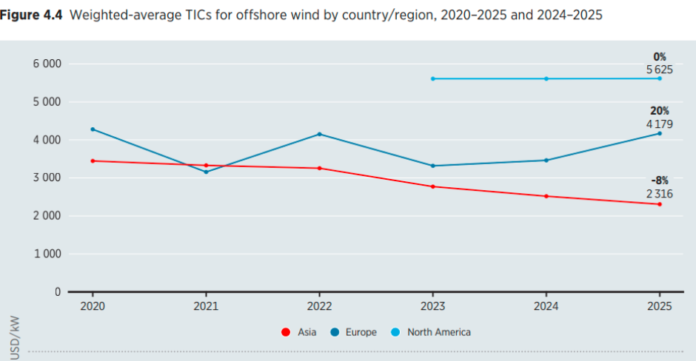
Asia recorded the world’s lowest weighted-average offshore wind cost at USD 2,316/kW.
Europe averaged USD 4,179/kW, continuing an upward cost trend observed since 2023.
North America reported the highest regional installation cost at USD 5,625/kW, remaining broadly unchanged from 2024.
China Maintains Lowest Offshore Wind Installation Costs
At the country level, China remained by far the world’s lowest-cost offshore wind market.
Chinese offshore wind projects commissioned during 2025 recorded a weighted-average installation cost of just USD 1,542/kW, supported by domestic manufacturing, large-scale deployment, competitive supply chains, and standardized project execution.
At the opposite end of the spectrum, France reported the highest installation cost among major offshore wind markets at USD 5,721/kW.
The United States followed closely with an average installation cost of USD 5,625/kW, remaining broadly unchanged from the previous year amid continued policy uncertainty and higher development costs.
Larger Turbines and Scale Continue to Improve Economics
Although offshore wind projects are moving into deeper waters and more challenging locations, larger turbines, expanding project sizes, and increasingly competitive supply chains continue to offset many of these cost pressures.
With global installation costs now 48 percent lower than in 2010, offshore wind is steadily becoming more economically competitive, particularly in Asia, where manufacturing scale and deployment efficiencies continue to reduce project costs while supporting the next phase of global offshore renewable energy expansion.
BABURAJAN KIZHAKEDATH
