
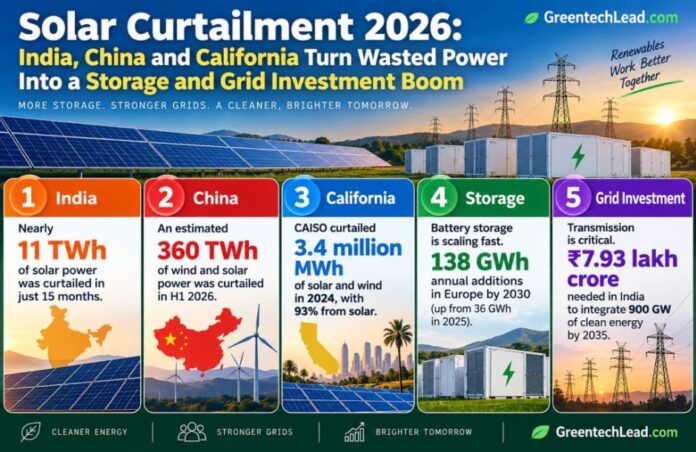
Solar and wind curtailment is becoming one of the strongest investment signals in renewable energy in 2026. India curtailed nearly 11 TWh of solar electricity over 15 months, China is estimated to have curtailed 360 TWh of wind and solar power in the first half of 2026, while California continues to curtail millions of MWh as renewable generation exceeds the grid’s ability to absorb it during some periods.
The numbers expose the next challenge for the global energy transition. Building inexpensive solar and wind capacity is no longer enough. Electricity must also be stored, transported and delivered when customers need it.
That is creating major opportunities in battery energy storage systems (BESS), pumped hydro, transmission lines, transformers, substations, grid software and flexible demand.
India Curtails Nearly 11 TWh of Solar Power
India illustrates the scale of the challenge.
Nearly 11 TWh of solar electricity was curtailed over the past 15 months, despite rapidly rising power demand. Grid limitations, insufficient storage and inflexible conventional generation have contributed to the problem.
Solar production is heavily concentrated in renewable-rich states such as Gujarat and Rajasthan. Moving large volumes of midday electricity to demand centres requires transmission infrastructure that has not always expanded at the same pace as generation.
India currently has only around 3 GW of battery storage, while requirements could reach approximately 74 GW by 2032, according to India’s energy-storage outlook from the Ministry of New and Renewable Energy.
The Central Electricity Authority estimates India’s overall storage requirement could reach 411.4 GWh by 2031-32, comprising 236.22 GWh of battery storage and 175.18 GWh of pumped storage.
This turns curtailment from an operational problem into a major investment opportunity.
China Curtailment Estimated at 360 TWh in H1 2026
China provides an even larger example.
Global Energy Monitor and the Centre for Research on Energy and Clean Air estimate that Chinese wind and solar curtailment, including reported and unreported volumes, reached approximately 360 TWh during the first half of 2026.
That was 49 percent higher year over year.
The estimated curtailed electricity was large enough to cover China’s entire increase in electricity demand during the period.
At the same time, China commissioned 30 GW of new coal capacity in H1 2026, up 43 percent, while only 2.7 GW was retired. Another 25.4 GW started construction, with approximately 274 GW remaining in the development pipeline.
The figures show why installed renewable capacity alone is becoming an incomplete measure of the energy transition. The more important question is how much renewable electricity can actually reach customers.
For China, that strengthens the case for ultra-high-voltage transmission, grid-scale batteries, pumped storage and more flexible power markets.
California Shows Why Batteries Become Essential
California demonstrates what happens when a mature solar market produces more electricity than the grid can economically absorb during some hours.
CAISO curtailed around 3.4 million MWh of utility-scale wind and solar electricity in 2024, with solar accounting for approximately 93 percent.
The commercial response has been rapid battery expansion.
Instead of selling all solar electricity during increasingly crowded midday periods, storage systems can charge when solar output is abundant and discharge during evening demand peaks.
That makes batteries valuable not only for energy arbitrage but also for capacity, frequency regulation and other grid services.
Storage is therefore moving from an optional addition to a core renewable-energy asset.
Wärtsilä Deploys 150 MW / 300 MWh Battery in Australia
Wärtsilä provides a clear example of the investment opportunity.
In June 2026, the company announced commercial operation of the 150 MW / 300 MWh Bungama battery energy storage system for Revera Energy in South Australia.
The project is designed to respond rapidly to changes in solar and wind generation and support reliability in Australia’s National Electricity Market.
Wärtsilä’s 150 MW / 300 MWh Bungama battery project is its fourth operational energy-storage project in Australia, while the company’s Australian storage portfolio has exceeded 6 GWh.
The project shows how battery storage is evolving from renewable backup into critical grid infrastructure.
Adani Green Targets 50,000 MWh of Battery Storage
Adani Green Energy is scaling storage alongside renewable generation.
The company commissioned 1,972 MWh of BESS capacity at Khavda during Q1 FY27, increasing installed battery-storage capacity to 3,551 MWh.
Adani Green plans to exceed 10,000 MWh of BESS capacity by FY27 and scale toward 50,000 MWh by 2030.
Its operational renewable capacity reached approximately 20.1 GW in Q1 FY27, up 27 percent from 15.8 GW, while energy sales increased 30 percent to 13,657 million units.
Storage is becoming increasingly important as India adds large volumes of variable solar and wind capacity.
Hitachi Energy Invests ₹2,000 Crore in India’s Grid
Batteries solve the timing problem. Transmission solves the geographic problem.
Hitachi Energy announced an investment of approximately ₹2,000 crore in June 2026 for a new large power transformer factory at Karjan in Vadodara, Gujarat.
Hitachi Energy’s ₹2,000 crore transformer investment in India takes the company’s cumulative announced capital expenditure in India to around ₹4,000 crore.
The facility is expected to be completed in FY28 and create more than 1,000 jobs.
The investment comes as India is estimated to require around ₹7.93 lakh crore of transmission investment to integrate more than 900 GW of non-fossil-fuel capacity by 2035.
Transformers and high-voltage equipment are therefore becoming as strategically important as new renewable generation.
Power Grid Targets Renewable Transmission
Power Grid Corporation of India is participating in the same investment cycle.
One major project is designed to integrate 7,500 MW of renewable capacity from the Lakadia Renewable Energy Zone in Gujarat, with annual transmission charges of approximately ₹1,152.49 crore.
The infrastructure includes 765/400 kV transformation capacity and 765 kV transmission lines.
Projects such as this highlight the scale of investment required to move renewable electricity from generation hubs to major demand centres.
Europe Battery Storage Heads Toward 138 GWh a Year
Europe is also moving rapidly toward storage.
The region installed 36 GWh of new battery-storage capacity in 2025, up 48 percent year over year, pushing total operational capacity beyond 100 GWh.
Annual installations are forecast to exceed 50 GWh in 2026, increasing around 44 percent from 2025.
By 2030, annual additions could reach 138 GWh, while total European battery capacity could approach 580 GWh, including around 470 GWh across the EU-27.
SolarPower Europe’s Battery Market Outlook 2026-2030 shows how renewable growth, curtailment and electricity-price volatility are driving storage investment.
Why Storage and Transmission Matter More
The investment case comes down to two constraints.
Storage moves electricity through time. Transmission moves electricity through geography.
A battery can capture low-value midday solar electricity and discharge it later. But it cannot move power hundreds or thousands of kilometres from a renewable-rich region to an industrial centre.
That is why the next clean-energy investment cycle extends well beyond solar panels and wind turbines.
The opportunity includes batteries, power-conversion equipment, transformers, substations, high-voltage transmission, grid-enhancing technologies and digital energy-management systems.
For investors, curtailment is becoming an important financial metric. A renewable project with cheap generation but persistent curtailment may produce weaker returns than a more expensive project with reliable transmission access and storage.
Renewable Energy’s Next Boom Is Storage and Grids
The numbers point toward a fundamental shift in clean-energy investment.
India curtailed nearly 11 TWh of solar electricity in 15 months while having only around 3 GW of battery storage and potentially requiring 74 GW by 2032.
China’s estimated wind and solar curtailment reached 360 TWh in H1 2026, increasing 49 percent year over year.
Europe is moving from 36 GWh of annual battery installations in 2025 toward a projected 138 GWh in 2030.
Companies are responding with major investments: Wärtsilä has commissioned a 150 MW / 300 MWh Australian battery, Adani Green is targeting 50,000 MWh of BESS by 2030, and Hitachi Energy is investing ₹2,000 crore in transformer manufacturing in India.
The first renewable boom was about producing the cheapest possible megawatt.
The next one is increasingly about extracting more value from every megawatt already installed.
That makes usable and deliverable megawatt-hours a more important metric than headline renewable capacity alone. Companies that can store surplus electricity, move it across congested networks and deliver it during higher-value periods are positioned at the centre of the next global clean-energy investment cycle.
SHAFANA FAZAL
