


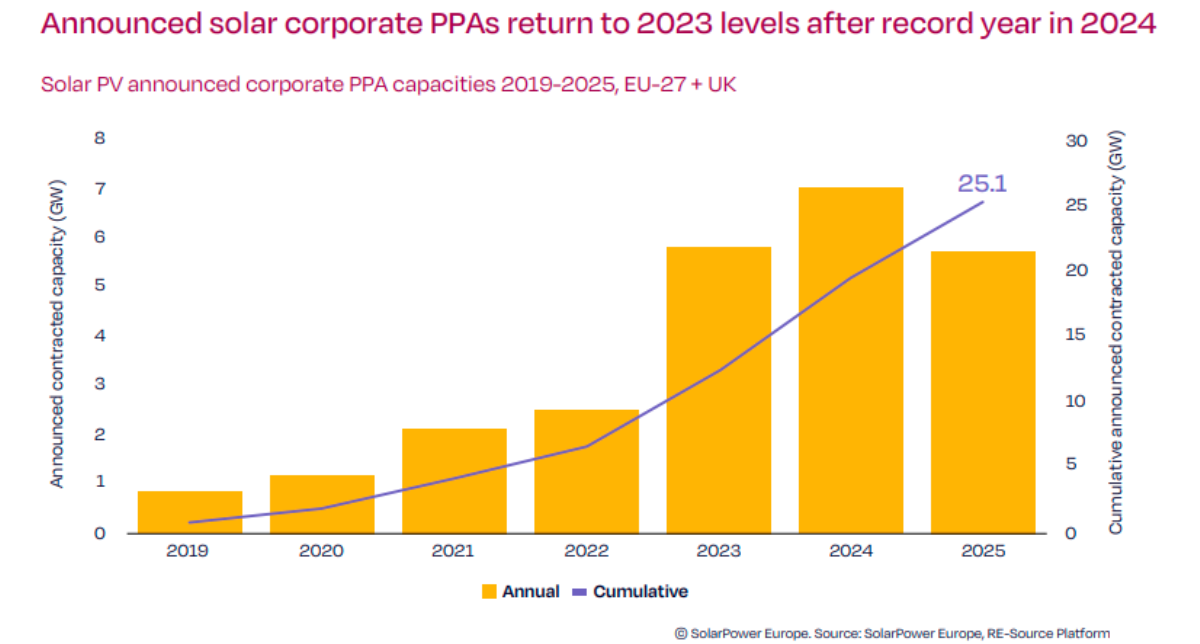
The European corporate renewable energy market experienced a moderate slowdown in solar power purchase agreements (PPAs) in 2025, marking the first decline in announced capacities after several years of rapid growth. Despite the dip, industry experts emphasize that the development reflects a return to 2023-level volumes rather than a structural decline in corporate demand for clean energy contracts.
Corporate PPAs remain a crucial mechanism enabling companies to secure long-term renewable electricity supplies, stabilize energy costs, and advance decarbonisation goals, SolarPower Europe said in its report.
Corporate Solar PPAs Reached Strong Levels in 2024
The year 2024 was a record period for corporate solar PPAs, with approximately 7 GW of solar projects secured under corporate offtake agreements across Europe. The strong demand highlighted the increasing role of businesses in driving renewable energy adoption while improving price predictability in volatile electricity markets.
At the same time, the corporate PPA landscape continued to diversify. In addition to standalone solar deals, hybrid renewable contracts combining solar and wind generation gained traction. In 2024, hybrid agreements accounted for around 1.9 GW of announced capacity, reflecting growing interest in diversified renewable portfolios that provide more stable energy generation profiles.
Market Slowdown Reflects Structural Challenges
The slight decline in announced corporate PPA capacities in 2025 is largely the result of varying trends across European markets rather than a uniform drop in demand. Several structural challenges are influencing corporate contracting activity.
One of the most significant issues is price cannibalisation, where large volumes of solar generation during peak production hours reduce wholesale electricity prices. This has led to lower solar capture prices, weakening project economics and reducing the attractiveness of new contracts.
Additionally, grid congestion and curtailment risks are becoming increasingly common in several European electricity markets. These constraints limit the ability of renewable projects to deliver electricity to the grid and can delay investment decisions.
Together, these factors have pushed PPA prices downward, in some cases reaching levels that threaten the financial viability of new solar projects. Industry analysts note that improving system flexibility, including energy storage and grid upgrades, will be essential to sustain long-term growth in corporate PPAs.


Germany and Northern Europe Experience Declines
Germany provides a clear example of the slowdown in corporate solar contracting. In 2025, solar PPA capacities signed in Germany declined by 56 percent, reflecting increasing market saturation and falling capture prices.
Similar patterns have emerged in Sweden, Denmark, and the Netherlands, where developers face growing challenges related to grid congestion, curtailment risks, and price cannibalisation.
In several European markets, stagnating electricity demand is also limiting PPA growth. The slow pace of industrial electrification means that additional renewable generation is not always matched by rising power consumption.
Countries with highly decarbonised electricity systems face particular constraints. In such markets, new corporate PPA demand increasingly depends on new electricity consumption from electrified industrial processes. France is a clear example, where corporate PPA volumes have remained relatively stable due to limited demand growth.
Spain Remains Europe’s Leading Corporate Solar PPA Market
Despite broader market challenges, Spain continues to lead Europe in corporate solar PPA activity. Between 2023 and 2025, the country consistently recorded more than 2 GW of corporate solar PPA agreements each year.
Spain’s resilience is driven by strong solar resource conditions and favorable seasonal production patterns. Solar generation during the winter months, when electricity prices are typically higher, allows corporate buyers to secure significant cost savings through long-term solar contracts.
These advantages continue to sustain strong demand from companies seeking to hedge electricity costs and reduce carbon emissions.
Italy Sees Rapid Growth in Corporate PPAs
Italy has emerged as another fast-growing corporate PPA market in Europe. Announced PPA capacities tripled between 2023 and 2024 and doubled again in 2025, reflecting rising corporate interest in renewable electricity contracts.
The momentum is expected to strengthen further following the launch of Italy’s Energy Release program, designed to provide low-cost renewable electricity contracts for energy-intensive industries.
Under the scheme, renewable power is offered to industrial consumers at predefined and stable prices, helping businesses manage energy costs and improve competitiveness. In return, participating companies commit to supporting the development of new renewable energy capacity through long-term contracts such as PPAs.
The program attracted overwhelming interest during its first call for participation, demonstrating strong demand for long-term renewable electricity solutions among industrial consumers.
Energy Storage and Auctions May Influence Future PPA Activity
Several additional factors could shape corporate PPA markets in the near future. In some countries, developers and buyers are adopting a wait-and-see approach ahead of upcoming renewable energy auctions, which may influence contracting strategies.
For example, the United Kingdom awarded more than 5 GW of solar PV capacity in early 2026, potentially affecting corporate procurement decisions in the region.
At the same time, the rapid decline in battery energy storage costs is transforming the renewable energy market. Energy storage can help mitigate price cannibalisation, reduce curtailment risks, and improve the value of solar power for corporate buyers.
As battery technology becomes more affordable and widely deployed, solar projects paired with storage could play a critical role in revitalising corporate PPA growth across Europe.
BABURAJAN KIZHAKEDATH