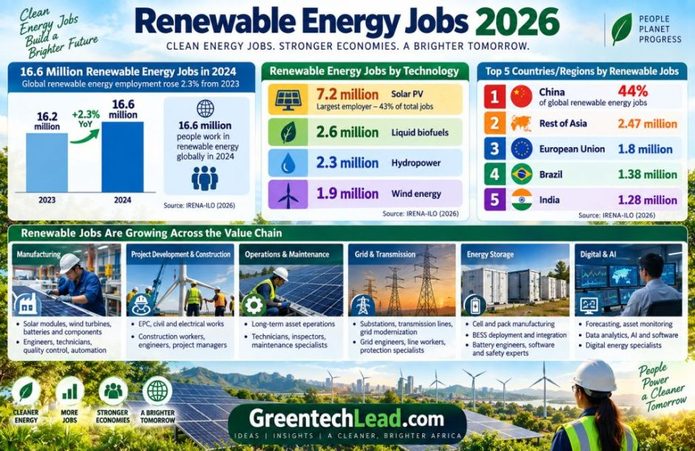
Renewable energy jobs in 2026 are expanding beyond traditional solar installation and wind-farm construction. The next employment wave is increasingly linked to solar and battery factories, energy storage, wind equipment, transmission networks, grid modernization, operations and maintenance, and digital energy systems.
The latest IRENA-ILO employment assessment, published in January 2026, estimates that renewable energy supported 16.6 million jobs globally in 2024, an increase of only 2.3 percent despite record renewable capacity additions. Automation, economies of scale, excess manufacturing capacity and productivity improvements are limiting the number of jobs created for each new gigawatt.
Solar PV remains by far the biggest employer with 7.2 million jobs, followed by liquid biofuels with 2.6 million, hydropower with 2.3 million and wind with 1.9 million.
The numbers suggest that the biggest employment opportunities through 2030 may emerge in countries that combine renewable deployment with manufacturing, batteries, grids and domestic supply chains.
Solar PV Leads with 7.2 Million Jobs
Solar remains the renewable industry’s largest employment engine, accounting for about 43 percent of all renewable-energy jobs worldwide.
The sector’s 7.2 million jobs span polysilicon, wafers, cells and modules as well as project development, engineering, procurement and construction (EPC), rooftop installation and O&M.
Asia dominates the solar workforce. Asian countries accounted for 75 percent of global PV employment, while China alone had 4.2 million solar jobs, representing about 58 percent of the global PV workforce.
China’s experience demonstrates why manufacturing matters. Countries importing most solar equipment primarily capture jobs in development, installation and O&M, while countries manufacturing equipment can create employment across a much wider value chain.
India is emerging as another major opportunity. Rapid solar deployment is being accompanied by investments in modules, cells, wafers and related equipment. These factories require process engineers, automation specialists, production technicians, quality-control teams and equipment-maintenance professionals in addition to construction workers.
China Has 44% of Global Renewable Jobs
Employment remains highly concentrated geographically.
China accounted for 44 percent of worldwide renewable-energy employment in 2024. Outside China, the rest of Asia supported 2.47 million jobs, followed by the European Union with 1.8 million, Brazil with 1.38 million and India with 1.28 million.
Together, the five largest employment markets accounted for more than 85 percent of global renewable jobs.
This concentration demonstrates that renewable capacity alone does not determine employment. Manufacturing, domestic supply chains, industrial policy, workforce availability and investment influence how much economic value countries retain from the energy transition.
The latest IRENA-ILO Renewable Energy and Jobs Annual Review therefore highlights the importance of combining renewable deployment with industrial and workforce-development policies.
Wind Supports 1.9 Million Jobs
Wind energy supported approximately 1.9 million jobs globally in 2024.
Employment spans turbine manufacturing, blades, towers, electrical systems, mechanical engineering, transportation, construction, installation, commissioning and long-term maintenance.
But the skills requirement is becoming more specialized as turbines become larger.
Offshore wind creates employment for marine engineers, subsea specialists, vessel crews, electrical engineers, heavy-lift operators and advanced inspection technicians. Onshore wind continues to need civil engineers, turbine technicians, electricians and grid specialists.
O&M is particularly important because wind farms require skilled workers throughout operating lives that can extend for decades.
Countries with established turbine manufacturing, large project pipelines and growing installed fleets therefore have an advantage in creating long-duration wind employment.
Battery Storage Becomes a New Jobs Engine
Battery energy storage is emerging as one of the most important new clean-energy employment markets.
A particularly useful 2026 benchmark comes from the United States. The latest U.S. Energy and Employment Report estimates 80,900 battery-storage workers in 2025, representing about 80 percent of total U.S. storage employment.
Battery-storage employment has increased 11 percent since 2022, adding approximately 8,000 workers. Total U.S. storage employment — including batteries, pumped hydro and other technologies—reached approximately 101,000 jobs in 2025.
These numbers illustrate how storage is becoming an employment category in its own right rather than merely an extension of solar or wind.
Battery factories need materials specialists, production engineers, automation technicians, quality-control staff and safety professionals. BESS projects also require power-electronics engineers, grid specialists, software developers, commissioning teams and long-term maintenance workers.
India could become another major storage employment market as companies build battery and BESS manufacturing capacity alongside rapidly expanding renewable generation.
Australia Links 7.8 GW Pipeline to 20,500 Jobs
Australia provides one of the clearest 2026 examples of renewable investment translating directly into employment.
In May 2026, the government selected 19 renewable projects representing 7.8 GW of generation under its Capacity Investment Scheme. Eight are hybrid projects incorporating more than 2 GW / 7.9 GWh of battery storage.
The projects are expected to support more than 19,000 jobs during construction and more than 1,500 O&M jobs over their operating lives.
The distinction is important.
Construction can create large employment peaks, but O&M, manufacturing, engineering and grid operations provide longer-duration jobs. Renewable employment statistics should therefore distinguish temporary construction employment from permanent or long-term positions.
Factories Could Determine Where Jobs Are Created
Renewable manufacturing is becoming one of the most important employment battlegrounds.
Solar factories require process engineers, automation specialists, production workers, quality-control teams and equipment technicians. Wind factories need workers in composites, blades, generators, towers, electrical systems and turbine assembly.
Battery plants create another layer of employment spanning cell chemistry, battery packs, battery-management systems, power electronics, thermal management and industrial automation.
This creates an important economic divide.
A country importing solar modules, batteries and wind turbines captures construction and O&M employment. A country manufacturing the equipment can capture jobs from raw materials and components through production, deployment and servicing.
China’s 4.2 million solar jobs provide perhaps the strongest evidence of the employment impact of combining manufacturing with massive domestic deployment.
Grid Expansion Opens Another Employment Market
Renewable employment is also becoming a transmission and grid story.
Gigawatts of additional solar, wind and storage cannot operate effectively without transmission lines, substations, transformers, grid-control systems and interconnections.
That creates demand for electrical engineers, transmission planners, substation specialists, protection engineers, line workers and transformer technicians.
Digitalization is expanding the opportunity further.
AI and data analytics are increasingly relevant for generation forecasting, predictive maintenance, battery optimization and renewable asset monitoring. Future renewable workforces will therefore combine conventional electrical and mechanical engineering with software, automation and data expertise.
Renewable Job Growth Is Slowing Despite Capacity Boom
One of the most important findings for 2026 is that renewable employment is no longer rising at the same pace as installations.
Global renewable employment increased from 16.2 million to 16.6 million, or only 2.3 percent, even as capacity additions reached record levels.
IRENA and ILO point to automation, technological innovation, economies of scale, manufacturing overcapacity and grid bottlenecks among the reasons for slower employment growth.
That means measuring the energy transition purely in gigawatts can give an incomplete picture of its labor impact.
The next major opportunity is likely to come from capturing more of the value chain—factories, batteries, grids, engineering, digital platforms and O&M.
Renewable Energy Jobs Outlook to 2030
Solar will probably remain renewable energy’s largest employer because of its enormous deployment and manufacturing scale. Wind should continue creating specialized engineering, manufacturing and O&M positions, while battery storage could become one of the fastest-growing employment categories.
The skills requirement is also changing.
Employers increasingly need specialists in power electronics, battery systems, transmission, industrial automation, AI, forecasting and data analytics alongside traditional electrical and mechanical engineers.
For workers, hybrid expertise could become particularly valuable: an electrical engineer who understands batteries, a wind technician trained in predictive analytics, or a software professional familiar with grid operations.
For governments, the message is equally important. Simply installing renewable capacity will not maximize employment.
The countries capturing the next wave of renewable-energy jobs are likely to be those that build complete ecosystems connecting manufacturing, solar and wind projects, battery storage, transmission infrastructure, digital technology and long-term operations.
The clean-energy employment story of 2026 is therefore no longer just about building more solar farms and wind turbines. It is about building the factories, batteries, grids and technical workforce needed to operate an increasingly electrified global economy.
SHAFANA FAZAL