
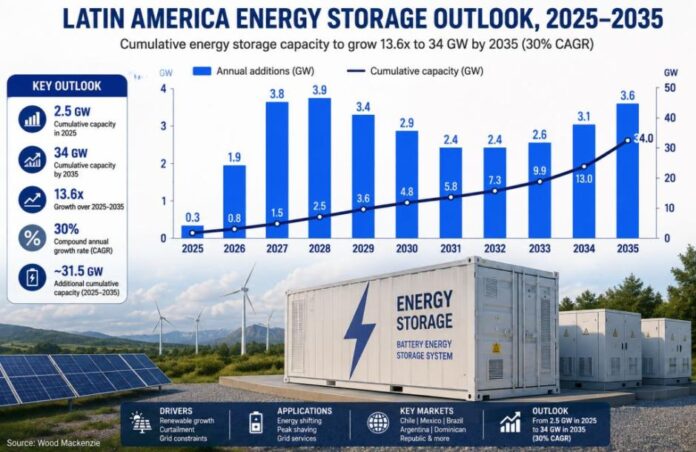
Latin America’s battery energy storage market is entering a major investment cycle as renewable-energy growth, curtailment and transmission constraints increase demand for grid flexibility. Wood Mackenzie forecasts cumulative energy storage capacity will surge from 2.5 GW in 2025 to 34 GW by 2035, representing 13.6-fold growth, a 30 percent CAGR and approximately 31.5 GW of additional capacity.
The latest outlook marks a significant upgrade from Wood Mackenzie’s September 2025 forecast of approximately 23 GW by 2034, when it projected an 8 percent CAGR. Faster storage tenders, renewable curtailment and ageing or insufficient transmission infrastructure are strengthening the investment case for battery energy storage systems (BESS).
According to Wood Mackenzie’s Latin America energy storage market outlook, the region is transitioning from a frontier storage market into an active one. The expansion will create opportunities beyond batteries, including power conversion systems, inverters, transformers, substations, energy-management software, grid connections and long-term operations and maintenance.
Renewable Investment Reaches US$70 Billion
Energy storage growth is closely connected with the expansion of renewable power across Latin America and the Caribbean. The IEA outlook for clean energy investment in Latin America estimates that clean-energy investment in the region reached approximately US$70 billion in 2025, an increase of nearly 25 percent compared with 2015.
Chile, Colombia and Costa Rica recorded particularly strong increases, while Brazil remains one of the region’s major clean-energy investment markets.
Higher penetration of variable solar and wind generation increases the requirement for energy shifting and grid balancing. BESS can capture electricity that would otherwise be curtailed and discharge it during periods of higher demand or electricity prices.
This is particularly relevant in transmission-constrained markets such as Chile, where renewable generation has expanded rapidly.
Chile Leads Latin America’s BESS Investment
Chile remains Latin America’s leading storage market, supported by extensive solar development and increasing renewable-energy curtailment.
However, the country is also demonstrating a risk that other markets could eventually encounter. Wood Mackenzie identifies price cannibalisation in northern Chile as an emerging challenge as additional battery capacity competes for the same arbitrage opportunities.
Future BESS returns will therefore increasingly depend on diversified revenues rather than electricity-price arbitrage alone.
AES Andes Invests More Than US$1.3 Billion
AES Andes has invested more than US$1.3 billion in the AES Andes solar and battery storage hub in Chile, which has reached 692 MW of photovoltaic capacity and 510 MW of battery storage.
The latest addition, Andes Solar III, combines 171 MW of solar PV with a 171 MW BESS offering three hours of storage.
AES Andes estimates that renewable generation from the hub is equivalent to the electricity consumption of nearly 800,000 households.
The company also has more than 2,000 MW of projects scheduled to start commercial operations during 2026 and 2027. Its Chilean portfolio includes 622 MW of battery storage, while its construction pipeline contains 2,021 MW of renewable capacity.
The investment demonstrates how storage is increasingly being developed as part of integrated renewable-energy platforms rather than as a standalone technology.
Grenergy Targets 22 GWh Across Oasis Platforms
Grenergy is scaling its Chilean storage portfolio under a €3.7 billion renewable energy investment plan running through 2028.
Its Oasis Atacama platform is expected to reach 2.5 GW of solar capacity and 14.1 GWh of battery storage, while Central Oasis is planned to reach 1.4 GW of solar and 5.1 GWh of storage.
Combined, Grenergy’s Oasis platforms are planned to deliver 5 GW of solar generation and 22 GWh of battery storage.
In March 2026, Grenergy also indicated an estimated US$900 million investment in Central Oasis, which at that stage was planned with 1.1 GW of solar and 4 GWh of storage.
The scale of these projects illustrates the shift toward longer-duration BESS capable of moving large volumes of daytime solar generation into evening demand periods.
Mexico Builds More Than 3 GW Storage Pipeline
Mexico is emerging as another major BESS opportunity. Wood Mackenzie expects procurement mechanisms requiring storage to award more than 3 GW by 2030.
One of the largest projects is Copenhagen Infrastructure Partners’ La Esperanza Solar development, combining 420 MWdc of solar PV with a 150 MW/750 MWh BESS.
The battery will provide five hours of storage, demonstrating the move toward longer-duration configurations capable of shifting substantial solar output into higher-value periods.
The project has reached final investment decision and financial close, providing an important indication that institutional infrastructure capital is moving into Mexico’s solar-plus-storage market.
Argentina Awards 1.3 GW of Standalone BESS
Argentina is developing a significant standalone storage segment, with approximately 1.3 GW of BESS awards expected to begin operations from 2027.
The development is significant because these batteries are being deployed as dedicated electricity infrastructure rather than simply being attached to renewable-generation assets.
Standalone BESS can support peak demand, reliability, transmission networks and grid balancing while creating opportunities for independent power producers, infrastructure funds and specialist storage developers.
Brazil Storage Auctions Could Attract US$4 Billion
Brazil could become one of Latin America’s largest future storage markets. Its first dedicated battery-storage auction is scheduled for December 2026, with new capacity expected to enter service from 2028.
Demand associated with the procurement has been estimated at at least 2 GW, with investors including Brookfield and Brasol preparing projects, permits and technical studies.
The potential market could be considerably larger. S&P Global reported that Brazilian storage auctions could attract approximately US$3 billion to US$4 billion of investment and add 4 GW to 5 GW by 2028.
The principal challenge is bankability. Uncertainty surrounding the allocation of auction costs among electricity-market participants could affect financing and project timing.
CATL Claims 45 Percent of Brazil Storage Market
CATL is strengthening its position ahead of Brazil’s storage procurement cycle through a battery energy storage partnership with Moura in Brazil.
In August 2026, CATL said it already held a 45 percent share of Brazil’s energy-storage market. The partnership combines CATL’s storage technology with Moura’s domestic manufacturing capabilities.
UCB Power and Jinko EES have also signed an agreement focused on localising energy-storage systems in Brazil.
These partnerships indicate that Brazil’s BESS expansion could create opportunities beyond project development, including battery-pack production, inverters, software, system integration and other components.
Dominican Republic Targets 500 MW by 2030
The Dominican Republic has established a target of 500 MW of energy storage by 2030, supported by a requirement equivalent to 50 percent storage-to-solar capacity.
The policy directly links additional solar development with storage rather than relying entirely on merchant battery economics.
Project activity is already emerging. In 2026, the country’s electricity regulator approved a modification allowing a 31.68 MW BESS to be incorporated into the Santana Solar project.
Long-Duration Storage Gains Momentum
The emerging Latin American market is increasingly about both MW and MWh.
Grenergy’s 14.1 GWh Oasis Atacama development and CIP’s 150 MW/750 MWh five-hour La Esperanza battery demonstrate the increasing importance of storage duration.
Longer-duration systems can capture more curtailed renewable electricity and shift solar generation from midday into evening periods, improving renewable asset utilisation and potentially creating additional revenue opportunities.
The shift also changes investment analysis. BESS projects increasingly need to be assessed using power capacity, energy capacity, duration, cycling requirements, degradation and revenue stacking rather than installed MW alone.
Multiple Revenue Streams Will Determine BESS Returns
As storage penetration rises, dependence on electricity-price arbitrage could become increasingly risky. Northern Chile’s emerging price-cannibalisation issue provides an early indication of what can happen when multiple batteries compete to charge and discharge during similar periods.
Successful BESS projects will increasingly need multiple revenue sources, potentially including energy arbitrage, capacity payments, frequency regulation, ancillary services, congestion management and renewable-curtailment reduction.
Contracted revenues will also be important for attracting lower-cost infrastructure capital.
This makes market design particularly important. Wood Mackenzie warns that deployment could stall without comprehensive regulatory frameworks and clear remuneration mechanisms.
34 GW Storage Boom Creates Wider Infrastructure Opportunity
Growth from 2.5 GW in 2025 to 34 GW in 2035 will create opportunities across the electricity infrastructure value chain.
Battery manufacturers and system integrators will benefit directly, while deployment will also require power-conversion systems, transformers, substations, grid connections and energy-management platforms.
Digital systems will become increasingly important for electricity-price forecasting, battery dispatch, degradation management and market trading.
Operations and maintenance, asset management, insurance, financing, recycling and lifecycle management will represent additional opportunities as the installed base expands.
Latin America’s strategic position in lithium and copper could also support the wider battery and electricity infrastructure supply chain, particularly in Chile and Argentina.
Regulation and Grid Access Remain Key Risks
The 34 GW forecast represents market potential rather than guaranteed deployment.
Investors need to distinguish between announced, awarded, financed, under-construction and operational capacity when evaluating Latin America’s storage pipeline.
Projects must still secure grid connections, permits, financing and predictable revenue structures. Regulatory uncertainty, financing costs and merchant-price exposure could delay investment even where the technical requirement for storage is strong.
Storage also cannot eliminate the requirement for transmission investment. Batteries can reduce congestion and provide flexibility, but continued renewable expansion will require simultaneous investment in generation, storage and electricity networks.
Latin America BESS Outlook: 31.5 GW Opportunity Through 2035
The most important figure for investors and suppliers is the approximately 31.5 GW of cumulative storage capacity expected to be added between 2025 and 2035.
Chile is leading through large-scale projects such as AES Andes’ 692 MW solar/510 MW storage Andes Solar Hub and Grenergy’s Oasis platforms, planned to reach 5 GW of solar and 22 GWh of storage.
Mexico could award more than 3 GW by 2030, Argentina has approximately 1.3 GW of standalone storage awards, Brazil’s auctions could support 4 GW to 5 GW by 2028, and the Dominican Republic is targeting 500 MW by 2030.
These markets will not develop at the same speed. Regulatory frameworks, grid conditions, project economics and revenue certainty will determine where capital moves first.
But the regional investment direction is increasingly clear. With clean-energy investment reaching approximately US$70 billion in 2025 and cumulative energy storage capacity forecast to increase 13.6-fold from 2.5 GW in 2025 to 34 GW by 2035, BESS is becoming a core component of Latin America’s renewable-energy and grid-modernisation investment cycle.
SHAFANA FAZAL
