
Europe’s power purchase agreement (PPA) market is entering a new investment phase as companies increasingly use long-term renewable electricity contracts to protect themselves against volatile power prices rather than viewing them primarily as sustainability tools.
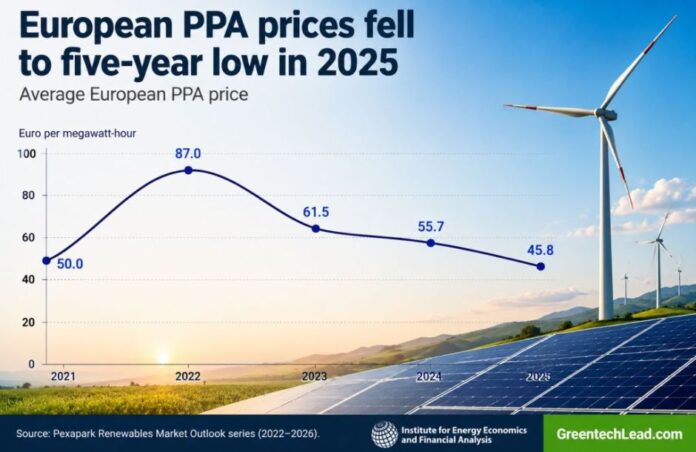
The shift is becoming significant as wholesale electricity prices can reach €120-150/MWh during periods of market stress in major markets such as Germany and Italy, compared with European PPA prices of approximately €60-85/MWh.
The IEEFA analysis of European power supply deals as protection against high electricity prices indicates that companies are increasingly treating renewable contracts as instruments for energy security, cost visibility and protection against future price shocks.
For renewable developers, PPAs provide revenue visibility that can improve project bankability. The result is a growing investment opportunity connecting corporate electricity demand with renewable generation, battery storage and electricity networks, IEEFA’s Jonathan Bruegel said.
PPA Price Gap Strengthens Corporate Investment Case
The economics explain why PPAs are attracting greater attention from manufacturers, data centres, retailers and other large electricity consumers.
For a company consuming 1 TWh of electricity annually, a hypothetical contracted electricity price of €60/MWh represents €60 million of annual energy expenditure, while €85/MWh represents €85 million.
At a wholesale electricity price of €120/MWh, the equivalent energy cost would reach €120 million, rising to €150 million at €150/MWh. The theoretical difference between a PPA price of €85/MWh and a wholesale price of €150/MWh is therefore €65 million for every 1 TWh.
This does not translate directly into guaranteed savings because electricity bills also contain network charges, taxes, balancing costs and supplier margins. However, it demonstrates why companies increasingly value predictable electricity prices.
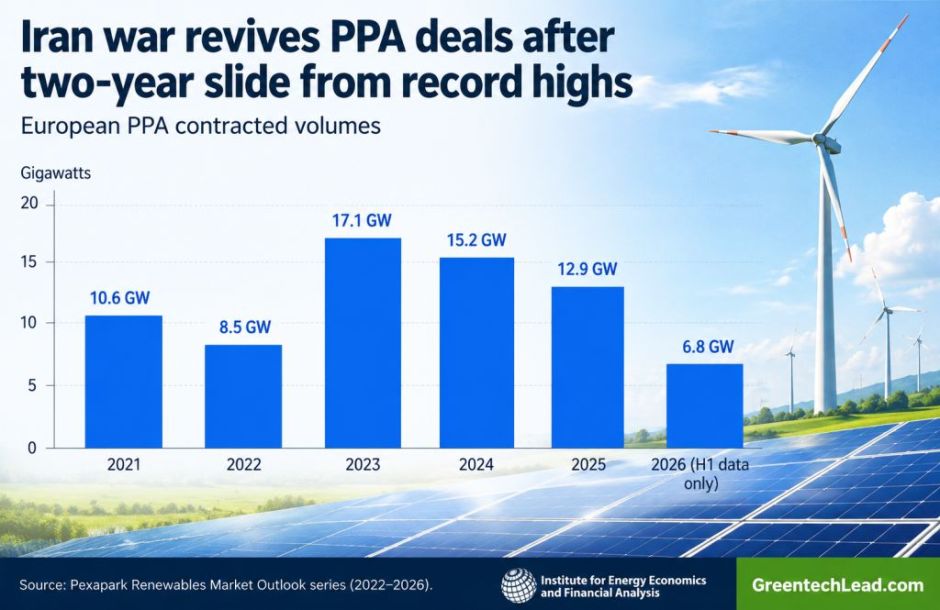
European PPA contracting reached a peak of 17.1 GW in 2023, but the market is now moving toward shorter and more flexible structures. Agreements of 5-10 years are becoming increasingly common, with corporate preferences frequently concentrated around 5-7 years.
Some emerging contracts use price floors of approximately €50-55/MWh and ceilings of €90-100/MWh, distributing electricity-market risk between renewable developers and corporate buyers.
Developers are also leaving around 30-40 percent of project output exposed to spot electricity markets in some cases, providing potential upside from higher prices while increasing merchant-market risk.
Germany, Italy, Spain and UK Show Wide PPA Price Differences
European PPA economics vary considerably between individual electricity markets.
LevelTen Energy’s European PPA market and pricing platform provides an indication of these differences. Its Q4 2025 solar PPA P25 benchmark was €49.77/MWh in Germany, €60.67/MWh in Italy, €32.50/MWh in Spain and €87.36/MWh in the UK. The European solar P25 index stood at €57.44/MWh.
Germany’s €49.77/MWh benchmark fell 4.3 percent quarter on quarter and 21.3 percent year on year as expanding solar generation increased cannibalisation and exposure to low or negative electricity prices.
Despite these challenges, Germany continues to attract major renewable investment. Amazon signed a 600 MW PPA with Skyborn Renewables for the Gennaker offshore wind project in the Baltic Sea, covering approximately 61 percent of its potential 976.5 MW capacity.
Italy recorded a solar PPA P25 price of €60.67/MWh, down 3.7 percent quarter on quarter. A2A and Ramacca Energia, part of a portfolio managed by Sosteneo, signed a 12-year PPA covering approximately 130 GWh of solar electricity annually from a 68 MW photovoltaic plant in Sicily.
Expected to begin operations in the second half of 2027, the project will generate electricity equivalent to annual consumption by approximately 48,000 households and is expected to avoid nearly 60,000 tonnes of CO2 emissions annually.
Spain presents a different challenge. Its solar PPA P25 benchmark dropped to €32.50/MWh, declining 3 percent quarter on quarter and 16.6 percent year on year, while the most competitive offers fell below €30/MWh.
Rapid solar deployment is pushing down midday electricity prices, increasing the importance of storage and flexible offtake agreements.
Hikma Pharmaceuticals’ 10-year virtual PPA with Q ENERGY supports a 34.6 MWp solar park in Castilla-La Mancha. The project is expected to generate approximately 40,000 MWh annually from 2027 for Hikma operations across Portugal, Spain, Italy and Germany.
The UK recorded a substantially higher solar PPA P25 benchmark of €87.36/MWh, up 1.7 percent quarter on quarter.
Good Energy signed a two-year PPA with Ørsted for 200 GWh of renewable electricity annually from the Walney 1 and Walney 2 offshore wind farms. The 400 GWh contracted over two years represents annual electricity consumption equivalent to more than 74,000 UK homes.
European Battery Capacity Forecast to Reach 582 GWh by 2030
Battery storage is becoming increasingly important to the economics of corporate renewable procurement because it can shift electricity from low-price periods to higher-value hours.
Europe installed 36 GWh of new battery energy storage capacity in 2025, representing 48 percent annual growth and taking its operational battery fleet above 100 GWh.
The EU-27 accounted for 27 GWh, or 75 percent, of Europe’s 2025 additions, taking cumulative EU battery capacity to almost 80 GWh.
The SolarPower Europe European Battery Market Outlook 2026-2030 expects annual European installations to exceed 50 GWh in 2026, representing approximately 44 percent growth from 2025, before reaching 138 GWh in 2030.
Cumulative European battery capacity could reach 582 GWh by 2030, including 470 GWh in the EU-27.
Utility-scale storage is expected to become the dominant segment, reaching approximately 392 GWh by 2030 and representing 67 percent of Europe’s projected battery fleet.
Europe’s solar PV-to-battery ratio was approximately 8:1 at the end of 2025, improving from 10:1 a year earlier but still demonstrating the need for significantly more storage as renewable generation expands.
Battery Offtake and Flexible Power Deals Accelerate
The increasing combination of renewable generation and storage is already changing the structure of European electricity contracts.
Pexapark reported that its Euro Composite PPA price increased 2.3 percent to €45/MWh in July 2026. Publicly announced activity included 24 PPAs representing 1.1 GW, alongside nine battery-storage agreements representing 865 MW.
Great Britain recorded a 5.8 percent monthly increase in PPA prices, while Italy posted a 4.3 percent increase.
Almost 6 GW of disclosed battery offtake volumes were reported during the first half of 2026, while flexibility purchase agreements increased by more than 180 percent.
Data centres and other technology companies represented more than 40 percent of disclosed PPA volume, compared with 30 percent a year earlier.
This trend could become increasingly important as artificial intelligence and data-centre expansion creates large, continuous electricity requirements. Such buyers are likely to place greater value on renewable electricity that can be shaped around their consumption profile rather than simply matched on an annual basis.
Europe Needs €477 Billion Transmission Investment
Corporate PPAs and renewable investment also depend heavily on electricity-network expansion.
IEEFA estimates that the EU transmission network will require approximately €477 billion of investment by 2040 as Europe connects more renewable generation and addresses congestion, curtailment and grid connection constraints.
Italy illustrates the scale of the investment requirement. Terna plans €16.6 billion of capital expenditure during 2024-2028 to modernise its transmission network and reduce congestion.
Transmission charges could remain close to 4 percent of customer electricity costs through 2028. Terna has also issued €1.6 billion of debt under the European Green Bond Standard.
The investment opportunity therefore extends beyond solar and wind projects to transmission, distribution, batteries, interconnectors, grid software, energy trading and electricity-market optimisation.
Shorter PPAs Create Financing Challenge
The move toward shorter contracts creates another challenge for renewable developers.
Corporate buyers may favour PPAs lasting 5-7 years, while project-finance lenders can require revenue visibility covering 10-15 years of debt.
A renewable project backed by a seven-year corporate PPA could therefore need to secure another contract, refinance the asset or accept greater merchant electricity-market exposure after the original agreement expires.
Government-backed Contracts for Difference provide another financing option, meaning developers increasingly need to evaluate the relative economics of corporate PPAs, CfDs and merchant-market exposure.
Energy security remains another major factor. EU gas storage was only 27.6 percent full at the beginning of April 2026, compared with 58.5 percent at the same point in 2024.
Because gas-fired generation continues to influence marginal electricity prices in parts of Europe, renewed gas-market disruption could again translate into higher electricity prices, strengthening the hedging value of renewable PPAs.
PPAs Become Bridge Between Corporate Power Demand and Energy Investment
Europe’s PPA market is evolving from a mechanism for purchasing green electricity into a broader financial and infrastructure tool for managing electricity costs.
European PPA prices of approximately €60-85/MWh compared with stress-period wholesale prices of €120-150/MWh illustrate the potential value of long-term price protection. At the same time, country benchmarks ranging from Spain’s €32.50/MWh to the UK’s €87.36/MWh demonstrate that renewable-power economics vary dramatically between markets.
Storage will become increasingly important as solar and wind penetration rises. Europe’s battery fleet is projected to reach 582 GWh by 2030, including 470 GWh in the EU-27, while utility-scale storage could account for 392 GWh.
Combined with an estimated €477 billion requirement for EU transmission investment through 2040, these figures indicate that corporate PPAs are becoming part of a much larger European investment cycle spanning renewable generation, battery storage, grids, electricity trading and power-market flexibility.
For investors and energy companies, the next opportunity is therefore not simply producing more renewable electricity. It is developing the infrastructure and commercial structures capable of delivering renewable power when companies need it — and at prices they can predict.
SHAFANA FAZAL
