
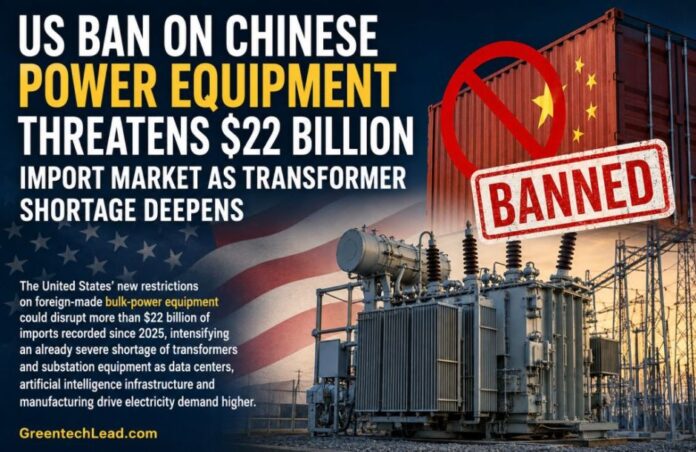
The United States’ new restrictions on foreign-made bulk-power equipment could disrupt more than $22 billion of imports recorded since 2025, intensifying an already severe shortage of transformers and substation equipment as data centers, artificial intelligence infrastructure and manufacturing drive electricity demand higher.
The Wood Mackenzie analysis of the US transformer shortage estimates that Executive Order 14420 could potentially affect suppliers from 24 countries, although China represents almost all bulk-power equipment imports covered by its analysis since the beginning of 2025. The biggest exposure could emerge in large power transformers used by data centers and other major electricity consumers.
The restrictions arrive when the U.S. power equipment supply chain has little spare capacity. Wood Mackenzie estimates a 15 percent shortage of power transformers and an 8 percent shortage of substations in 2026. Limiting access to Chinese equipment could widen those deficits and increase procurement costs and project delays.
100 MVA Transformers Face the Greatest Supply Pressure
The 100 MVA and above power transformer segment could experience the strongest impact because shortages are already particularly acute in this capacity range. Data center developers have increasingly considered Chinese manufacturers as an option for reducing equipment lead times, according to Wood Mackenzie.
The broader U.S. market for power transformers rated above 10 MVA has expanded nearly 300 percent since 2020, while demand for large units has accelerated sharply since 2023.
Earlier Wood Mackenzie data illustrates the scale of the demand surge. U.S. demand for generator step-up transformers increased 274 percent between 2019 and 2025, while demand for substation transformers rose 116 percent. Transformer prices increased about 80 percent over five years, while delivery times for some high-capacity equipment have stretched to as much as four years.
The combination of rapidly expanding demand and import restrictions means transformer availability could become an increasingly important constraint on U.S. data center, utility and power-generation investment.
Data Center Growth Adds Pressure to Transformer Supply
AI data centers are particularly exposed because their enormous electricity requirements require substations, transformers, backup generation, uninterruptible power supplies and other grid equipment.
Wood Mackenzie principal analyst Ben Boucher said utilities have largely avoided Chinese suppliers since the earlier bulk-power restrictions, meaning the latest measures could have a greater impact on data centers that turned to Chinese equipment to shorten procurement schedules.
The U.S. Department of Energy says electricity demand is now rising at close to 3 percent annually since 2023, following almost 20 years of relatively flat demand. Data centers, reshored manufacturing and other large loads are contributing to that expansion, while lead times for some critical grid equipment have reached two years or more.
DOE’s 2026 National Transmission Needs Study also identifies data centers, expanding domestic manufacturing and other large industrial loads as important drivers behind the need for additional U.S. transmission infrastructure.
Transformer Demand Has Jumped 41 Percent Since 2019
The supply problem extends beyond the large transformers highlighted by Wood Mackenzie.
The US Department of Energy transformer supply-chain analysis shows how rising electricity demand and supply constraints are affecting critical grid equipment. DOE says U.S. demand for distribution transformers has increased 41 percent since 2019. Procurement lead times that were only three to six months in 2019 had expanded to around one to two years or longer by 2024.
Large transformers serving substations and generators face an even more difficult supply environment, with lead times ranging from approximately three to four years. DOE attributes the shortage to rising electricity consumption, aging grid infrastructure, workforce constraints and shortages of critical raw materials.
The problem is also complicated by extensive customization. DOE has identified more than 80,000 different distribution-transformer varieties across the United States, making standardization and manufacturing efficiency more difficult.
Executive Order Covers Transformers, BESS, Inverters and UPS
The White House Executive Order 14420 on bulk-power equipment, signed on August 26, 2026, is broader than a straightforward transformer import ban.
The order declares foreign supply of certain bulk-power equipment a national-security risk and allows the U.S. government to prohibit acquisitions, imports, transfers or installations when equipment associated with a covered foreign entity is determined to pose unacceptable security or supply-chain risks.
Equipment potentially covered includes substation transformers, grid-connected inverters, battery energy storage systems, uninterruptible power supply systems, generators, voltage regulators, circuit breakers, protective relays, metering equipment, turbines and industrial control systems. Software, firmware, digital services, maintenance services and remote-access capabilities can also be considered when assessing security risks.
This creates potential implications beyond utilities. Data center developers, renewable-energy companies, battery storage developers, power producers and large industrial facilities could all need to review equipment sourcing strategies.
DOE Has 120 Days to Develop Implementation Rules
One of the biggest uncertainties is how broadly the restrictions will ultimately be applied.
The Energy Secretary has 120 days from the August 26 order to publish implementing rules or regulations as needed. The government can identify countries, companies and equipment requiring additional scrutiny while also establishing licensing procedures and potentially creating a list of pre-qualified equipment and vendors.
That implementation process will be particularly important for data centers. Wood Mackenzie says uncertainty remains over how the definition of the bulk-power system will apply to data center loads.
The eventual interpretation could determine whether the measure primarily affects utility-scale transmission infrastructure or reaches more deeply into electrical systems supporting hyperscale and AI data centers.
US Transformer Manufacturing Faces Capacity Challenge
Washington is simultaneously attempting to strengthen domestic transformer manufacturing.
DOE said in June that U.S. industry faces limited domestic production capacity, extended procurement timelines and dependence on foreign supply chains for distribution transformers and electrical core steel. The department is reviewing how transformer efficiency requirements scheduled to take effect in 2029 could affect domestic manufacturing, investment requirements and supply availability.
Domestic manufacturing expansion will therefore become increasingly important if Chinese and other foreign equipment becomes harder to source.
The market is already responding. U.S. transformer manufacturers and international suppliers have been expanding factories and reserving future manufacturing capacity, while developers are increasingly securing production slots years ahead of project completion. Some buyers have also turned to suppliers in countries such as South Korea and Türkiye to diversify procurement.
Transformer Shortage Could Become AI Infrastructure Bottleneck
Executive Order 14420 creates a difficult trade-off for the U.S. power sector. Washington is seeking to reduce cybersecurity and supply-chain risks associated with foreign equipment at the same time that AI data centers, manufacturing and grid investment are generating exceptional demand for transformers and substations.
Wood Mackenzie’s figures demonstrate the scale of the challenge: more than $22 billion of imports since 2025 could potentially be exposed, power transformers already face a 15 percent shortage, substations an 8 percent shortage, and the market for transformers above 10 MVA has expanded nearly 300 percent since 2020.
With distribution-transformer demand already 41 percent above 2019 levels and some large transformer lead times reaching three to four years, removing or restricting an important source of imported equipment could push developers toward higher prices, earlier procurement and alternative suppliers.
The next 120 days will therefore be critical. DOE’s implementation rules should provide greater clarity on which countries, manufacturers and equipment categories face restrictions — and whether rapidly expanding U.S. AI data centers become one of the sectors most exposed to the new power-equipment sourcing regime.
BABURAJAN KIZHAKEDATH
