
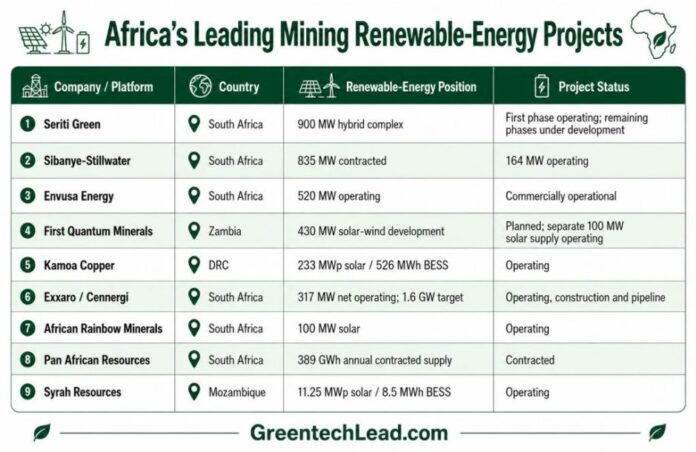
Africa’s mining companies are emerging as major renewable-energy buyers as rising electricity tariffs, unreliable grids and pressure to reduce mineral-production emissions reshape corporate power strategies.
A Reuters report on South African mining renewable-energy investment shows Envusa Energy operates a 520 MW solar-and-wind portfolio for Anglo American-linked mines, Sibanye-Stillwater has contracted 835 MW, Exxaro’s Cennergi is targeting 1.6 GW by 2030 and Seriti Green is developing a 900 MW hybrid complex.
The most significant advance has come from Kamoa Copper in the Democratic Republic of Congo. Its 233 MWp solar plant and 526 MWh battery system reached commercial operation in August 2026, demonstrating that large batteries can convert African solar generation into continuous power for energy-intensive mining.
These figures represent different categories. Contracted capacity should not be treated as operating capacity, while a long-term target carries less certainty than a financed or commissioned project.
Envusa Energy Operates 520 MW Koruson 2 Portfolio
Envusa Energy, the joint venture established by Anglo American and EDF power solutions, has completed Envusa Energy’s 520 MW Koruson 2 project in South Africa.
The portfolio comprises:
240 MW Mooi Plaats Solar PV project in the Northern Cape.
140 MW Umsobomvu Wind Farm in the Eastern Cape.
140 MW Hartebeesthoek Wind Farm in the Eastern Cape.
Mooi Plaats reached commercial operation in March 2026, followed by Umsobomvu in April and Hartebeesthoek in August. The portfolio supplies renewable electricity to operations associated with Kumba Iron Ore, De Beers and Valterra Platinum.
The three projects are connected through the privately developed Koruson 400 kV Main Transmission Substation. The combined portfolio is expected to avoid approximately 2.2 million tonnes of carbon dioxide emissions annually.
Koruson 2 involved approximately R15 billion–R16 billion of investment. That implies capital expenditure of roughly R29 million–R31 million per MW, although the total includes transmission and supporting infrastructure rather than generation equipment alone.
Envusa currently has a project pipeline of approximately 1.5 GW and is targeting 3 GW of generation by 2030. The wider platform was originally established with an ambition to develop between 3 GW and 5 GW.
Sibanye-Stillwater Contracts 835 MW of Renewable Power
Sibanye-Stillwater has contracted 835 MW of renewable capacity, making it one of South Africa’s largest private renewable-energy offtakers.
Approximately 164 MW was operating by August 2026, equivalent to 20 percent of the contracted portfolio. The remaining projects are expected to enter operation through 2028.
Renewables could supply approximately 64 percent of Sibanye-Stillwater’s South African energy demand by the end of 2028. The portfolio is expected to avoid around 2.63 million tonnes of CO2e annually, representing a 41 percent reduction against the company’s 2024 emissions.
The financial case is equally important. Sibanye expects contracted renewable electricity to cost 20 percent to 30 percent less than forecast Eskom wholesale tariffs, generating annual savings of more than R1 billion from 2028.
Eskom will remain part of Sibanye’s power mix because variable wind and solar projects cannot independently provide all the continuous electricity required by mining operations.
Exxaro’s 68 MW Solar Plant Could Save R100 Million Annually
Exxaro’s 68 MW Lephalale Solar Project reached commercial operation on April 20, 2026, following an investment of R1.7 billion.
The behind-the-meter project supplies the Grootegeluk coal mine in Limpopo and includes 129,024 solar modules installed across 185 hectares.
It is expected to generate approximately 176 GWh annually under a 25-year PPA. Based on its 68 MW capacity, this represents an estimated capacity factor of approximately 29.5 percent.
Exxaro expects the project to reduce annual electricity expenditure by more than R100 million; lower Grootegeluk’s Scope 2 emissions by approximately 17 percent and reduce the mine’s dependence on Eskom electricity. The expected annual saving is equivalent to approximately 5.9 percent of the project’s original investment.
Cennergi Targets 1.6 GW by 2030
Exxaro is expanding its renewable-energy business through wholly owned subsidiary Cennergi.
Its acquisition of majority interests in the operating 138 MW Gouda Wind Farm and 75 MW Sishen Solar Facility is expected to increase Cennergi’s net operating capacity from approximately 200 MW to 317 MW. The associated transaction value ranges from R1.7 billion to R1.8 billion.
The 140 MW Karreebosch Wind Farm has reached financial close and will supply Northam Platinum under a 20-year PPA. Cennergi’s net share of Karreebosch is approximately 112 MW.
The company has been selected as bidder for the 240 MW Corona Solar Project. Reaching financial close would increase Cennergi’s portfolio of operating and construction assets to approximately 607 MW net, or 890 MW gross.
Exxaro is targeting 1.6 GW of managed net renewable capacity by 2030. The target represents a new energy business rather than only an emissions-reduction programme for its mines.
Kamoa Copper Commissions 233 MWp Solar and 526 MWh Battery Plant
CrossBoundary Energy’s solar-and-storage facility for Kamoa Copper reached commercial operation on August 12, 2026, only 16 months after the PPA was signed.
Kamoa Copper 233 MW solar and 526 MWh battery project near Kolwezi in the Democratic Republic of Congo includes:
233 MWp of solar PV.
123 MVA of battery power capacity.
526 MWh of battery energy capacity.
More than 357,000 solar modules.
Approximately 180 battery containers.
The system supplies at least 30 MW of continuous renewable power with a targeted annual availability of 95 percent.
At its rated 123 MVA output, the battery has an energy-to-power ratio of approximately 4.3 hours.
Supplying 30 MW continuously equates to approximately 263 GWh annually before accounting for the 95 percent availability commitment. At 95 percent availability, the guaranteed annual supply would be approximately 250 GWh.
Seriti Green Develops 900 MW Hybrid Energy Complex
Seriti Green’s Ummbila Emoyeni project in Mpumalanga is designed as a 900 MW hybrid renewable-energy complex comprising:
750 MW of wind generation.
150 MW of solar PV.
800 MWh of battery storage.
The first 155 MW wind phase reached commercial operation in 2026. Construction of the second and third 155 MW wind phases is progressing, while the complete seven-stage development is targeted for 2027.
At full capacity, the project is expected to generate electricity equivalent to the consumption of approximately 500,000 South African households.
The first wind phase, valued at approximately R5 billion, supplies Seriti’s mining operations through Eskom’s grid using a wheeling structure.
First Quantum’s Zambia Strategy Includes Operating and Planned Projects
First Quantum Minerals receives electricity from Zambia’s operating 100 MW Chisamba solar project, which was inaugurated in June 2025.
The PowerChina-developed facility supplies power to First Quantum while freeing other Zambian grid capacity for domestic consumers. A potential additional 100 MW has been discussed, but no firm commissioning date has been announced.
First Quantum has also pursued a separate 430 MW development comprising 230 MWp of solar and 200 MW of wind. The approximately $500 million proposal is intended to support the Kansanshi and Sentinel copper mines.
The wind-and-solar combination could diversify generation across daytime and nighttime periods. However, the 430 MW remains a development project rather than an operating asset and should not be combined with the 100 MW Chisamba plant as completed capacity.
African Rainbow Minerals Adds 100 MW Solar Plant
A 100 MW solar facility supplying African Rainbow Minerals’ platinum operations was commissioned in December 2025.
The project involved approximately R2.5 billion of investment and is supported by a long-term PPA. It is expected to reduce ARM Platinum’s carbon dioxide emissions by approximately 30 percent.
Estimated emissions avoidance reaches 4.8 million tonnes over the 20-year contract, equivalent to an average of approximately 240,000 tonnes annually.
The facility is owned by a consortium including SOLA Group and African Rainbow Energy, demonstrating how third-party investment can finance mine-linked renewable infrastructure while the mining company acts as the long-term customer.
Pan African Resources Targets 70% Renewable Electricity
Pan African Resources has contracted approximately 389 GWh of renewable electricity annually and expects renewable penetration across its operations to reach around 70 percent.
The company also operates the $8.1 million, 10 MW Elikhulu solar plant, which can meet up to 30 percent of the Elikhulu Tailings Retreatment Plant’s annual electricity requirements.
This strategy combines mine-site generation with externally contracted renewable electricity. On-site solar reduces grid consumption directly, while wheeled power allows the company to procure larger volumes from projects located elsewhere.
Syrah’s Balama Project Replaces Diesel with Solar and Batteries
Syrah Resources’ Balama graphite operation in Mozambique uses an operating 11.25 MWp solar array and 8.5 MW/8.5 MWh battery system.
The hybrid facility was commissioned in 2023 and is designed to supply approximately 35 percent of the mine’s electricity demand. It operates alongside an existing 15.4 MW diesel power station.
Its one-hour battery supports power management and renewable integration but does not provide overnight solar shifting on the scale of the Kamoa Copper system.
SHAFANA FAZAL
