
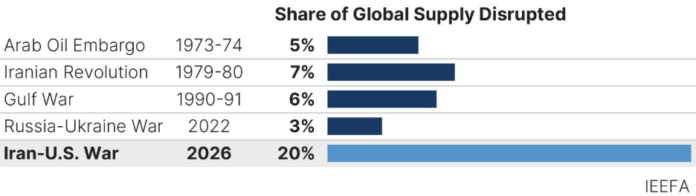
Geopolitical tensions in the Middle East have once again highlighted the vulnerabilities of fossil fuel-dependent economies, reinforcing the need for countries to accelerate investments in renewable energy, electrification, and energy efficiency.
According to the latest report from the Institute for Energy Economics and Financial Analysis (IEEFA), Deal or No Deal: Five Energy Market Lessons from the Middle East Crisis, long-term energy security can no longer rely solely on diversified fossil fuel imports or expanded oil and gas infrastructure. Instead, governments should prioritize clean energy investments to reduce economic risks, improve resilience, and support sustainable growth.
There is heavy dependence on imported fossil fuels as one of the greatest economic vulnerabilities during periods of geopolitical instability. According to IEEFA, India, Pakistan, Japan, and the Philippines each import more than 90 percent of their crude oil requirements from the Persian Gulf, leaving their economies exposed to supply disruptions, price volatility, inflation, and deteriorating trade balances.
Australia, despite being a major energy exporter, relies on Asian refineries supplied by Middle Eastern crude while maintaining relatively limited domestic petroleum reserves, demonstrating how interconnected global energy supply chains expose both importing and exporting nations to market disruptions.
IEEFA also challenges the perception of liquefied natural gas (LNG) as a long-term energy security solution. LNG remains vulnerable to international commodity price fluctuations and geopolitical developments. Between March and May, the United States supplied 60 percent of European Union LNG imports as Europe continued reducing its dependence on Russian pipeline gas. During the same period, Russian LNG imports increased 25 percent year over year, while combined LNG imports across the European Union and the United Kingdom declined 3 percent as energy demand reduction measures became more effective. Rising market uncertainty has also prompted China and Vietnam to delay or cancel multiple LNG import projects because of growing investment risks and long-term affordability concerns.
Government interventions designed to shield consumers from energy price shocks can place enormous pressure on public finances. Japan allocated more than USD 77 billion in emergency fuel subsidies between 2022 and 2024. In India, state-owned oil marketing companies absorbed more than USD 4 billion in losses on cooking fuels to stabilize retail prices. Meanwhile, Bangladesh spent more than USD 1 billion on LNG subsidies in just three months to maintain electricity generation. According to IEEFA, these recurring fiscal burdens reduce governments’ ability to invest in cleaner and more sustainable energy systems.
Energy supply disruptions extend well beyond oil and gas markets. The Strait of Hormuz carries approximately one-third of global seaborne fertilizer shipments and between 7 percent and 8 percent of worldwide fertilizer supplies, making it one of the world’s most strategically important trade routes. Any disruption to shipping through the corridor could have significant consequences for agricultural production and global food security. The report also highlights potential shortages of helium, polyethylene, polypropylene, and aluminum. In India, upstream supply disruptions could affect nearly 5 million jobs across approximately 30,000 plastic micro, small, and medium-sized enterprises (MSMEs), illustrating the broader economic consequences of fossil fuel market instability.
Rather than replacing one energy supplier with another, IEEFA argues that reducing overall fossil fuel consumption offers the most effective long-term protection against future energy crises. The report estimates that even if geopolitical tensions eased immediately, crude oil and LNG shipments through the Strait of Hormuz would require at least six months to return to pre-crisis levels. This finding highlights the limitations of supply diversification and underscores the importance of structural changes in national energy systems through renewable energy deployment, electrification, and energy efficiency.
In India, electric cooking is 37 percent cheaper than non-subsidized LPG and 14 percent less expensive than piped natural gas, providing both economic and energy security advantages. Pakistan has also strengthened its resilience by deploying nearly 50 GW of solar capacity since 2021, reducing dependence on imported fuels while expanding access to domestically generated renewable electricity.
Beyond energy security, IEEFA said investments in renewable energy, battery storage, modern electricity grids, and electrified transport improve industrial competitiveness, reduce exposure to fuel price volatility, strengthen national energy independence, and support emissions reduction targets. Countries that accelerate clean energy infrastructure will be better positioned to withstand future geopolitical shocks while building more efficient and resilient energy systems.
According to IEEFA, the recent Middle East crisis has reinforced that long-term economic stability depends less on securing additional fossil fuel supplies and more on reducing dependence on them. By expanding domestic renewable energy, increasing electrification, improving energy efficiency, and modernizing electricity infrastructure, governments can reduce vulnerability to future market disruptions while supporting sustainable economic development and long-term energy security.
SHAFANA FAZAL
