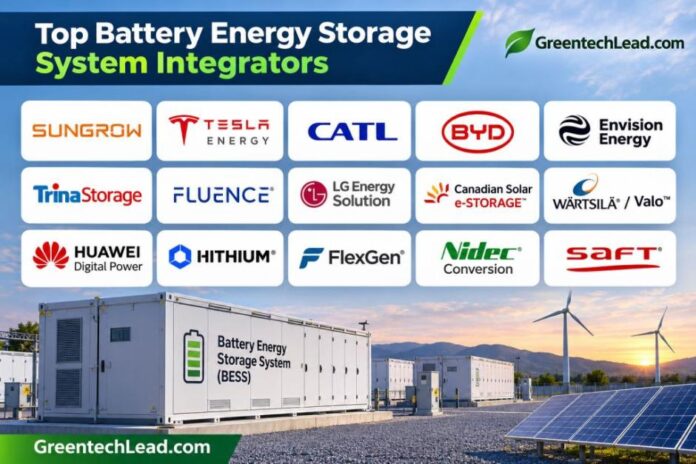
The global battery energy storage system (BESS) market is entering 2027 with intensifying competition among Sungrow, Tesla Energy, CATL, BYD, Fluence, Envision Energy and Trina Storage. Utility-scale developers are evaluating suppliers based on commissioned projects, battery costs, grid-forming technology, software capabilities, delivery schedules and long-term performance guarantees.
According to Wood Mackenzie’s 2026 global BESS integrator ranking, Sungrow secured first position, followed by Tesla, CATL and BYD. Envision Energy and Trina Storage shared fifth position. Fluence, LG Energy Solution, Canadian Solar and Wärtsilä completed the top ten.
The ranking evaluates AC-integrated storage solutions, including technology, safety and financial strength. Five additional companies have been selected for their technology, project references and market opportunities.
Top 15 BESS Integrators: Projects, Achievements and Customer Strategies
1. Sungrow: Large-Scale Project Execution
Sungrow leads through its PowerTitan storage platform, integrated power conversion systems and utility-scale execution capabilities.
Its 350 MW/1,243 MWh Hams Hall project in the UK reached commercial operation in November 2026, with the first phase achieving operation within 20 days after grid connection. Sungrow also commissioned a 150 MW/600 MWh storage project in Nova Zagora, Bulgaria, in June 2026.
Sungrow’s customer-winning strategy combines integrated equipment, faster commissioning, grid-support capabilities and reduced coordination requirements for developers.
2. Tesla Energy: Megapack Manufacturing and Software
Tesla Energy competes through Megapack battery systems, Autobidder trading software and vertically integrated manufacturing.
Tesla reports more than 77 GWh of operational deployments across over 65 countries and approximately 80 GWh of annual factory production capacity.
Its customer strategy emphasizes standardized Megapack installations, automated energy trading, software optimization and long-term maintenance. Tesla’s hardware-software combination appeals to utilities and independent power producers seeking fewer integration interfaces.
3. CATL: Battery Manufacturing and Eight-Hour Storage
CATL leverages its battery manufacturing scale, TENER storage platform and long-duration technology.
Its EnerQB technology targets eight-hour storage applications. CATL’s October 2026 announcements concerning Quinbrook involve a 3 GW/24 GWh Australian development framework, rather than completed installations.
CATL competes through cell manufacturing economics, energy density, long-duration solutions and supply agreements with major developers.
4. BYD: Vertical Integration and Project Supply
BYD combines battery cell production, storage systems and manufacturing capabilities.
Its battery supply relationship with Grenergy’s Oasis de Atacama development in Chile demonstrates its participation in large-scale solar-plus-storage projects.
BYD targets customers seeking competitive battery pricing, integrated supply chains and large-volume procurement. However, battery supply contracts should not be confused with complete AC-system integration or EPC responsibility.
5. Envision Energy: Renewable Energy and Digital Integration
Envision Energy integrates storage with renewable generation, digital energy management and grid technologies.
Its 193 MW/386 MWh Neuilly-en-Thelle project in France entered construction in 2026, with operation targeted before spring 2028.
Envision’s customer acquisition strategy emphasizes renewable-storage integration, digital optimization and grid-support services for utilities and project developers.
6. Trina Storage: Solar Customer Relationships
Trina Storage is expanding its battery storage business using its established solar industry relationships.
Its 40 MW/160.48 MWh Gamma project in Romania combines Elementa battery storage with Electra AC equipment. Installation and delivery activities were underway in 2026.
Trina targets solar developers seeking hybrid generation and storage projects, integrated procurement and fewer technology interfaces.
7. Fluence: Software, Backlog and Utility Customers
Fluence differentiates itself through storage integration, energy management software and utility-scale project delivery.
As of June 30, 2026, Fluence reported 19.3 GWh of deployed storage, a 12.6 GW backlog and a 45.6 GW pipeline. It introduced its 10 MWh Smartstack platform in June 2026.
Fluence’s customer strategy focuses on software optimization, modular systems, grid services and long-term lifecycle support. Its investor disclosures provide additional information on deployments and commercial commitments.
8. LG Energy Solution: Battery Technology and Supply Security
LG Energy Solution competes through battery manufacturing, energy storage products and established customer relationships.
Its strengths include cell engineering, manufacturing expertise and battery supply capabilities. Its commercial scope varies between cell supply and broader storage-system offerings.
Customers should verify whether contracts cover batteries, PCS, energy management, commissioning and lifecycle warranties.
9. Canadian Solar e-STORAGE: Project Pipeline and Integration
Canadian Solar’s e-STORAGE business combines battery storage systems with renewable energy project experience.
At June 30, 2026, Canadian Solar disclosed an 84.1 GWh storage pipeline, 4.378 GWh backlog and 600 MWh under construction.
Its competitive strategy combines integrated storage equipment, solar-plus-storage relationships and project delivery capabilities. Developers should distinguish contracted backlog from prospective pipeline opportunities.
10. Wartsila / Valo: Grid Software and Energy Optimization
Wartsila established its BESS position through GEMS energy management software and utility-scale integration.
Its 150 MW/300 MWh Bungama project in South Australia was operational by June 2026.
On October 1, 2026, the storage business transitioned into Valo, a 50:50 joint venture with RCT.
Its customer strategy emphasizes grid integration, energy management, operational optimization and lifecycle services.
11. Huawei Digital Power: Grid-Forming Storage
Huawei Digital Power competes through power conversion, digital controls and grid-forming technology.
Its 500 MW/1,000 MWh Cambodia storage project completed GWh-scale black-start and island-operation tests in September 2026.
Huawei targets utilities requiring voltage support, grid stability and advanced inverter control, particularly in renewable-heavy electricity networks.
12. Hithium: Long-Duration Battery Systems
Hithium specializes in stationary battery technology and long-duration storage.
The company reported cumulative battery shipments exceeding 200 GWh in October 2026. Its agreement involving a 421 MWh Fraser Coast project in Australia provides another development-stage reference.
Hithium competes through dedicated storage-cell manufacturing, high-capacity products and long-duration system development.
13. FlexGen: Multi-Vendor Integration
FlexGen focuses on energy management software and integrating storage equipment from multiple manufacturers.
Its acquisition of selected Powin assets and intellectual property expands its technology capabilities.
FlexGen’s customer strategy centers on vendor flexibility, software controls and integration services. Customers should verify responsibility for legacy Powin warranties, equipment replacement and project performance.
14. Nidec Conversion: Power Conversion Technology
Nidec Conversion supplies power conversion equipment for utility-scale storage.
It supplied Power Units for the 291 MW/582 MWh Ignitis storage programme in Lithuania, where Rolls-Royce Power Systems served as the broader system integrator.
Nidec’s competitive strength lies in PCS technology, grid connectivity and power electronics rather than necessarily acting as the turnkey integrator.
15. Saft: Battery Engineering and Energy Services
Saft, part of TotalEnergies, offers industrial battery engineering and energy storage solutions.
Its EnerShift offering, announced in October 2026, combines storage with energy trading and financing services.
Saft targets customers seeking battery engineering, integrated energy services and alternative financing arrangements. Contract evaluation should cover operating references, performance guarantees and long-term service obligations.
Global BESS Market: Chinese Suppliers Gain Share
Wood Mackenzie reported that Chinese integrators captured 76 percent of the global BESS market in 2025, with eight Chinese companies among the ten largest suppliers by market share. The combined share of the three largest integrators declined from 36 percent in 2024 to 30 percent in 2025.
The market-share ranking differs from the comprehensive technology and execution ranking. In North America, Tesla maintained leadership, supported by Megapack manufacturing, Autobidder software and domestic production.
BESS Project Costs: $125/kWh Benchmark
According to Ember’s battery storage cost analysis, published in December 2025 using October benchmarks, four-hour-plus utility-scale BESS projects outside China and the United States averaged approximately $125/kWh in installed capital expenditure.
Equipment
$75
per kWh
Installation
$50
per kWh
Total CapEx
$125
per kWh
Indicative benchmark for eligible utility-scale projects; actual costs vary by market.
At this benchmark, a 100 MW/400 MWh BESS project would require approximately $50 million in upfront investment. Ember estimated a levelized storage cost of $65/MWh under its reference assumptions.
Customer procurement decisions must also account for battery degradation, financing, warranties, augmentation, operating expenses and revenue from electricity arbitrage and ancillary services.
India BESS Market: ₹14,500 Crore Funding Opportunity
India approved ₹14,500 crore in viability-gap funding on November 4, 2026, supporting 92 GWh of energy storage capacity through FY2030-31.
The programme allocates 30 GWh to battery storage, 60 GWh to pumped hydro and 2 GWh to emerging storage technologies. Estimated investment totals ₹97,600 crore, with a minimum 40 percent domestic-content requirement for BESS projects.
India also projects a requirement of 411 GWh of grid-scale storage by FY2031-32, according to the Ministry of Power announcement.
These policies create opportunities for international integrators and domestic manufacturers, including Exide Energy Solutions, Amara Raja, Reliance New Energy, Waaree and BHEL, across batteries, power conversion, controls and integration.
BESS Integrator Outlook for 2027
The strongest BESS suppliers in 2027 will compete on commissioned capacity, grid-forming technology, lifecycle cost and long-term service commitments rather than battery prices alone.
Sungrow and Tesla offer established integration platforms, CATL and BYD emphasize manufacturing scale, Fluence and Wärtsilä/Valo compete through software and grid integration, while Envision and Trina Storage target renewable energy developers.
For utilities and investors, verified operating references, accountable system integration, transparent performance guarantees and local service capacity remain critical to selecting a BESS partner.
SHAFANA FAZAL