Which EV charger is best for Indian electric car owners: 60 kW, 120 kW or 350 kW? The answer depends on vehicle compatibility, charging time, electricity prices, station availability and convenience.
As India’s electric vehicle market expands, customers increasingly encounter different DC fast-charging options at public charging stations operated by Tata Power, Jio-bp, ChargeZone, Statiq and other providers.
While a 350 kW charger promises faster charging than a 60 kW charger, not every electric vehicle can use its full capacity. Customers may also pay higher prices at ultra-fast charging locations without receiving significantly faster charging.
Understanding the differences can help EV owners reduce charging expenses, avoid unnecessary waiting and choose reliable charging stations.
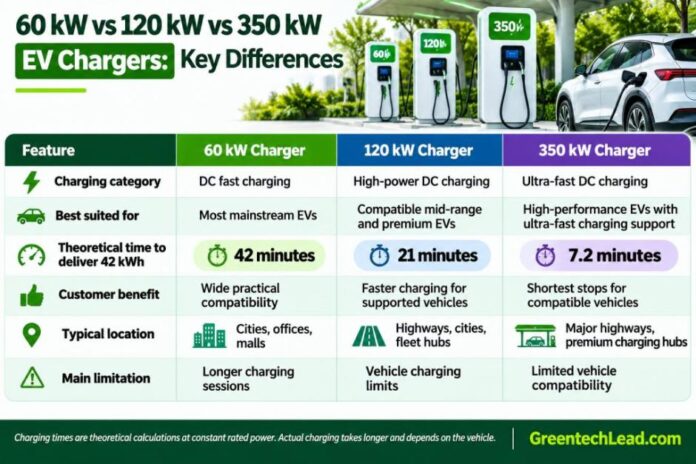
60 kW vs 120 kW vs 350 kW EV Chargers: Key Differences
| Feature | 60 kW Charger | 120 kW Charger | 350 kW Charger |
| Charging category | DC fast charging | High-power DC charging | Ultra-fast DC charging |
| Best suited for | Most mainstream EVs | Compatible mid-range and premium EVs | High-performance EVs with ultra-fast charging support |
| Theoretical time to deliver 42 kWh | 42 minutes | 21 minutes | 7.2 minutes |
| Customer benefit | Wide practical compatibility | Faster charging for supported vehicles | Shortest stops for compatible vehicles |
| Typical location | Cities, offices, malls | Highways, cities, fleet hubs | Major highways, premium charging hubs |
| Main limitation | Longer charging sessions | Vehicle charging limits | Limited vehicle compatibility |
Charging times are theoretical calculations at constant rated power. Actual charging takes longer and depends on the vehicle.
How Long Does It Take to Charge an Electric Car?
Charging speed is one of the most important considerations for EV customers.
Consider an electric vehicle with a 60 kWh battery. Charging from 10 percent to 80 percent requires approximately 42 kWh.
A 60 kW charger could theoretically deliver this energy in 42 minutes, while a 120 kW charger could deliver it in 21 minutes.
A 350 kW charger could theoretically deliver the same energy in just over seven minutes.
However, these figures assume the vehicle continuously accepts the charger’s maximum power.
In reality, EV batteries have charging limits, and charging speed typically decreases as the battery approaches higher charge levels.
A vehicle supporting only 60 kW DC charging will not charge at 120 kW simply because it is connected to a more powerful station.
For customers, the vehicle’s maximum DC charging capability matters more than the charger’s advertised capacity.
Which Indian Electric Cars Support Fast Charging?
Different electric vehicles support different charging speeds.
Tata Motors states that the Nexon.ev can charge from 10 percent to 80 percent in approximately 40 minutes using a compatible 60 kW DC fast charger.
The Tata Curvv.ev 55 supports faster DC charging, with the manufacturer quoting approximately 40 minutes using a 70 kW charger.
Customers can review the Tata Nexon.ev charging specifications before selecting a public charging station.
Premium electric vehicles generally offer higher charging capabilities.
Hyundai states that the IONIQ 5 can charge from 10 percent to 80 percent in approximately 18 minutes using a compatible 350 kW charging system under specified conditions.
The Hyundai IONIQ 5 specifications provide additional information about its charging capabilities.
Kia EV6 also supports ultra-fast charging under suitable conditions.
These differences explain why customers should check their vehicle’s specifications before paying for access to high-power charging infrastructure.
EV Charging Cost in India: How Much Will Customers Pay?
Public EV charging prices vary depending on the operator, location, electricity costs, charging speed and applicable fees.
Consider a customer purchasing 42 kWh of electricity during a charging session.
| Charging price | Cost for 42 kWh |
| ₹15 per kWh | ₹630 |
| ₹18 per kWh | ₹756 |
| ₹20 per kWh | ₹840 |
| ₹22 per kWh | ₹924 |
| ₹25 per kWh | ₹1,050 |
These are illustrative tariffs, not verified prices from specific charging operators. Taxes and additional fees may apply.
At ₹20 per kWh, a customer pays ₹840 for 42 kWh of delivered electricity.
At ₹25 per kWh, the same charging session costs ₹1,050.
The difference is ₹210 for a single session.
For customers charging frequently, selecting competitively priced stations can generate meaningful savings.
However, charging at a cheaper location may not always be worthwhile if it requires a long diversion or extended waiting time.
Is a 350 kW Charger Worth Paying More For?
Ultra-fast charging is particularly attractive to customers undertaking long-distance journeys.
Drivers of compatible premium electric vehicles may significantly reduce charging stops by selecting high-power charging stations.
However, customers driving vehicles with lower DC charging limits may experience little or no improvement.
For example, an electric car accepting a maximum of 70 kW cannot take full advantage of a 350 kW charger.
Customers should compare the expected charging time, electricity tariff and station availability before choosing a high-power charger.
If two stations offer similar charging speeds for a particular vehicle, the cheaper and more conveniently located option may deliver better value.
Tata Power, Jio-bp, ChargeZone and Statiq: What Customers Should Compare
India’s leading charging operators are expanding their networks across cities, highways and commercial transport corridors.
Tata Power EZ Charge offers public, semi-public and destination charging services, supported by its broader electricity business.
Jio-bp pulse focuses on high-power charging infrastructure, including DC chargers rated between 60 kW and 480 kW.
ChargeZone serves passenger vehicles and commercial fleets, with charging infrastructure supporting power ratings up to 360 kW.
Statiq provides a digital charging platform that helps customers discover stations, check availability and manage charging sessions.
For EV owners, the most useful comparison is not necessarily the total number of installed chargers.
Customers should evaluate actual charger availability, connector compatibility, pricing transparency, payment convenience and reliability.
A functioning 60 kW charger located nearby may be more valuable than a 350 kW station requiring a substantial detour.
How to Reduce EV Charging Expenses
Customers can reduce public charging costs by selecting stations based on their vehicle’s charging capabilities and travel requirements.
Home charging, where available, is often more economical than public DC fast charging.
Public fast charging is particularly useful for highway journeys, emergency charging and situations where customers cannot access private charging infrastructure.
Drivers should also consider charging from approximately 10 percent to 80 percent during long journeys because charging frequently slows beyond 80 percent.
For customers who need to reach their destination quickly, two shorter charging stops may sometimes be more efficient than one extended session approaching 100 percent.
Charging apps can help customers compare station locations, availability and tariffs before travelling.
India’s PM E-DRIVE scheme supports the expansion of public charging infrastructure, potentially improving charging accessibility as additional stations become operational.
Which EV Charger Is Best for Indian Customers?
60 kW chargers: A practical option for mainstream electric vehicles, urban charging and customers whose cars have moderate DC charging capabilities.
120 kW chargers: Suitable for customers with compatible vehicles who want faster charging during city travel and highway journeys.
350 kW chargers: Most beneficial for electric vehicles designed to accept very high charging power, particularly during long-distance travel.
For most customers, choosing the highest-powered charger is not automatically the best decision.
The ideal charging station offers a compatible connector, reliable equipment, transparent pricing and convenient access.
The best EV charging experience combines affordable electricity, dependable availability and charging speeds that match the vehicle’s actual capabilities. As India’s charging network expands, these customer-focused factors will become increasingly important in determining which charging operators attract repeat users.
SHAFANA FAZAL