India’s wind-energy investment cycle is accelerating in 2026 as Suzlon, Tata Power, ReNew and other developers expand wind farms, wind-solar hybrids, battery storage and manufacturing, while transmission investment opens capacity for the next wave of projects.
India’s wind market is moving beyond conventional standalone wind farms toward a broader infrastructure opportunity spanning wind-solar hybrids, battery energy storage systems, transmission, repowering, turbine manufacturing and contracted industrial power.
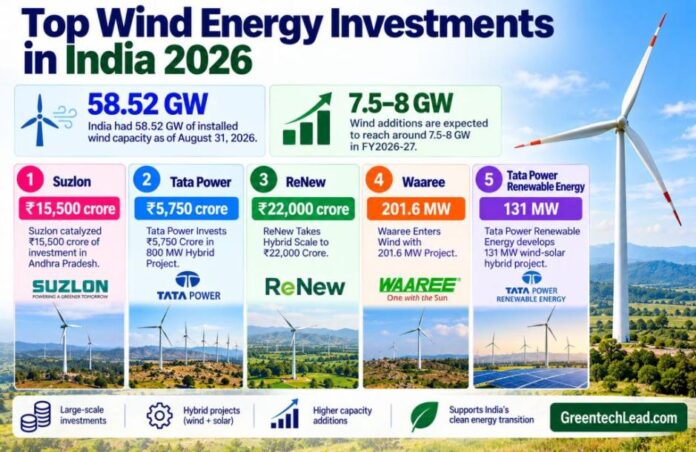
India had 58.52 GW of installed wind capacity as of August 31, 2026, after adding 2.43 GW during April-August FY2026-27.
Wind additions are expected to reach around 7.5-8 GW in FY2026-27. At an indicative project cost of ₹7 crore/MW, that level of annual construction could represent approximately ₹52,500-56,000 crore of wind investment.
But investment quality will depend on more than MW. The strongest projects will combine high capacity factors, reliable transmission, long-term PPAs, competitive financing and battery storage.
Andhra Pradesh Emerges as a ₹30,000 Crore-Plus Investment Hotspot
Andhra Pradesh is becoming one of India’s most important wind-investment destinations.
In August 2026, Suzlon and the state government broke ground on 1,325 MW of wind projects in Ananthapuramu, involving approximately ₹10,500 crore of investment and 1,600 direct and indirect jobs.
The disclosed investment works out to approximately ₹7.9 crore/MW, although this should be treated as a project-level benchmark rather than a standard industry cost.
Suzlon says it has catalyzed approximately ₹15,500 crore of investment in Andhra Pradesh and is executing around 1,600 MW of wind projects there.
Its Ananthapuramu blade manufacturing operation now has four production lines.
This combination of project development + turbine manufacturing + employment + grid infrastructure gives Andhra Pradesh a broader investment proposition than simply building additional generation.
Tata Power Invests ₹5,750 Crore in 800 MW Hybrid Project
Tata Power Renewable Energy provides another example of the integrated model.
Its new Andhra Pradesh project involves ₹5,750 crore of investment for 800 MW, split between:
400 MW wind + 400 MW solar.
The project has secured 800 MW of Inter-State Transmission System connectivity, an important advantage because renewable assets cannot generate commercial returns without reliable power evacuation.
Suzlon will execute the wind component, while the overall development is expected to create approximately 4,000 jobs.
The wind order itself involves 127 Suzlon S144 turbines rated at 3.15 MW each. Suzlon’s cumulative partnership with Tata Power has now crossed 1 GW across Andhra Pradesh, Karnataka, Maharashtra and Tamil Nadu.
The Tata Power-Suzlon 400 MW wind project also demonstrates a broader change in India’s turbine market: suppliers are providing development, EPC, grid infrastructure, commissioning and O&M rather than simply selling turbines.
ReNew Takes Hybrid Scale to ₹22,000 Crore
ReNew is pursuing an even larger integrated renewable project in Andhra Pradesh.
Its approximately ₹22,000 crore development combines:
1 GW wind
1.8 GWp solar
2 GWh battery storage
The project is designed to supply renewable electricity during peak demand periods for up to four hours.
This represents a fundamental change in wind-project economics.
Instead of simply asking how much electricity a wind farm produces annually, investors need to ask when the electricity is available and what it is worth at that time.
ReNew also commissioned approximately 2.4 GW of renewable assets during FY2026, including 620 MW of wind and 25 MW/100 MWh of battery storage. Its operating renewable portfolio reached approximately 12.6 GW.
The ReNew wind-solar-BESS investment model shows how wind is evolving from intermittent generation into part of a dispatchable renewable-energy platform.
Waaree Enters Wind with 201.6 MW Project
Another interesting 2026 development is Waaree’s expansion from its solar base into wind.
Waaree Forever Energies placed its first wind order with Suzlon for a 201.6 MW project in Andhra Pradesh.
Suzlon will supply 64 S144 turbines rated at 3.15 MW each under its DevCo model.
The project is strategically important because it demonstrates how India’s solar companies are moving into multi-technology renewable portfolios.
For developers, combining solar and wind can provide a more balanced generation profile. For turbine manufacturers, it creates a new customer pool beyond traditional wind developers.
Gujarat Leads India with 16.72 GW of Wind
India’s investment opportunities differ significantly by state.
Gujarat leads with approximately 16.72 GW of installed wind capacity, followed by Tamil Nadu with 12.32 GW, Maharashtra at 6.45 GW, Rajasthan at 5.69 GW and Andhra Pradesh at 4.48 GW as of August 2026.
Gujarat benefits from scale, wind resources, industrial demand and renewable infrastructure.
Tamil Nadu offers a different opportunity because its large fleet includes aging turbines at some of India’s best-established wind locations.
That makes repowering attractive.
Replacing older sub-MW and 1 MW-class turbines with modern 3 MW-5 MW machines could increase generation significantly while potentially reusing land, roads and grid infrastructure.
Wind Repowering Could Unlock ₹40,000 Crore
India’s aging wind fleet creates a second investment cycle beyond greenfield development.
CRISIL has previously estimated that repowering could potentially attract approximately ₹40,000 crore of investment over three to five years, with more than 5 GW of opportunity concentrated particularly in Gujarat and Tamil Nadu.
The productivity difference can be substantial.
CRISIL estimates that a modern 3 MW turbine operating at a 34-36 percent PLF could produce around 200 percent more electricity than an older 1 MW turbine operating at 22-24 percent PLF at the same site.
However, investors must account for dismantling, new foundations, grid approvals, downtime and changes to existing PPAs.
Repowering therefore makes most sense where incremental MWh justify redevelopment CAPEX.
Suzlon’s 6.1 GW Order Book Shows Turbine Demand
India’s investment cycle is also visible in turbine-manufacturer orders.
Suzlon ended Q1 FY27 with an order book of approximately 6.1 GW, with 84 percent coming from PSU and commercial and industrial customers.
The company delivered a record 506 MW during the quarter, up 14 percent, while commissioning reached 269 MW, more than twice the previous-year level.
Suzlon has also introduced its S175 5 MW platform, reflecting India’s transition toward larger turbines.
Larger machines can potentially increase annual generation while reducing the number of turbines, foundations and individual maintenance points required for a project.
The economic benefit, however, depends on site-specific wind conditions, logistics, availability and grid capacity.
Corporate Buyers Are Creating Another Wind Revenue Model
Industrial companies are becoming important renewable-energy buyers.
Tata Power Renewable Energy and Tata Motors, for example, are developing a 131 MW wind-solar hybrid project that is expected to generate around 300 million units of electricity annually.
The electricity will supply six Tata Motors manufacturing facilities in Maharashtra and Gujarat.
Corporate PPAs can provide developers with long-term revenue visibility while helping industrial customers manage electricity costs and decarbonization targets.
This creates an alternative to projects dependent exclusively on utility procurement.
Capacity Factor Can Change Revenue by ₹17 Lakh Per MW
For investors, one of the most important wind metrics is capacity factor.
A 1 MW turbine at a 35 percent capacity factor produces approximately:
3,066 MWh annually.
At 40 percent, annual generation increases to:
3,504 MWh.
At an illustrative realized tariff of ₹4/kWh, gross revenue increases from approximately ₹1.23 crore/MW annually at 35 percent to around ₹1.40 crore at 40 percent.
That is roughly ₹17 lakh of additional annual gross revenue for every MW installed.
For a hypothetical 500 MW project, the difference could approach ₹85 crore annually before accounting for losses, O&M, curtailment, taxes and financing.
This demonstrates why wind resource quality can matter more than obtaining the lowest turbine price.
Transmission Is Becoming an Investment Opportunity Itself
India’s wind expansion also requires enormous grid investment.
Green Energy Corridor Phase III has an outlay of ₹1,86,405 crore, including ₹1,36,378 crore for intra-state transmission and ₹50,000 crore associated with 50 GWh of battery storage.
The infrastructure is designed to facilitate evacuation of up to 135 GW of renewable capacity by FY2032-33.
This creates investment opportunities beyond wind farms in transformers, substations, switchgear, transmission lines, power electronics and BESS.
The Green Energy Corridor investment programme is particularly important because awarded renewable capacity cannot become productive infrastructure until grid access is available.
India’s 24 GW Manufacturing Base Creates Another Opportunity
India has around 24 GW of annual wind-equipment manufacturing capacity, covering turbines, blades, towers, generators and other components.
Growing domestic installations can increase factory utilization, while exports provide another revenue opportunity.
The value chain is also becoming broader.
Suzlon, for example, is increasing its EPC exposure alongside turbine manufacturing. Its EPC share increased from 22 percent in Q1 FY26 to 32 percent in Q1 FY27.
Long-term O&M creates another recurring revenue stream after project commissioning.
Wind investment therefore supports not only electricity generation but also manufacturing, construction, engineering and decades of service revenue.
India Wind Investment Is Moving Toward Integrated Platforms
India’s wind opportunity is becoming much larger than conventional turbine installation.
The country already has 58.52 GW of installed wind capacity, while expected FY2026-27 additions of 7.5-8 GW could imply more than ₹50,000 crore of annual project investment at indicative current costs.
Andhra Pradesh demonstrates the emerging model: Suzlon’s 1,325 MW development represents ₹10,500 crore, Tata Power is investing ₹5,750 crore in an 800 MW wind-solar project, and ReNew plans approximately ₹22,000 crore for its 2.8 GW hybrid project with 2 GWh of storage.
Gujarat offers scale and industrial demand. Tamil Nadu provides a major repowering opportunity. Rajasthan is suited to wind-solar hybrids, while corporate PPAs are creating additional demand across industrial states.
The investment equation is therefore changing:
Wind resource determines generation. Turbine technology determines productivity. PPAs determine revenue visibility. Transmission determines deliverability. BESS determines flexibility. Financing determines equity returns.
The future of India’s wind energy market will belong to projects that combine these elements rather than simply installing the maximum number of MW.
For investors, the best Indian wind asset in 2026 is therefore not necessarily the biggest or cheapest project. It is the project capable of converting strong wind resources into high lifetime generation, reliable grid-connected output, contracted cash flow and dispatchable renewable electricity.
SHAFANA FAZAL