Global battery storage deployment reached a record 108 GW in 2025, increasing 40 percent and rising to 11 times its 2021 level, according to the International Energy Agency. Wood Mackenzie recorded a comparable 106 GW of additions, taking cumulative global energy-storage capacity to approximately 270 GW.
The market is now moving from one- and two-hour grid-balancing batteries toward multi-GWh projects designed to shift renewable electricity, provide capacity and convert solar generation into dispatchable power.
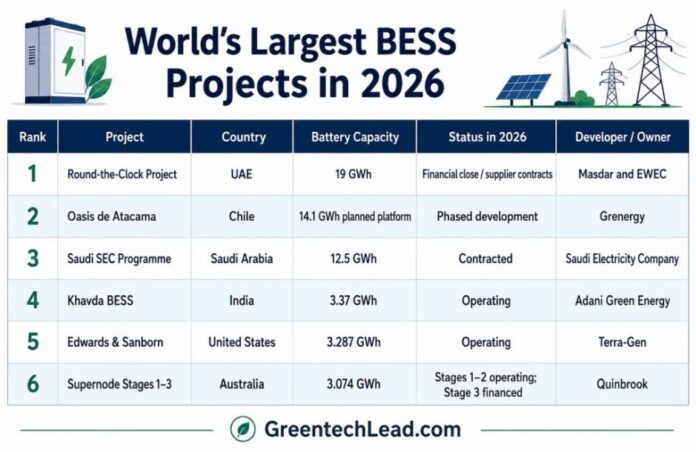
Abu Dhabi’s 19 GWh solar-plus-storage development, Chile’s planned 14.1 GWh Oasis de Atacama platform and Saudi Arabia’s 12.5 GWh programme illustrate the new scale. However, these projects are at different development stages and should not be treated as equivalent to operating facilities.
The ranking uses energy capacity rather than power capacity because GWh indicates how much electricity a system can store. Development platforms are included but are identified separately from operating projects.
1. Abu Dhabi Round-the-Clock Project: 19 GWh
Masdar and Emirates Water and Electricity Company’s Round-the-Clock project combines 5.2 GW of solar generation with 19 GWh of battery storage.
The world’s largest solar-plus-storage project is designed to supply up to 1 GW of renewable electricity continuously, making it a potential model for converting variable solar generation into a baseload-style clean-power product.
BYD’s 11.275 GWh Abu Dhabi battery contract shows it has secured a contract for a 1,644 MW/11,275 MWh portion of the battery system. The configuration provides a maximum-duration ratio of approximately 6.9 hours.
Sungrow will supply another 7.5 GWh through its PowerTitan 3.0 platform, alongside 2.6 GW of solar inverter capacity. Together, the BYD and Sungrow orders total 18.775 GWh, representing approximately 98.8 percent of the project’s planned battery capacity.
The project reached financial close in July 2026. That milestone gives it greater development certainty than an announced project that has not secured financing, although the batteries are not yet commercially operational.
2. Oasis de Atacama: 14.1 GWh Planned Across Multiple Phases
Oasis de Atacama solar and battery project indicated that Grenergy’s Oasis de Atacama is a multi-phase development platform in Chile rather than a single battery facility.
The expanded plan encompasses approximately 2.5 GW of solar generation and 14.1 GWh of battery storage. Its location in the Atacama Desert allows abundant daytime solar electricity to be stored and supplied during evening and overnight periods.
Phase Five, known as Algarrobal, includes approximately 242 MW of solar and 1,412 MWh of battery capacity. Grenergy has signed a 12-year hybrid PPA covering 350 GWh of annual electricity supply from January 2028.
Algarrobal is scheduled to start operating in the third quarter of 2027. The contract’s investment-grade buyer provides stronger revenue visibility than a battery project exposed entirely to merchant electricity prices.
3. Saudi Electricity Company Programme: 12.5 GWh
Saudi Arabia’s 12.5 GWh battery programme indicated BYD’s agreement with Saudi Electricity Company covering five battery projects with combined capacity of 2.5 GW/12.5 GWh.
Each site is configured at 500 MW/2,500 MWh, providing five hours of storage at maximum output. The projects are located in Riyadh, Qaisumah, Dawadmi, Al Jouf and Rabigh.
The Saudi contract and BYD’s 11.275 GWh Abu Dhabi order give the supplier more than 23.7 GWh across two major Middle Eastern programmes.
4. Khavda BESS: 3.37 GWh Operating
Adani Green’s 3.37 GWh Khavda BESS project report shows that Adani Green Energy commissioned 3.37 GWh of battery storage at Khavda in Gujarat by May 2026, including 1.37 GWh completed during March.
Unlike the larger projects in Abu Dhabi, Chile and Saudi Arabia, Khavda’s 3.37 GWh represents operating capacity. Adani Green describes it as the largest single-location battery deployment outside China.
The system forms part of the Khavda renewable-energy complex, which is being developed toward 30 GW of solar and wind capacity.
Adani Green subsequently commissioned another 181 MWh, taking its total installed BESS capacity to 3.551 GWh by June 2026. The company plans to add more than 10 GWh during FY2027 and scale storage capacity to approximately 50 GWh over five years.
5. Edwards & Sanborn: 3.287 GWh Operating
The Edwards & Sanborn project in California combines approximately 864 MW of solar capacity with 3,287 MWh of battery storage.
The facility became fully operational in 2024 and remains one of the world’s largest completed solar-plus-storage developments. It uses more than 120,000 battery units and was developed through several construction phases.
6. Supernode: 780 MW/3,074 MWh
Quinbrook’s Supernode battery campus in Queensland is scheduled to reach 780 MW/3,074 MWh across its first three stages.
Stage Two reached commercial operation in 2026, while Stage Three secured A$469 million in debt financing. Total financing across the first three stages has reached approximately A$1.2 billion.
Stage Three will add approximately 260 MW/1,216 MWh, giving it a duration of nearly 4.7 hours.
CATL’s Supernode battery project report indicated that CATL supplies EnerC Plus systems for the first two stages and TENER S equipment for Stage Three. It will also provide lifecycle services under a long-term agreement.
Sungrow Leads Wood Mackenzie’s 2026 Integrator Ranking
Wood Mackenzie’s 2026 global BESS ranking placed Sungrow first, followed by Tesla, CATL and BYD. Envision and Trina Storage shared fifth place.
Fluence, LG, Canadian Solar and Wartsila completed the top 10.
The ranking evaluates more than shipment volumes. It includes project execution, research and development, safety, financial strength, supply-chain resilience, ESG performance and lifecycle capabilities.
Chinese integrators captured 76 percent of the global BESS market during 2025 and occupied eight of the top 10 market-share positions.
Why Sungrow, Tesla, CATL and BYD Lead the BESS Market
Sungrow
Sungrow combines batteries, power-conversion systems, solar inverters and energy-management technology. Its 7.5 GWh Abu Dhabi contract demonstrates its ability to supply batteries and solar equipment for an integrated renewable-power project.
Tesla
Tesla’s Megapack platform combines battery hardware with energy-management and optimisation software. Its position reflects the growing value of deciding when a battery should charge, discharge or reserve energy for higher-value grid services.
CATL
CATL’s stationary-storage revenue increased 87.5 percent to approximately RMB 53.26 billion in the first half of 2026. BESS represented nearly one-quarter of its sales, compared with only 2 percent five years earlier.
CATL expects energy storage to reach approximately half of global sales by 2030. The company has also invested $440 million in a testing centre designed to simulate grid operation and investigate safety risks.
BYD
BYD is gaining market share through battery manufacturing, system integration and multi-GWh contracts. Its 23.775 GWh of disclosed orders across Abu Dhabi and Saudi Arabia establishes it as a leading supplier for the industry’s largest projects.
Global Battery Additions Reach 108 GW
The IEA reported 108 GW of battery storage additions in 2025, an increase of 40 percent. Lithium-iron-phosphate technology accounted for approximately 90 percent of deployments.
LFP has become the dominant stationary-storage chemistry because it generally offers lower costs, good cycle life and stronger thermal stability than chemistries designed primarily for higher energy density.
BloombergNEF estimated that stationary-storage battery-pack prices fell 45 percent to an average of $70 per kWh in 2025. Based only on battery-pack prices, one GWh would represent approximately $70 million of equipment value. Complete BESS project costs are substantially higher after adding containers, power electronics, transformers, construction, interconnection, software and development expenses.
The IEA estimates that battery storage capacity needs to rise to approximately 1,200 GW by 2030 in its net-zero pathway, forming the majority of the required 1,500 GW of global storage.
Abu Dhabi’s 19 GWh project demonstrates the potential for batteries to support continuous renewable electricity. Saudi Arabia’s 12.5 GWh procurement applies storage across a national transmission network. Oasis de Atacama combines multi-phase development with long-term hybrid PPAs, while Khavda and Edwards & Sanborn provide evidence that single-location assets above 3 GWh can already operate at scale.
SHAFANA FAZAL