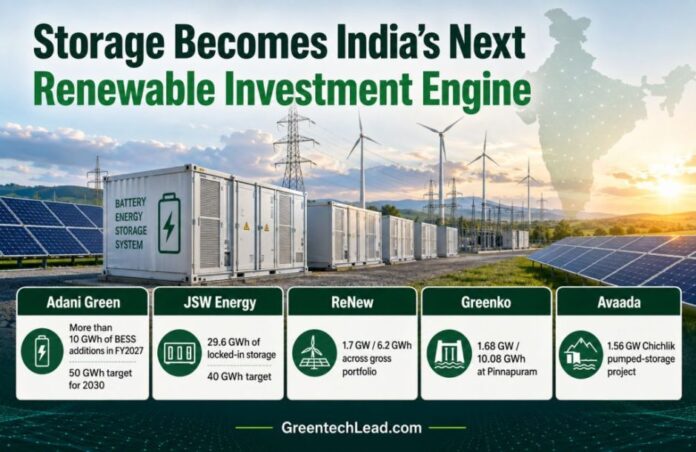
India’s renewable-energy market is moving from standalone solar and wind projects toward integrated investments combining generation, battery storage, pumped hydro, transmission, domestic manufacturing and green hydrogen.
Installed renewable capacity in India reached 288.58 GW on June 30, 2026, up nearly four-fold from 76.38 GW in 2014. The total included 162.15 GW of solar and 57.44 GW of wind, giving these two technologies a combined capacity of 219.59 GW.
Including 8.78 GW of nuclear power, India’s non-fossil electricity capacity reached 297.36 GW. The country has therefore completed approximately 59.5 percent of its 500 GW non-fossil capacity target for 2030, leaving another 202.64 GW to be installed.
Adani Green Energy Targets ₹42,000 Crore Capex and 10 GWh BESS Additions
Adani Green Energy is leading India’s private renewable market by operating capacity and annual project execution.
The company added 5,051 MW during FY2026, taking its operational portfolio to 19.3 GW. The additions comprised 3,412 MW of solar, 683 MW of wind and 956 MW of wind-solar hybrid capacity.
By June 30, 2026, Adani Green Energy’s operational capacity had increased to 20.1 GW, representing 27 percent year-on-year growth. Energy sales during the first quarter of FY2027 increased 30 percent to 13,657 million units.
Storage is becoming central to the company’s next investment phase. Adani Green commissioned 1,972 MWh of battery capacity at Khavda during the quarter, lifting installed BESS capacity to 3,551 MWh.
The company plans to add more than 10,000 MWh of BESS during FY2027 and is targeting 50,000 MWh by 2030. Its wider goal is to operate 50 GW of renewable capacity by the end of the decade.
Adani Green has indicated approximately ₹42,000 crore of capital expenditure for FY2027, including around ₹15,000 crore associated with storage. This follows approximately ₹30,365 crore of investment during FY2026.
The investment model also benefits from Adani Group’s transmission business. Adani Energy Solutions secured a ₹4,700 crore Maharashtra project capable of transmitting 4,500 MW of renewable and storage electricity. The project includes 562 circuit kilometres of transmission lines and 9,000 MVA of transformation capacity.
ReNew Combines 12.6 GW Operating Capacity with Solar Manufacturing
ReNew commissioned approximately 2.4 GW during FY2026 — its highest annual addition — to reach approximately 12.6 GW of operating capacity after accounting for 600 MW of asset sales.
Its gross portfolio stood at approximately 20 GW on March 31, 2026, including 1.7 GW/6.2 GWh of battery storage. The operating portfolio included approximately 6.8 GW of solar, 5.6 GW of wind, 99 MW of hydro and 100 MW/250 MWh of BESS.
ReNew FY2026 renewable capacity and storage indicated that it is differentiating itself through solar manufacturing. It has 6.4 GW of commissioned module capacity and 2.5 GW of solar-cell capacity, with another 4 GW TOPCon cell facility under construction.
The company produced more than 4.1 GW of modules and 1.86 GW of cells during FY2026.
ReNew is now investing ₹4,200 crore in a 6.5 GW ingot-and-wafer facility in Andhra Pradesh. The plant is expected to begin operations within 24 months and create more than 2,100 direct and indirect jobs.
The facility will take ReNew further upstream from modules and cells into wafers, one of the supply-chain segments where India remains heavily dependent on imports.
NTPC Green Crosses 10 GW, Targets 60 GW by 2032
NTPC Green Energy commissioned 4,225 MW during FY2026, taking total operating renewable capacity to 10,126 MW on March 31, 2026.
NTPC Green 10 GW renewable-energy milestone indicated that more than half of the year’s addition —2,116 MW — was commissioned during the final quarter. Major projects included 2,560 MW at Khavda, 500 MW at Bhadla, 250 MW at Pavagada and 250 MW at Kadapa.
The portfolio could produce enough electricity to meet the annual requirements of approximately 3.4 million households and avoid nearly 15 million tonnes of carbon dioxide emissions annually.
NTPC is targeting 60 GW of renewable capacity by 2032. The Indian government has increased the investment limit available to NTPC for its green-energy subsidiaries from ₹7,500 crore to ₹20,000 crore, giving the group additional flexibility to finance expansion.
NTPC Green is also moving into green fuels. It has signed an agreement with SECI for 70,000 tonnes per annum of green ammonia under the National Green Hydrogen Mission’s SIGHT programme.
This creates a new industrial demand channel for renewable electricity beyond conventional utility power purchase agreements.
JSW Energy Plans ₹1.3 Lakh Crore Investment Through FY2030
JSW Energy has outlined one of India’s largest power-sector capital programmes, with approximately ₹1.3 lakh crore of incremental investment planned between FY2026 and FY2030.
As of March 31, 2026, JSW Energy’s locked-in generation portfolio stood at 32,062 MW. This included 13,454 MW of operating assets, 14,048 MW under construction and 4,561 MW in the pipeline.
JSW Energy had 29.6 GWh of locked-in storage, principally comprising pumped-storage hydro alongside BESS. The company is targeting 40 GWh of storage and 30 GW of generation by FY2030.
JSW Energy is establishing a 5 GWh battery-container assembly facility in Pune, creating manufacturing exposure alongside its storage-development business.
JSW Green Hydrogen Plant Supplies 3,800 TPA to Steel Operations
JSW Energy has commissioned a 3,800-tonne-per-annum green-hydrogen facility at Vijayanagar in Karnataka.
The project supplies green hydrogen to JSW Steel under a seven-year agreement and produces approximately 30,000 tonnes of green oxygen annually. It forms part of a 6,800 TPA allocation awarded through the government’s SIGHT programme.
JSW is targeting green-hydrogen production of approximately 85,000–90,000 TPA and green-oxygen output of up to 720,000 TPA by 2030.
Tata Power Invests ₹5,750 Crore in 800 MW Solar-Wind Project
Tata Power Renewable Energy has started developing an 800 MW project in Andhra Pradesh with an investment of ₹5,750 crore.
Tata Power’s ₹5,750 crore Andhra Pradesh renewable project report indicated the project comprises 400 MW of solar and 400 MW of wind and has secured 800 MW of inter-state transmission connectivity. It is expected to create approximately 4,000 jobs.
A 200 MW portion will be developed as a Firm and Dispatchable Renewable Energy project for NTPC. This component includes a 25 MW/50 MWh battery system.
Tata Power has a distributed-energy opportunity through rooftop solar. Its Bihar programme is targeting solar deployment across 500,000 households over three years, potentially creating demand for household and commercial battery systems.
Avaada Secures ₹12,800 Crore for 2.15 GW Portfolio
Avaada Group reached financial close on approximately ₹12,800 crore, or $1.3 billion, of debt for 2.15 GW of renewable projects in Gujarat and Maharashtra.
The financed portfolio comprises 1.35 GW of hybrid renewable projects and 800 MW of utility-scale solar. The projects are backed by power purchase agreements with MSEDCL and GUVNL.
Commercial operations are scheduled to begin from March 2027, while the loans have an aggregate tenure of approximately 21.5 years.
Avaada is also developing the 1,560 MW Chichlik pumped-storage project in Uttar Pradesh and building capabilities across green hydrogen, ammonia and methanol.
Greenko’s $4.2 Billion Pinnapuram Project Makes Storage the Core Asset
Greenko Pinnapuram storage project in Andhra Pradesh represents one of India’s largest attempts to combine renewable generation with long-duration storage.
The $4.2 billion development includes 4,000 MW of solar, 1,000 MW of wind and 1,680 MW of pumped-storage hydro, according to the Indian government’s project description.
Pumped-storage capacity is designed to provide 10,080 MWh in a single daily cycle. This is equivalent to six hours of discharge at the project’s 1,680 MW rated capacity.
Serentica Commits ₹50,000 Crore for 10 GW in Rajasthan
Serentica Renewables has committed approximately ₹50,000 crore to develop 10 GW of renewable capacity in Rajasthan.
India has extended the inter-state transmission charge waiver for qualifying storage projects commissioned by June 30, 2028. The government has also approved a ₹5,400 crore viability-gap-funding programme supporting 30 GWh of BESS.
CRISIL expects India’s storage-backed renewable capacity to increase from almost zero in FY2025 to approximately 25–30 GW by FY2028.
₹9.15 Lakh Crore Transmission Plan Supports Renewable Expansion
India’s renewable developers cannot achieve their targets without a corresponding expansion of the transmission network.
The National Electricity Plan envisages more than ₹9.15 lakh crore of transmission investment through 2032. The national network is expected to expand from 5.09 lakh circuit kilometres in June 2026 to 6.48 lakh circuit kilometres by 2032.
Transformation capacity is planned to increase from 1,478 GVA to 2,345 GVA, while interregional transfer capacity is targeted to rise from 120 GW to 168 GW.
The government has withdrawn approximately 6.3 GW of grid-connectivity approvals since 2022 from projects that failed to meet commissioning milestones, demonstrating that connectivity cannot be held indefinitely by delayed developments.
Domestic Solar Manufacturing Faces a Capacity Gap
ReNew, Reliance Industries and other manufacturers are investing in cells, modules, wafers, batteries and electrolysers as India seeks to reduce its dependence on imported clean-energy equipment.
India had approximately 25.6 GW of solar-cell manufacturing capacity in April 2026 against annual demand estimated at around 50 GW. More than 90 percent of requirements were still being met through imports, principally from China.
New domestic sourcing rules could strengthen Indian manufacturing, but insufficient cell capacity may temporarily increase costs or delay projects. Facilities such as ReNew’s 6.5 GW wafer plant will improve upstream capacity, although commissioning is still expected to take approximately two years.
India Renewable Energy Outlook: Execution Replaces Announcements as the Key Metric
India has built 288.58 GW of renewable capacity, but another 202.64 GW of non-fossil capacity is required to reach the 500 GW target for 2030.
Adani Green’s ₹42,000 crore FY2027 Capex, JSW Energy’s ₹1.3 lakh crore five-year programme, ReNew’s ₹4,200 crore wafer plant, Tata Power’s ₹5,750 crore Andhra Pradesh project, Avaada’s ₹12,800 crore financing and Serentica’s ₹50,000 crore Rajasthan commitment demonstrate the breadth of capital entering the market.
SHAFANA FAZAL