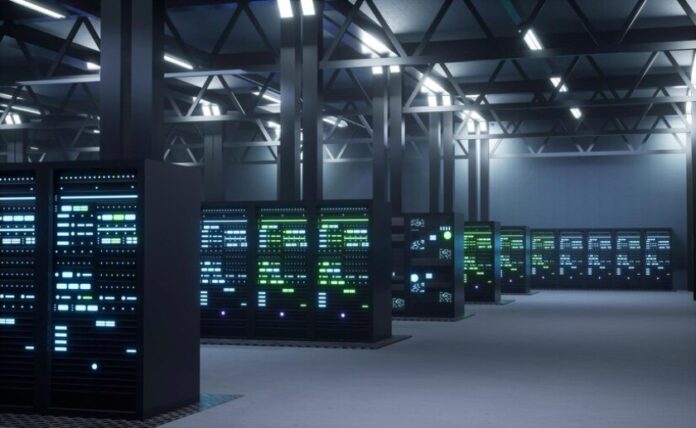
Global artificial intelligence infrastructure investment is expanding beyond chips and cloud platforms into data centres, renewable energy, electricity grids, transformers, battery storage and cooling systems.
J.P. Morgan estimates hyperscaler capital expenditure will reach $697 billion in 2026. Meanwhile, the International Energy Agency expects global data-centre electricity consumption to almost double from 485 TWh in 2025 to approximately 950 TWh by 2030. AI-focused facilities could consume three times more electricity in 2030 than in 2025.
This combination of investment and electricity demand is creating major opportunities for renewable-energy developers, utilities, battery suppliers and electrical-equipment manufacturers.
More Than $520 Billion Could Support AI Infrastructure
AI-related capital expenditure has increased from 33 percent of hyperscalers’ operating cash flow in 2023 to approximately 93 percent in 2026, according to J.P. Morgan Asset Management.
CreditSights estimates that approximately 75 percent of aggregate hyperscaler Capex in 2026 could be directed towards AI infrastructure. Based on the $697 billion forecast, more than $520 billion may support AI computing and related physical infrastructure.
Alphabet has raised its 2026 Capex forecast from $180 billion–$190 billion to $195 billion–$205 billion. The midpoint is approximately $200 billion. Google Cloud revenue increased 82 percent to $24.8 billion in the second quarter of 2026, while computing demand continued to exceed available capacity.
AWS GPU Expansion Raises Power Requirements
Amazon Web Services plans to deploy an additional 2 million NVIDIA Blackwell Ultra, Rubin and Rubin Ultra GPUs during 2027 and 2028. This follows its plan to add more than 1 million NVIDIA GPUs beginning in 2026, implying more than 3 million additional GPUs across multiple years and regions.
These deployments will require high-speed networks, liquid cooling, power-distribution equipment and substantial electricity. AWS and NVIDIA also plan to expand cooperation covering Vera CPUs, Spectrum networking and AI-factory infrastructure.
Anthropic has reportedly agreed to pay Nscale $45 billion over six years for approximately 460 MW of computing capacity at a planned West Virginia campus. Services are expected to begin in late 2027, giving the contract an average value of around $7.5 billion annually.
The capacity forms part of Nscale’s proposed 1.35 GW Monarch campus, which reportedly includes a dedicated 2 GW natural-gas power plant. While contracted demand may support financing, the project remains exposed to construction, power-generation and equipment-delivery risks.
Meta’s 5 GW Campus Highlights Energy Challenge
Meta has committed more than $50 billion to its Hyperion data-centre campus in Richland Parish, Louisiana. Meta’s $50 billion Hyperion data-centre investment is expected to deliver 5 GW of IT capacity across nearly 10 million square feet.
That represents investment exceeding $10 billion per gigawatt, although the final ratio will depend on the campus configuration and total expenditure.
A 5 GW data centre has electricity requirements comparable to a major metropolitan area. It requires coordinated development of generation, transmission, substations, storage, cooling and water infrastructure — not simply a conventional grid connection.
Data-Centre Electricity Demand to Reach 950 TWh
The IEA forecasts data-centre electricity consumption will rise by 465 TWh between 2025 and 2030, reaching around 950 TWh and approximately 3 percent of global electricity consumption.
The United States and China are expected to represent nearly 80 percent of the worldwide increase. US data-centre electricity consumption could grow approximately 130 percent from 2024, while China’s consumption could increase 170 percent.
Renewable energy, nuclear power and battery storage will expand to serve this demand. However, natural gas and coal are forecast to supply more than 40 percent of incremental data-centre electricity requirements through 2030 because AI campuses need continuous power and many grids cannot connect new renewable capacity quickly enough.
The renewable-energy challenge is therefore not simply building more solar and wind farms. AI developers must combine clean generation with transmission, storage, flexible demand and firm power resources.
US Utility Capex Approaches $1.3 Trillion
US investor-owned utilities could spend nearly $1.3 trillion between 2026 and 2030, according to S&P Global Market Intelligence.
S&P’s $1.3 trillion U.S. utility investment forecast indicated that the investment will support ageing-grid replacement, resilience, industrial electrification, renewable-energy connections and large data-centre loads. CenterPoint Energy, for example, increased its 2026–2035 capital programme by $1.2 billion to $66.7 billion, partly because of accelerating large-load demand around Houston.
AI facilities generate several investment layers: data-centre construction, renewable and conventional generation, transmission expansion, substations, transformers, switchgear, storage and cooling equipment.
Texas demonstrates the risks accompanying this opportunity. ERCOT was assessing approximately 474 GW of large-load connection requests in August 2026—more than five times the grid’s record peak demand. Around 90 percent of the requests were associated with data centres.
Texas paused their advancement while authorities reviewed projected electricity and water requirements. The 474 GW queue includes overlapping or speculative proposals and should not be interpreted as future operating demand.
Adani Links $100 Billion AI Plan with Renewable Energy
Adani Group plans to invest $100 billion in renewable-powered, AI-ready data centres in India by 2035. Adani’s $100 billion AI data-centre plan targets an increase in AdaniConneX capacity from 2 GW to 5 GW.
Adani expects its investment to catalyse another $150 billion across the supporting ecosystem, potentially creating a $250 billion AI infrastructure programme.
Its renewable-energy backbone includes the 30 GW Khavda project in Gujarat, where more than 10 GW was operational when the AI investment was announced. Integration with renewable generation and transmission could help Adani serve high-density computing while limiting dependence on constrained public grids.
Google is separately investing approximately $15 billion between 2026 and 2030 in an AI hub in Visakhapatnam, Andhra Pradesh — its largest investment in India.
Google’s $15 billion India AI hub project includes a gigawatt-scale data-centre campus, subsea cables, fibre connectivity and clean-energy arrangements, with AdaniConneX and Bharti Airtel supporting elements of the development.
Together, the programmes expand India’s opportunity across solar and wind generation, batteries, grids, cooling and construction.
Australia Proposes A$31 Billion AI Campus
Zerra DC has proposed the Western Downs Digital Park in Queensland, with investment potentially exceeding A$31 billion.
Plans cover four data-centre buildings of approximately 360 MW each, creating total capacity of around 1.44 GW on a 725.5-hectare site. The location is close to a major substation and existing gas and renewable-generation assets.
Natural gas may support the initial power supply, while the wider development could access substantial renewable capacity. However, it remains a proposal requiring approvals, financing, power contracts and phased construction.
Alibaba has also raised HK$80 billion, approximately $10.2 billion, through a Hong Kong share placement for chips, computing infrastructure and model development. The placement became the largest primary follow-on offering by a Hong Kong-listed company, although Alibaba has not disclosed how much will support individual data centres or renewable-energy procurement.
Battery Storage Enters the AI Power Stack
Battery energy storage systems can reduce peak demand, balance solar and wind generation and provide fast-response backup power to AI campuses. Batteries cannot independently power multigigawatt facilities continuously, but they can improve grid reliability and shift renewable electricity into periods of high computing demand.
Opportunities extend across utility-scale BESS, on-site storage, power-conversion equipment and energy-management software. Storage becomes especially valuable where grid connections are limited or renewable output must be aligned with round-the-clock data-centre consumption.
The $697 billion AI investment cycle could become a major renewable-energy growth engine. However, the winners will be projects that secure clean electricity, grid access, storage, equipment, customers and financing — not those announcing the largest speculative gigawatt pipelines.
SHAFANA FAZAL