Jharkhand is preparing to integrate climate priorities, industrial decarbonisation and coal-district resilience into fiscal planning through a proposed Green Budgeting Framework developed by the Institute for Energy Economics and Financial Analysis (IEEFA).
Released on August 25, 2026, the framework proposes a structured system for measuring how state expenditure supports environmental goals, while identifying allocations that may prolong dependence on fossil fuels.
The initiative has significant financial implications. IEEFA estimates that Jharkhand could require approximately US$256 billion, or ₹21.52 lakh crore, between 2026 and 2070 to achieve an equitable energy and industrial transition.
This is the estimated requirement for the state’s broader transition—not a proposed allocation under the Green Budgeting Framework. It covers coal-mine closure, thermal-power transition, steel decarbonisation, economic diversification, environmental restoration and support for affected workers and communities.
Jharkhand Faces 32 Percent Fossil-Fuel Revenue Exposure
Fossil-fuel dependence represents a major long-term fiscal risk for Jharkhand. According to IEEFA, coal and petroleum account for 32 percent of the state’s own revenue, with coal alone contributing 17 percent.
More than 50 percent of Jharkhand’s GST collections are also linked to fossil-fuel-dependent industries.
A long-term decline in coal demand could consequently reduce state revenue while simultaneously increasing expenditure requirements for mine closure, land restoration, worker compensation, reskilling and regional diversification.
The proposed Green Budgeting Framework seeks to help Jharkhand develop replacement industries and revenue sources before falling coal-related income becomes a serious fiscal constraint.
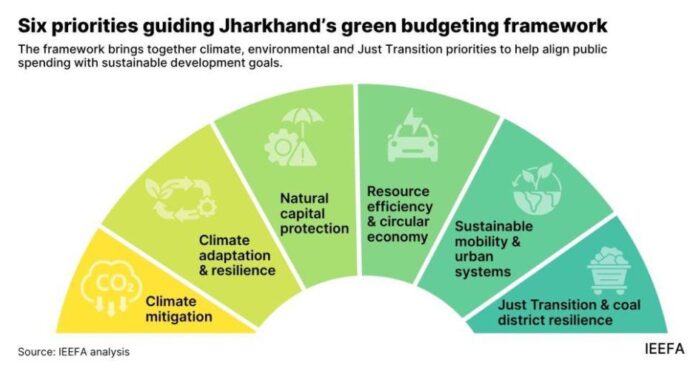
Six Green Budget Objectives Cover Energy, Industry and Coal Communities
The framework is organised around 6 thematic objectives:
Climate mitigation
Climate adaptation and resilience
Natural-capital protection
Resource efficiency and the circular economy
Sustainable mobility and urban systems
Just Transition and coal-district resilience
This structure recognises that Jharkhand’s transition cannot be achieved only by replacing coal-fired power with renewable energy. It will also require cleaner industrial processes, improved resource efficiency, modern transport, resilient cities, alternative employment and economic diversification in coal-dependent districts.
The framework could therefore connect the state’s fiscal policy with its energy, industrial, urban-development and social-protection strategies.
Four Spending Categories and Five Relevance Bands Proposed
IEEFA proposes classifying state expenditure through 4 categories and 5 environmental-relevance bands.
The proportional classification system is intended to provide a more credible assessment than a simple green or non-green label. Government programmes frequently have several objectives, and only part of their expenditure may produce measurable environmental benefits.
For example, a large infrastructure project may include a climate-resilience component without qualifying entirely as green expenditure. Assigning spending across different relevance bands could reduce greenwashing and prevent the state from overstating its climate-related allocations.
A separate Just Transition flag would identify expenditure benefiting coal districts, displaced workers, fossil-fuel-dependent communities and vulnerable populations.
The system would therefore measure both environmental alignment and the distribution of transition support.
Three-Stage Roadmap Starts With Four Departments
Implementation would proceed through 3 stages.
The Essential stage would introduce expenditure tagging, test the methodology in 4 departments and produce an initial green budget statement.
The Developed stage would expand coverage to 12 departments, refine the classification methodology and establish a public green-budget portal.
The Advanced stage would integrate environmental considerations into medium-term expenditure frameworks, public-investment decisions and independent evaluation.
An annual green budget statement would disclose classifications, methodologies and non-sensitive expenditure data. This could improve transparency for investors, lenders, climate-finance institutions and communities affected by the transition.
US$12.5 Billion Needed to Support Workers and Communities
The social cost of Jharkhand’s energy transition will also be substantial. IEEFA estimates that more than US$12.5 billion, or approximately ₹1.05 lakh crore, could be required to reskill, compensate and support workers, communities and livelihoods dependent on the fossil-fuel economy.
Investment will be required in vocational education, entrepreneurship, youth employment, community infrastructure and alternative livelihoods.
The Just Transition flag would help distinguish this spending from general climate expenditure. This is important because reducing emissions without creating alternative employment could deepen economic inequality in coal-producing regions.
Jharkhand’s 217 Coal Mines Require Long-Term Transition Planning
Jharkhand has 217 coal mines, including 101 active mines with combined production capacity of approximately 259 million tonnes per annum.
IEEFA projects that coal production in the state could peak around 2047, followed by mine retirements extending through 2070.
This gives Jharkhand time to pursue a gradual transition, but it also demonstrates why planning cannot be delayed. Mine closure, land remediation and declining coal employment will create long-term liabilities that need to be incorporated into fiscal projections.
Green budgeting could help direct expenditure towards coal-district diversification before closures accelerate.
Economic Diversification Could Generate ₹6.7 Lakh Crore
The transition also presents a major economic opportunity. IEEFA estimates that successful diversification could add approximately ₹6.7 lakh crore, or US$79.3 billion, to Jharkhand’s economy cumulatively by 2070.
Emerging low-carbon sectors could generate new investment, employment, tax revenue and local supply chains, progressively reducing the state’s exposure to coal.
Early public expenditure on grids, industrial infrastructure, workforce development, environmental restoration and project preparation could therefore create future fiscal capacity rather than functioning solely as a transition cost.
Tata Steel’s ₹11,000 Crore Green-Steel Programme
Steel decarbonisation will be central to Jharkhand’s transition because of the sector’s importance to the state economy.
Tata Steel’s proposed green-steel programme represents an investment of around ₹11,000 crore. Its components include approximately ₹7,000 crore for HIsarna/EASyMelt technology, ₹1,500 crore for a Combi Mill and ₹2,600 crore for tinplate expansion.
The individual announced components amount to approximately ₹11,100 crore, indicating that the overall ₹11,000 crore figure is rounded.
The investment could help reduce emissions while retaining steel production, employment and industrial supply chains. Public policy will need to support the surrounding ecosystem, including clean electricity, transmission infrastructure, technology development, skills and financing.
SAIL Decarbonisation Requires Technology and Clean Power
Steel Authority of India Limited’s existing operations make it another important participant in Jharkhand’s industrial transition.
Unlike a greenfield developer, SAIL faces the challenge of decarbonising existing assets. This will require improvements in energy efficiency, production technology, renewable-energy access and workforce capabilities.
The Green Budgeting Framework could therefore support both the creation of new low-carbon industries and the modernisation of established industrial capacity.
Jindal Steel Proposes Over ₹70,000 Crore Investment
Jindal Steel has been associated with proposed investments of more than ₹70,000 crore across steel and energy projects in Jharkhand.
The proposals include a 6 million tonnes per annum integrated steel plant and a 1,400MW nuclear-power project, subject to regulatory and statutory approvals.
The projects demonstrate the potential connection between industrial expansion and low-carbon electricity. However, the investment remains proposed capital and should not be treated as deployed expenditure until approvals, financing, construction and commissioning are completed.
NTPC Identifies 50MWp Solar Opportunity
NTPC’s role in Jharkhand illustrates how companies with strong links to coal can participate in energy diversification.
A 50MWp ground-mounted solar project associated with NTPC’s coal-mining operations in Ranchi has been identified as a potential renewable-energy opportunity.
Although modest compared with Jharkhand’s overall transition requirement, the project demonstrates how existing land, infrastructure, institutional expertise and energy-sector capabilities could support renewable-energy deployment.
Steel MSMEs Need Dedicated Transition Finance
Jharkhand’s smaller steel manufacturers and suppliers will also require financial and technical assistance.
Steel micro, small and medium enterprises frequently face limited access to affordable capital, technology gaps and insufficient project-development capacity. Without dedicated support, smaller companies may struggle to meet emerging emissions and energy-efficiency standards.
Financing mechanisms for MSMEs will be important because these companies support local employment and industrial supply chains beyond the state’s major steel plants.
Public Spending Cannot Finance ₹21.52 Lakh Crore Requirement Alone
Jharkhand cannot meet the entire ₹21.52 lakh crore transition requirement through state expenditure.
IEEFA proposes combining public finance with private investment, concessional debt, international climate funds, green bonds, blended-finance structures and corporate social responsibility funding.
Public expenditure can finance enabling infrastructure, skills, project preparation, data systems, environmental restoration and risk reduction. Commercial capital can then fund bankable renewable-energy, clean-industry and diversification projects.
The Green Budgeting Framework should therefore be viewed as an allocation and transparency mechanism rather than an independent source of transition capital.
Green Budgeting Governance Led by Finance Department
The Department of Finance would serve as the nodal agency, supported by a dedicated green-budgeting cell.
The Planning and Development Department would connect green budgeting with medium-term state development plans, while the Forest, Environment and Climate Change Department would provide technical guidance.
Line departments would undertake scheme-level tagging and reporting. The Task Force on Sustainable Just Transition would support priority-setting, stakeholder engagement and capacity building, while an independent expert panel would review the methodology and tagging quality.
The framework was prepared by Gaurav Upadhyay and Shantanu Srivastava. Upadhyay is IEEFA’s Lead Energy Finance Specialist for India Just Transition in South Asia and has more than 12 years of experience in climate finance, renewable energy and Just Transition. Srivastava leads IEEFA South Asia’s sustainable-finance and climate-risk work.
Jharkhand Green Budget Must Deliver Bankable Projects
The effectiveness of Jharkhand’s Green Budgeting Framework will depend on outcomes rather than the amount of spending classified as green.
The state will need credible data, consistent expenditure tagging, measurable targets, investment-ready projects and coordination across departments. It must also differentiate between announced investment, sanctioned expenditure, deployed capital and completed projects.
Success should be measured through capital mobilised, projects commissioned, emissions reduced, workers reskilled, coal districts diversified and new sources of revenue created.
If effectively implemented, the framework could become the financial architecture for managing Jharkhand’s transition from a coal-dependent economy towards cleaner energy, lower-carbon steel production and more diversified industrial growth.
SHAFANA FAZAL