Australia could unlock a AUD 96 billion-a-year green iron export industry by 2040, but replacing the country’s metallurgical coal exports with low-emissions iron would demand one of the largest industrial investment programs in its history.
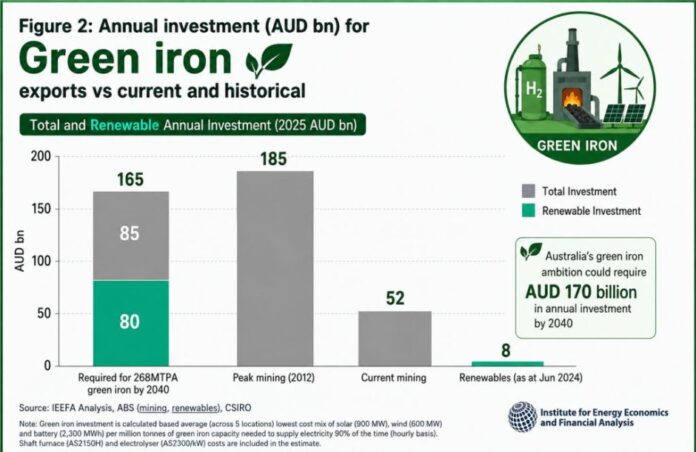
Analysis by the Institute for Energy Economics and Financial Analysis (IEEFA) estimates Australia may need to mobilize around AUD 170 billion in investment every year over the next 14 years to build green iron production alongside the renewable energy, battery storage, transmission and hydrogen infrastructure needed to support it.
The analysis, authored by Lachlan Wright, Energy Finance Analyst, Global Steel Sector at IEEFA, highlights both the enormous economic opportunity and the financing challenge facing Australia as global steelmakers seek lower-carbon alternatives to coal-based iron production.
Australia Green Iron Opportunity Could Reach 268 Million Tonnes
Australia currently exports approximately 150 million tonnes of metallurgical coal annually, making the commodity an important part of its resources economy.
Based on the relationship between metallurgical coal consumption and blast furnace iron production, those exports are equivalent to roughly 268 million tonnes of green iron, IEEFA report said.
Replacing that coal-export value chain with domestically produced green iron could fundamentally reshape Australia’s resources sector while allowing more processing and value creation to remain within the country.
The potential prize is significant. Green iron exports could generate around AUD 96 billion in annual export revenue by 2040, based on projections associated with the Australian government’s Green Iron Investment Fund.
Achieving that scale, however, would require a dramatic increase in capital deployment.
Australia currently records approximately AUD 51 billion in mining investment. The estimated AUD 170 billion annual green iron investment requirement would be more than three times that level and approach the country’s inflation-adjusted mining investment peak of approximately AUD 190 billion in 2012.
The comparison illustrates why financing is emerging as one of the biggest hurdles to Australia becoming a global green iron powerhouse.
Green Iron Plants Could Cost AUD 7-10 Billion per Million Tonnes
Green iron production is highly capital intensive before the associated renewable electricity infrastructure is considered.
Developing 1 million tonnes per annum of green iron production capacity in Australia could require approximately AUD 7 billion to AUD 10 billion of investment.
Major technology components carry substantial costs. Ironmaking shaft furnaces have benchmark capital costs of around AUD 2,150 per tonne, while electrolyzers are estimated at approximately AUD 2,300 per kilowatt.
International green steel projects demonstrate the financing challenge.
Sweden’s Stegra project secured EUR 6.5 billion in initial financing and subsequently raised another EUR 1.4 billion. The project has an estimated capital intensity of around EUR 4 billion for every 1 million tonnes of production capacity.
Australia could face even greater capital requirements because projects may not benefit from the same abundance of local hydropower available to Swedish industrial developments.
That makes access to low-cost renewable electricity one of the most important factors determining whether Australian green iron can compete internationally.
Renewable Energy Could Absorb Half of Green Iron Investment
Around 50 percent of the investment required for green iron development could be directed toward dedicated clean-energy infrastructure.
Producing 1 million tonnes of green iron while maintaining a 90 percent hourly power supply could require approximately 900 MW of solar capacity, 600 MW of wind generation and 2,300 MWh of battery storage.
Scaling those requirements across a large green iron export industry would create enormous demand for renewable power projects, batteries, transmission infrastructure and associated grid investment.
Current renewable investment is far below the potential requirement. Annualized investment in Australian renewable energy stood at approximately AUD 9.5 billion in the June quarter of 2024.
Closing the gap between existing clean-energy investment and the infrastructure required for green iron represents a major challenge for governments, utilities, renewable developers and institutional investors.
Whyalla Green Iron Project Shows Enormous Power Demand
A potential 2 million tonne green iron facility at Whyalla in South Australia demonstrates how dramatically green iron could change regional electricity requirements.
IEEFA estimates a plant of this size could require approximately 2.5 times the utility-scale solar and battery capacity currently installed across South Australia’s entire electricity grid.
It could additionally require around 1.1 GW of new wind capacity, equivalent to approximately 40 percent of South Australia’s existing wind generation capacity.
Green iron development therefore cannot be treated simply as construction of new industrial plants. Renewable generation, storage, transmission and ironmaking capacity would need to expand together.
Failure to coordinate those investments could create power shortages, infrastructure bottlenecks, higher project costs and delays.
Green Iron Economics Depend on USD 30-40/MWh Renewable Power
Electricity prices could ultimately determine whether Australian green iron becomes globally competitive.
Firmed renewable electricity may need to cost approximately USD 30 to USD 40 per MWh for green iron to achieve price parity with conventional coal-based production.
IEEFA indicates such electricity prices could become achievable in selected regions by 2035, potentially improving the economics of large-scale green iron production.
Green premiums could also help bridge the gap before full cost parity is achieved.
Emerging voluntary markets for near-zero-emissions iron and steel suggest some customers could accept price premiums of approximately 20 percent to 30 percent for lower-carbon products.
Long-term purchasing commitments from steelmakers and industrial customers willing to pay such premiums could provide green iron developers with stronger revenue visibility and improve their ability to secure project financing.
Carbon Prices Could Strengthen Green Iron Competitiveness
Carbon pricing is another factor that could influence demand for Australian green iron.
The European Union Emissions Trading System carbon price is approximately EUR 74, or around USD 86 per tonne of CO2 equivalent, according to the figures analyzed.
Steel producers currently receive more than 95 percent of their allowances free, but that share is expected to fall to below 50 percent by 2031. Declining free allowances could increase the financial pressure on carbon-intensive steel production and strengthen demand for lower-emissions alternatives.
China’s emissions trading system has a carbon price of approximately RMB 100, equivalent to around USD 15 per tonne. Steel entered China’s emissions trading system in 2025, although full free allowances remain an important feature of the market.
Japan’s carbon tax is much lower at around JPY 2,890, equivalent to approximately USD 2 per tonne, providing a considerably weaker carbon-price signal for investment decisions in the steel sector.
These differences mean the economics of importing Australian green iron could vary substantially across major steel-producing markets.
Australia Needs Green Iron, Renewable Energy and Grid Investment to Move Together
Australia already has extensive experience building resources supply chains, but green iron introduces a new level of complexity.
The rapid expansion of iron ore exports during the 2000s was supported partly by vertically integrated supply chains connecting mines with railways and ports. Metallurgical coal developed through a more fragmented ownership model that required greater coordination.
Green iron will need to connect iron ore, renewable generation, batteries, transmission networks, electrolyzers, ironmaking plants and export infrastructure.
Unlike a conventional mining development, many of these assets must become available on compatible timelines. A completed green iron plant without adequate renewable electricity would face production constraints, while major renewable projects without committed industrial demand could struggle to secure financing.
Government Policy Could Help Unlock AUD 170 Billion Annual Investment
Mobilizing approximately AUD 170 billion every year cannot depend solely on government funding. Policy will instead need to create conditions capable of attracting private infrastructure, energy and industrial capital at unprecedented scale.
One major obstacle is the absence of a sufficiently strong near-term price signal for green iron. Developers must commit billions of dollars before future electricity prices, customer demand, green premiums and carbon-market conditions are fully known.
Policy mechanisms such as contracts for difference, renewable portfolio standards and feed-in tariffs could provide greater revenue certainty. Long-term funding commitments and purchasing agreements could similarly reduce investment risk.
The objective would be to use government support to accelerate early projects and establish markets that can ultimately attract much larger volumes of private capital.
Australia Green Iron Industry Faces Massive 2040 Scale-Up Challenge
Australia has the iron ore resources and renewable energy potential to become a major green iron exporter, but the numbers demonstrate the extraordinary scale of the transition.
Replacing the equivalent of 150 million tonnes of annual metallurgical coal exports could require production of around 268 million tonnes of green iron, potentially creating AUD 96 billion in annual exports by 2040.
Getting there could demand around AUD 170 billion of annual investment for 14 years, compared with current mining investment of approximately AUD 51 billion and the historical real-terms mining investment peak of about AUD 190 billion in 2012.
For every 1 million tonnes of green iron capacity, investment could reach AUD 7 billion to AUD 10 billion, while the supporting electricity system could require roughly 900 MW of solar, 600 MW of wind and 2,300 MWh of battery storage to provide a 90 percent hourly power supply.
The economics will depend heavily on Australia delivering firmed renewable electricity at around USD 30-40/MWh, potentially achievable in some locations by 2035, while securing customers willing to support an emerging 20-30 percent green premium.
Australia’s green iron opportunity is therefore much larger than a new mining or manufacturing industry. It represents a potential restructuring of the country’s resources, electricity and export economy. Coordinating investment in renewable power, storage, transmission, hydrogen, ironmaking technology and export infrastructure will determine whether Australia can convert its vast iron ore and clean-energy resources into a competitive AUD 96 billion green iron export industry by 2040.
SHAFANA FAZAL