
Leonardo has significantly strengthened its sustainability performance in 2025 by reducing greenhouse gas emissions, expanding climate investments, advancing circular manufacturing, and earning recognition from leading ESG rating agencies. The aerospace, defense, and security company continues to integrate sustainability across its operations through science-based climate targets, supply chain decarbonization, renewable energy projects, and innovation.
Leonardo strengthens climate governance
Sustainability remains embedded within Leonardo’s corporate governance. Chief Sustainability Officer Raffaella Luglini leads the company’s ESG strategy and reports directly to the Chief Executive Officer. Renata Mele, Senior Vice President and Head of Sustainability, oversees climate initiatives, ESG implementation, and sustainability reporting, while Ben Knight, Head of Sustainability in the UK, leads regional sustainability programs aligned with national net-zero objectives.
Operational emissions continue to decline
Leonardo has achieved a 44 percent reduction in Scope 1 and Scope 2 greenhouse gas emissions compared with its 2020 baseline using the market-based methodology, Leonardo sustainability report 2025 indicated.
Total operational emissions declined to 373,101 metric tons of CO₂e, representing a 7.15 percent reduction compared with 2024.
The company also improved emissions intensity by 9.5 percent relative to revenue, demonstrating continued decoupling of business growth from operational carbon emissions.
Direct Scope 1 emissions fell to 185,262 metric tons of CO₂e, representing a 48.5 percent reduction since 2020. Leonardo attributed much of this improvement to replacing sulfur hexafluoride industrial gases used in helicopter manufacturing with lower-emission alternatives.
Market-based Scope 2 emissions reached 53,090 metric tons of CO₂e, while location-based Scope 2 emissions declined to 187,839 metric tons of CO₂e, representing a 13.19 percent year-on-year reduction as electricity grids increasingly incorporated renewable energy.
Supply chain emissions remain the biggest challenge
Leonardo continues expanding its Scope 3 emissions reporting to improve sustainability across its value chain.
Purchased Goods and Services remain the largest contributor, generating 2,843,800 metric tons of CO₂e, accounting for 50.54 percent of total Scope 3 emissions.
The Use of Sold Products generated 2,449,608 metric tons of CO₂e, representing 43.53 percent of Scope 3 emissions, reflecting lifetime fuel consumption of aerospace and defense platforms.
Capital Goods contributed another 142,219 metric tons of CO₂e, highlighting the importance of reducing emissions throughout product lifecycles.
Science-based climate targets guide decarbonization
Leonardo continues aligning its sustainability roadmap with internationally recognized science-based targets.
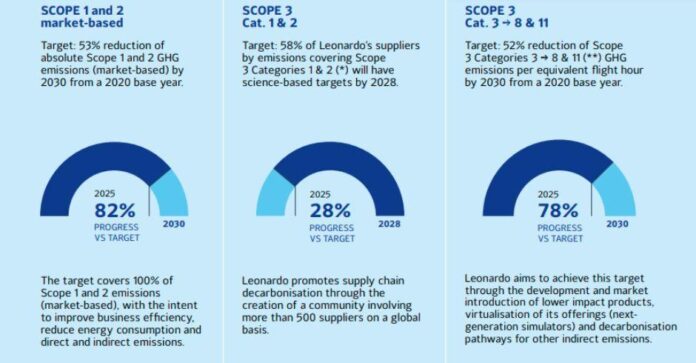
The company aims to reduce absolute Scope 1 and Scope 2 emissions by 53 percent by 2030 while targeting a 52 percent reduction in Scope 3 emissions per equivalent flight hour.
Leonardo also requires 58 percent of suppliers, measured by emissions volume, to establish science-based climate targets by 2028, extending decarbonization efforts across its supply chain.
€1.2 billion investment supports sustainability projects
Leonardo has committed €1.2 billion to sustainable transition initiatives, including solar photovoltaic installations and energy-efficiency improvements across manufacturing facilities.
The company has also linked 79 percent of its financing, representing approximately €5 billion, to sustainability performance through sustainability-linked revolving credit facilities and corporate bonds.
Research and innovation remain central to Leonardo’s sustainability strategy, with 15 percent of annual revenue invested in research and development.
These investments support Sustainable Aviation Fuel compatibility, advanced digital engineering using the Davinci-1 supercomputer, and circular manufacturing programs such as CRM4Defence, which focuses on recovering valuable metals and carbon fiber materials from industrial production.
Leonardo earns industry-leading ESG recognition
Leonardo strengthened its position among the world’s leading sustainable aerospace and defense companies during 2025.
The company increased its S&P Global ESG Score to 83 out of 100, retaining the No. 1 position in the Aerospace and Defense industry for the sixth consecutive year.
Leonardo also improved its ISS ESG Quality Rating to B- while maintaining Prime Status.
Its MSCI ESG Rating was upgraded from BBB to A, while the company achieved the highest possible CDP Climate Change score of A, securing a place on the Climate Change A List.
Sustainability outlook
Leonardo’s 2025 sustainability performance demonstrates continued progress in reducing operational emissions while investing in renewable energy, cleaner manufacturing, circular economy initiatives, and supply chain decarbonization.
With a 44 percent reduction in Scope 1 and Scope 2 emissions since 2020, a €1.2 billion sustainability investment program, €5 billion in sustainability-linked financing, ambitious science-based climate targets, and recognition from major ESG rating agencies, Leonardo continues strengthening its position as one of the aerospace and defense industry’s sustainability leaders.
SHAFANA FAZAL
