
Global solar photovoltaic (PV) power continued its remarkable cost decline in 2025, with utility-scale project costs falling for the 15th consecutive year, making solar one of the world’s cheapest sources of electricity.
According to the latest IRENA report, global solar PV capacity exceeded 2,393 GW, while installation costs dropped to USD 667/kW, an 88 percent reduction compared with 2010.
Global Solar PV Capacity Reaches 2,393 GW
Solar PV remained the fastest-growing renewable energy technology in 2025, with approximately 511 GW of new capacity commissioned worldwide, representing 4 percent growth compared with 2024 despite expectations of slower expansion following policy changes in China, IRENA report said.
Global installed solar PV capacity has now reached more than 2,393 GW.
Utility-scale projects accounted for 295 GW, representing 58 percent of all new solar installations during the year.
China, India, and the United States remained the world’s three largest solar markets. China contributed approximately 62 percent of global utility-scale solar installations during 2025.
Solar Plus Battery Storage Gains Momentum
As electricity grids experience increasing congestion, curtailment, and price volatility, developers are rapidly pairing solar farms with battery energy storage systems (BESS).
During 2025, 25 percent of newly installed utility-scale solar capacity worldwide included battery storage.
According to IRENA’s 2026 analysis of 24/7 renewable electricity, firm electricity generated by solar-plus-BESS at 95 percent reliability can now achieve a levelized cost of electricity (LCOE) below USD 85/MWh at high-quality project sites.
The combination of solar and battery storage is helping utilities maximize constrained grid connections, shift electricity generation to higher-value periods, and improve project economics.
Utility-Scale Solar Costs Continue Falling
The economics of solar PV improved further in 2025.
IRENA reported that the global weighted-average total installed cost (TIC) of utility-scale solar projects declined 6 percent year-on-year to USD 667/kW, extending a cost reduction trend that has now lasted 15 consecutive years.
Compared with 2010, utility-scale solar installation costs have fallen by 88 percent, highlighting the industry’s extraordinary improvement in manufacturing efficiency, supply chains, and project execution.
For projects commissioned in 2025, installation costs ranged between USD 383/kW and USD 1,211/kW across the 5th and 95th percentiles.
The 95th percentile cost declined 27 percent compared with 2024, while the 5th percentile dropped 24 percent. The gap between the lowest- and highest-cost projects was the narrowest recorded to date, indicating increasingly competitive pricing across global markets.
Compared with 2010, the 5th percentile installation cost has fallen 90 percent, while the 95th percentile has declined 87 percent.
Europe Records Lowest Regional Solar Costs
Among world regions, Europe recorded the lowest weighted-average installation cost for utility-scale solar projects commissioned in 2025 at USD 823/kW.
Eurasia reported the highest regional cost at USD 998/kW.
Africa achieved the largest long-term cost improvement. Between 2015 and 2025, the continent reduced average installation costs by 76 percent, falling from USD 3,520/kW to USD 837/kW, including a 25 percent decline during 2025 alone.
China and India Deliver Lowest Project Costs
At the country level, China and India continued to offer the world’s lowest utility-scale solar installation costs.
China recorded a weighted-average installation cost of USD 533/kW, while India followed closely at USD 545/kW.
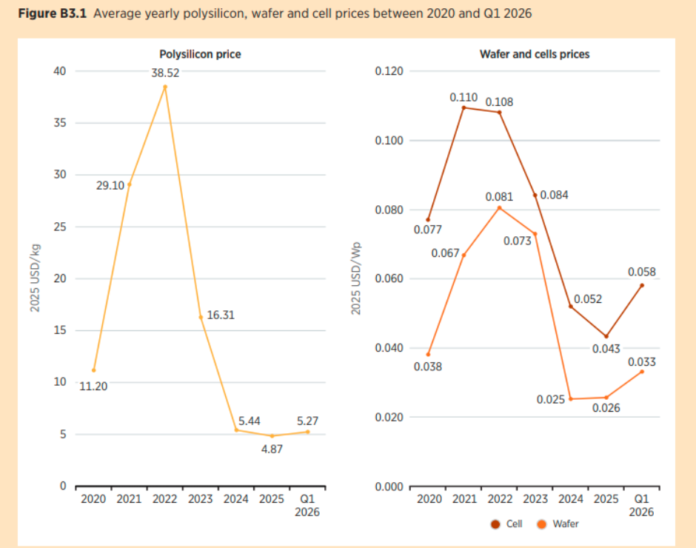
China’s costs declined another 12 percent compared with 2024, largely because module prices remained extremely low as manufacturers faced excess production capacity, weaker export demand, and intense market competition that pushed selling prices close to—or even below—manufacturing costs.
Among the four largest solar markets, the United States reported the highest installation cost at USD 1,180/kW, representing a 9 percent increase over 2024 due to higher import tariffs and ongoing supply chain pressures.
Brazil Leads Long-Term Cost Reductions
Brazil recorded the largest long-term decline among major solar markets.
Between 2015 and 2025, utility-scale installation costs fell 74 percent, dropping from USD 2,558/kW to USD 672/kW.
Over the same period:
China reduced costs by 68 percent
India achieved a 66 percent reduction
The United States lowered costs by 62 percent
Among the top 15 solar markets, installation costs declined in 6 countries between 2024 and 2025.
The largest annual reduction occurred in Uzbekistan, where costs fell 48 percent while deployment increased by more than 50 percent. Increased competition, broader project sizes, and greater participation from international developers helped improve economies of scale and reduce costs.
Brazil also reduced costs by 10 percent during the year.
Germany Records Largest Cost Increase
Not every market benefited from lower project costs.
Germany experienced the highest annual increase among leading solar markets, with installation costs rising 40 percent to USD 850/kW, although this remained close to the European average of USD 823/kW.
Higher balance-of-system (BoS) expenses offset falling solar module prices.
Other European markets also recorded cost increases:
Poland: 28 percent
Italy: 23 percent
Meanwhile, project costs declined in several countries:
France: 24 percent decrease to USD 860/kW
Spain: 18 percent decrease to USD 690/kW
Solar Technology Continues Advancing
Technology improvements continued to support declining project costs and higher energy output.
During 2025:
Bifacial heterojunction (HJT) modules achieved an average efficiency of 24.14 percent
Bifacial TOPCon modules reached 24.43 percent
Bifacial XBC modules achieved 24.80 percent
TOPCon technology has now become the industry’s dominant architecture, accounting for 88 percent of the global solar module market, while older PERC technology continues to be phased out.
Manufacturers are also accelerating development of silicon-perovskite tandem solar cells, which have already demonstrated efficiencies of up to 34.85 percent in laboratory settings. Large-scale commercial deployment is expected within the next two years, supported by ongoing pilot production, durability testing, and outdoor performance trials.
With utility-scale installation costs down 88 percent since 2010, battery storage becoming increasingly integrated, and next-generation solar technologies nearing commercialization, solar PV continues to strengthen its position as the world’s most affordable and scalable source of new electricity generation.
BABURAJAN KIZHAKEDATH
