
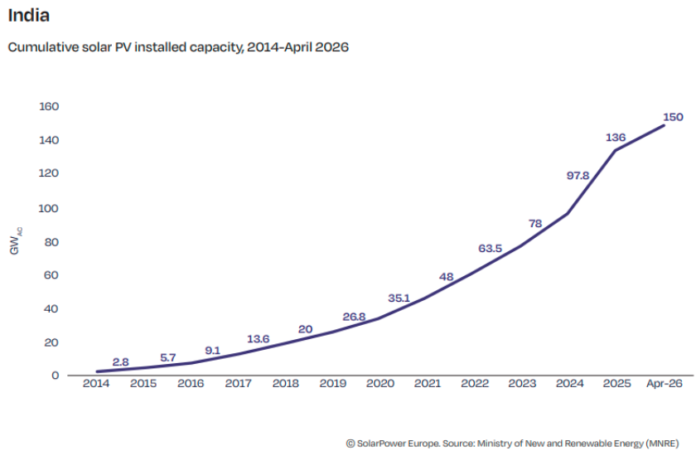
India has strengthened its position as one of the world’s fastest-growing solar energy markets, emerging as the second-largest solar market globally in 2025 and positioning itself as the leading growth engine outside China. According to the Global Solar Market Outlook 2026-2030 from SolarPower Europe, India installed a record 45.7 GW of new solar capacity in 2025, representing annual growth of 49 percent and adding approximately 15 GW more capacity than the previous year.
India accounted for 7 percent of global solar installations in 2025, while cumulative installed solar capacity reached 166 GW, making the country the third-largest solar market worldwide in total installed capacity. The market remains heavily driven by utility-scale projects, which contributed 78 percent of new installations, while rooftop solar accounted for the remaining 22 percent.
India’s solar momentum is expected to accelerate further in 2026. Annual installations are projected to increase from 45.7 GW in 2025 to 57.2 GW in 2026, reinforcing India’s role as the largest solar growth market outside China. Within the Asia-Pacific region, India’s share of solar installations is forecast to rise from 9 percent to 14 percent in 2026 as large utility-scale projects, commercial and industrial solar deployments, and supportive government policies continue driving growth.
Looking ahead, India is expected to install 363 GW of new solar capacity between 2026 and 2030, maintaining its position as the world’s second-largest solar market after China. This forecast represents a significant upward revision of 53 percent, or an additional 126 GW, compared with previous projections, reflecting stronger confidence in India’s solar deployment pipeline, policy framework, and manufacturing ecosystem.
India’s cumulative solar capacity is projected to reach between 325 GWAC and 385 GWAC by 2030, exceeding the country’s own target range of 280-300 GWAC. The expansion will be supported by continued deployment under the PM Surya Ghar rooftop solar program, the rollout of PM-KUSUM 2.0 for agricultural solarization, growth in commercial and industrial solar installations, wider adoption of Battery Energy Storage Systems (BESS), and increasing investments in hybrid renewable energy projects.
The rapid development of domestic solar manufacturing across the value chain is also strengthening supply chain resilience and reducing dependence on imports. Combined with improvements in grid infrastructure, project execution, energy storage deployment, and transmission capacity, India is well positioned to sustain long-term solar growth and play a central role in the global clean energy transition through 2030.
BABURAJAN KIZHAKEDATH
