


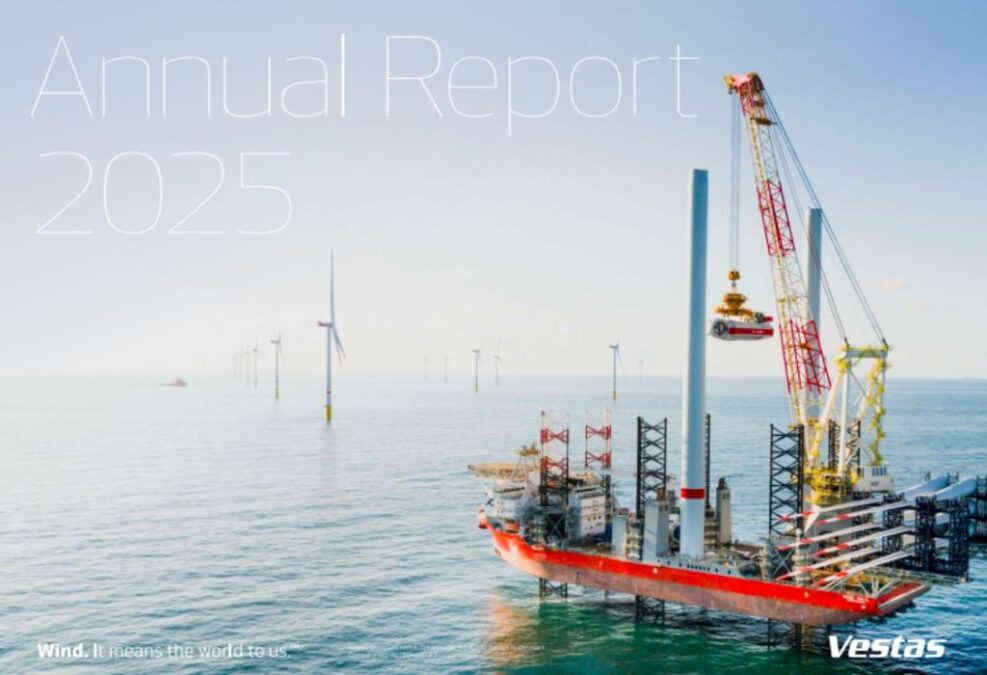
Vestas Annual Report 2025 has revealed a year of strategic recovery and operational strengthening, reinforcing its role at the center of the global renewable energy transition.
Vestas reported total revenue of EUR 18.8 billion in 2025, up from EUR 17.3 billion in 2024, reflecting strong execution and a solid order backlog.
Segment performance:
Power Solutions (Turbines): EUR 15.1 billion
Onshore: EUR 12.6 billion
Offshore: EUR 2.4 billion
Service: EUR 3.8 billion
The company achieved an EBIT margin of 5.7 percent before special items, supported by disciplined project execution and improved pricing. Profit for the period rose sharply to EUR 780 million compared to EUR 77 million in 2024, highlighting a significant recovery in operational performance.
Vestas closed the year with a record combined order backlog of €71.9 billion, providing strong long-term revenue visibility and financial stability.
Capital Expenditure Focused on Offshore Growth
Vestas maintained steady investment momentum in 2025, with cash flow from investing activities totaling approximately EUR 1.16 billion for the year.
A key highlight is that 98 percent of Vestas’ capital expenditure is aligned with the EU Taxonomy, as investments in manufacturing, technology, and development are classified as sustainable.
Major capex initiatives included:
Ramping up offshore manufacturing capacity
Expanding four offshore factories across Europe
Strengthening supply chain and production capabilities
These investments are designed to support increasing demand for large-scale offshore wind installations.
Strategy Reset and Long-Term Financial Targets
Vestas’ vision remains to become the global leader in sustainable energy solutions across Onshore, Offshore, Service, and Development.
Long-term ambitions include:
Revenue growth faster than the market
EBIT margin of at least 10 percent
Service EBIT margin of 25 percent
Return on Capital Employed of 20 percent over the cycle
In 2025, ROCE reached 11.8 percent, reflecting steady progress toward the long-term target.
In August 2025, the company launched an operating model reset aimed at simplifying processes, reducing bureaucracy, and improving efficiency through 2026. This initiative is expected to further strengthen profitability and competitiveness.
Strong Order Backlog and Landmark Offshore Projects
Vestas ended 2025 with a combined order backlog of EUR 71.9 billion:
Wind turbines: EUR 33.2 billion
Service: EUR 38.7 billion
Full-year order intake totaled 16.3 GW, valued at EUR 17.4 billion, underscoring robust global demand.
A key milestone was achieved when the flagship V236-15.0 MW offshore turbine delivered its first power at the He Dreiht project in the German North Sea. Installation also began at the Baltic Power offshore wind project, reinforcing Vestas’ leadership in next-generation offshore technology.
Workforce Expansion and Safety Improvements
Vestas employed approximately 37,000 people globally in 2025. Manufacturing expansions in Poland and Italy now support nearly 4,000 jobs, contributing to economic revitalization in rural and coastal regions.
Safety performance improved, with the Total Recordable Injury Rate declining to 2.5 from 2.7 in 2024, reflecting enhanced operational standards across global sites.
CO2 Emissions and Sustainability Performance
Vestas continues to lead on sustainability metrics:
Scope 1 and 2 emissions: 109 kt CO2e in 2025
Scope 3 emissions: 9.34 Mt CO2e, accounting for more than 99 percent of total emissions and primarily linked to purchased goods and transportation
Wind turbines produced and shipped in 2025 are expected to avoid approximately 463 million tonnes of greenhouse gas emissions over their operational lifetime.
Lifecycle carbon intensity remains extremely low, with Vestas turbines generating electricity at 4 to 9 grams of CO2 per kWh. This compares favorably with solar at around 30 grams and coal at roughly 1,060 grams per kWh.
In addition, more than 97 percent of a turbine’s mass is now recyclable, reinforcing Vestas’ circular economy strategy.
Industrializing the Global Energy Transition
Vestas describes 2025 as a turning point in the energy transition, shifting from policy ambition to full-scale industrial deployment. The company positions wind energy as a cornerstone of decarbonizing power systems and enhancing national energy security.
To accelerate deployment, Vestas is working closely with governments to streamline permitting frameworks and modernize aging transmission infrastructure. Advanced digital solutions are being integrated to manage wind variability and maintain grid reliability as fossil fuel plants are gradually retired.
Beyond electricity generation, Vestas is targeting green hydrogen and Power-to-X fuels as the next wave of renewable demand. By optimizing turbine technology to power large-scale electrolyzers, the company aims to decarbonize hard-to-abate sectors such as heavy shipping and aviation. This strategy expands the addressable market for wind energy, anchoring it as the foundation of a broader sustainable industrial ecosystem.
Strategic Capex and Offshore Expansion
Capital expenditure in 2025 totaled €1.25 billion, primarily directed toward scaling next-generation turbine platforms and expanding global manufacturing capacity. A major focus was the production ramp-up of the V236-15.0 MW offshore turbine, one of the most powerful in the market.
Vestas continues to execute its “Value over Volume” strategy, prioritizing profitability and product standardization to reduce the levelized cost of energy. During the year, the company achieved the milestone of 200 gigawatts of installed capacity across 88 countries, strengthening its global footprint in both onshore and offshore wind.
Emissions Reduction and Sustainability Performance
Sustainability remains embedded in Vestas’ operating model, with reporting aligned to European Sustainability Reporting Standards. In 2025, the company achieved a 42 percent reduction in Scope 1 and Scope 2 greenhouse gas emissions compared to its 2019 baseline.
Wind turbines shipped during the year are expected to avoid 463 million tonnes of CO2e over their operational lifetime. Vestas turbines generate electricity at just 4 to 9 grams of CO2e per kilowatt-hour, maintaining a significantly lower carbon intensity than conventional fossil fuel generation.
Circular Economy and Biodiversity Focus
Vestas continues to advance its circular economy roadmap, targeting zero-waste wind turbines by 2040. The company reports a rotor recyclability rate of 94 percent, supported by Cetec technology that enables epoxy-based blades to be recycled into virgin-grade materials.
Under the EU Taxonomy framework, Vestas classifies its core activities as enabling substantial climate change mitigation. Biodiversity considerations are integrated into project planning, with comprehensive environmental impact assessments conducted to mitigate risks to avian species and marine ecosystems.
Workforce Expansion and Governance Alignment
By the end of 2025, Vestas employed approximately 37,000 people globally. Workforce development remained a priority, particularly in offshore wind markets, supporting domestic green job creation across its 88-country footprint.
Executive remuneration follows a performance-based model aligned with long-term shareholder value creation. Compensation for the Executive Management Team includes fixed salaries and variable incentives tied to financial performance, safety indicators, and carbon reduction milestones.
Positioned for Sustainable Industrial Growth
Vestas’ Annual Report 2025 highlights a disciplined financial recovery combined with a strategic scale-up of renewable manufacturing and service capabilities. With a record backlog, improved margins, and expanding global capacity, the company is positioning wind power as a central pillar of industrial decarbonization and long-term energy security. FASNA SHABEER