


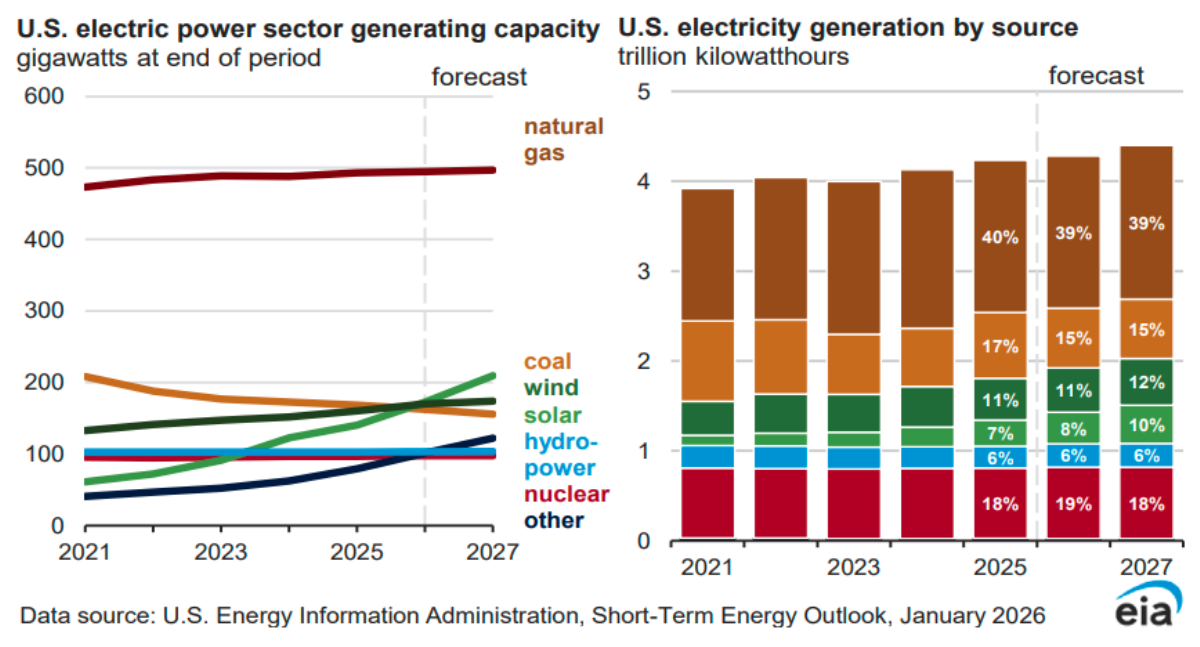
Wind energy in the United States is set for steady growth over the next few years, reinforcing its critical role in the nation’s transition to cleaner electricity.
According to the U.S. Energy Information Administration’s (EIA) January 2026 Short-Term Energy Outlook (STEO), wind generation is projected to rise by about 6 percent annually, adding roughly 28 billion kilowatt hours (BkWh) in both 2026 and 2027. This growth reflects the continued deployment of onshore wind projects and accounts for the announced pause on selected offshore wind initiatives.
Wind Generation Trends Nationwide
Total U.S. wind generation is forecast to increase from 464.7 BkWh in 2025 to 493.0 BkWh in 2026, reaching 520.6 BkWh by 2027. Seasonal fluctuations remain significant, with quarterly generation peaking in the first and fourth quarters each year due to prevailing wind patterns. This steady expansion positions wind power as a key contributor to renewable electricity growth, alongside solar and hydropower.
Regional Wind Highlights
- New England (ISO-NE): Wind generation is relatively small but growing, rising from 4.8 BkWh in 2025 to 9.4 BkWh by 2027. Incremental growth reflects new distributed and utility-scale installations.
- New York (NYISO): Solar output increases steadily from 6.8 BkWh in 2025 to 10.5 BkWh in 2027, supported by state clean energy mandates and ongoing investments in onshore wind farms.
- Mid-Atlantic (PJM): Wind generation rises from 31.7 BkWh in 2025 to 41.8 BkWh in 2027, helping diversify the region’s power mix alongside nuclear and natural gas.
- Midwest (MISO): Wind continues as a major regional power source, generating roughly 100 BkWh annually from 2025 through 2027. Both onshore wind expansion and upgrades to existing turbines contribute to this stable output.
- Northwest: Wind generation grows steadily from 57.4 BkWh in 2025 to 70.9 BkWh in 2027, complementing the region’s hydropower-dominated energy mix.
- Southwest: Wind output increases modestly, from 13.9 BkWh in 2025 to 15.1 BkWh in 2027, as the region relies primarily on solar and natural gas generation.
- California: Wind generation grows slightly from 16.2 BkWh in 2025 to 17.4 BkWh in 2027. While solar dominates the state’s renewable portfolio, wind remains an important contributor to California’s clean energy targets.
Wind Energy’s Role in U.S. Renewable Growth
Wind power continues to offset fossil fuel-based electricity generation and supports broader renewable energy expansion. Combined with solar energy, wind is expected to drive most of the increase in U.S. renewable electricity supply through 2027. Onshore wind projects remain the primary driver of growth, with offshore developments contributing once the paused projects resume.
Conclusion
Steady expansion of wind energy across multiple regions of the United States highlights its growing importance in the nation’s energy mix. From the wind-rich plains of the Midwest to coastal and mountain regions, wind power complements solar and hydro resources to strengthen the U.S. transition toward a low-carbon future. With continued investment in wind infrastructure and supportive policies, wind energy is set to remain a cornerstone of the U.S. renewable energy landscape through 2027 and beyond.
BABURAJAN KIZHAKEDATH