


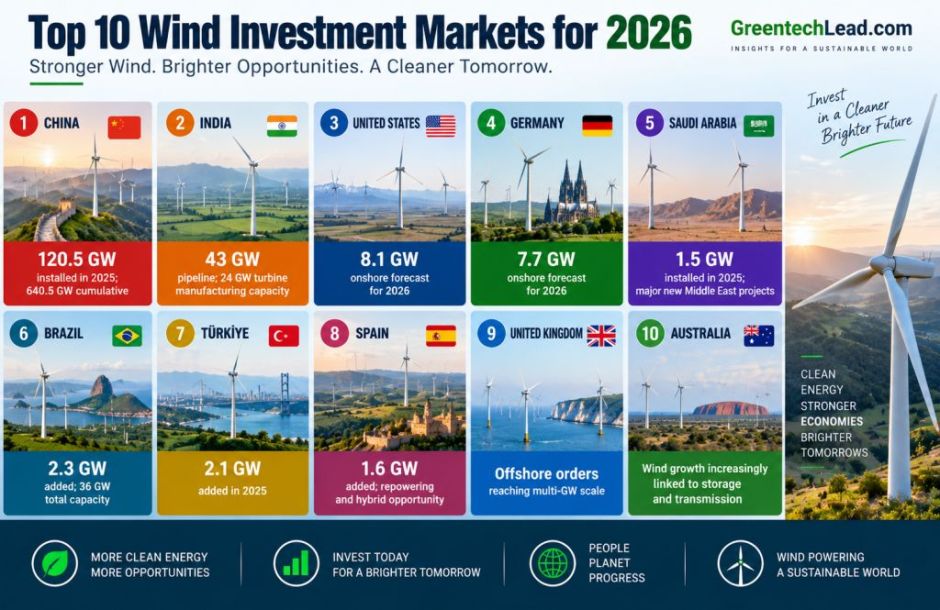
Global wind investment is entering a new phase in 2026 as China dominates installations and manufacturing, India builds a 43 GW development pipeline, the US heads toward 8.1 GW of onshore additions, Germany targets 7.7 GW, and Saudi Arabia emerges as a gigawatt-scale Middle East market.
Worldwide wind installations reached a record 165 GW in 2025, up 40 percent, taking cumulative capacity to 1,299 GW, according to the Global Wind Energy Council. Of the additions, 155.3 GW was onshore and 9.3 GW offshore.
China installed 120.5 GW, followed by the US with 6.9 GW, India with 6.3 GW, Germany with 5.7 GW and Brazil with 2.3 GW. Together, the five largest markets accounted for 86 percent of global additions.
For investors, however, installation volumes tell only part of the story. Grid availability, storage, turbine manufacturing, repowering, electricity demand and realised power prices increasingly determine returns.
Rystad Energy’s 2026 wind outlook highlights grid congestion, curtailment and storage alongside new capacity as important considerations for wind investment.
1. China: 120.5 GW Makes It the Wind Superpower
China installed an extraordinary 120.5 GW of wind power in 2025, taking cumulative capacity to approximately 640.5 GW. It accounted for roughly 73 percent of global new onshore installations.
China also dominates turbine manufacturing. The five largest suppliers by 2025 installations were Chinese: Goldwind 29.7 GW, Envision Energy 21.8 GW, Windey 19.8 GW, Mingyang 18.6 GW and SANY 15.1 GW.
More than 124 GW of future wind capacity was approved during 2025 under China’s market-oriented pricing mechanism.
For investors, China’s next opportunity therefore extends beyond turbines into transmission, storage and grid flexibility required to integrate enormous renewable volumes.
2. India: 43 GW Pipeline and 24 GW Manufacturing Base
India offers one of the strongest combinations of wind deployment and manufacturing growth outside China.
The country added a record 6.05 GW in FY2025-26, while installed wind capacity reached approximately 58.14 GW by July 31, 2026.
More importantly, India has a 43 GW wind development pipeline and approximately 24 GW of annual turbine manufacturing capacity, up from about 10 GW in 2014. Wind-equipment exports exceeded ₹12,000 crore in FY26, while domestic value addition has reached around 70-80 percent.
India is targeting approximately 100 GW of wind capacity by 2030 and 155 GW by 2035.
Suzlon demonstrates the scale of the opportunity. In August 2026, the company and Andhra Pradesh broke ground on 1,325 MW of wind projects expected to attract ₹10,500 crore of investment and create around 1,600 jobs.
GE Vernova has also secured 263.4 MW of highlighted 2026 orders from Powerica and Enfinity Global.
India therefore offers opportunities across projects, turbines, blades, towers, generators, transmission and repowering.
3. United States: 8.1 GW Meets Rising Electricity Demand
The US installed 6.9 GW in 2025, taking cumulative wind capacity to approximately 161.2 GW.
Rystad Energy expects onshore additions to increase to about 8.1 GW in 2026, partly as developers advance projects ahead of important tax-credit deadlines.
The longer-term investment case is being strengthened by electricity demand from data centres, AI infrastructure, manufacturing and electrification.
Repowering is another major opportunity. Developers can replace ageing turbines while retaining valuable grid connections, land agreements and parts of existing infrastructure.
That makes the US opportunity broader than new wind farms, extending into repowering, storage, transmission and corporate renewable-energy contracts.
4. Germany: 7.7 GW Onshore Growth Plus Offshore Investment
Germany could be Europe’s strongest onshore growth market in 2026.
Rystad forecasts approximately 7.7 GW of new onshore wind capacity, compared with 5.7 GW installed in 2025.
Offshore investment is also significant. EnBW’s 960 MW He Dreiht project uses 64 Vestas V236-15 MW turbines and represents approximately €2.4 billion of investment.
By the end of Q2 2026, 59 of the 64 turbines had been installed and 43 connected to the grid, representing 645 MW.
Germany therefore combines rapid onshore development, offshore projects and significant repowering potential.
5. Saudi Arabia: Middle East Wind Moves Into Gigawatt Scale
Saudi Arabia commissioned approximately 1.5 GW of new wind capacity in 2025, making it one of only 14 markets globally to add more than 1 GW.
Rystad expects major Saudi projects to help drive Middle East wind expansion during 2026.
The investment opportunity is particularly attractive because Saudi Arabia is simultaneously developing solar, wind, battery storage, transmission and green-hydrogen infrastructure.
That creates opportunities for integrated renewable projects rather than standalone wind farms and positions companies such as ACWA Power to participate across multiple parts of the energy transition.
6. Brazil: 36 GW Installed Base Supports Expansion
Brazil added 2.3 GW in 2025, taking cumulative wind installations to approximately 36 GW.
The country combines strong wind resources, an established renewable supply chain and growing corporate demand.
Vestas’ 230 MW Esquina do Vento project, developed with Rio Energy and Equinor, provides one recent example of continuing investment.
Transmission will remain critical because some of Brazil’s strongest wind resources are concentrated in northeastern states, far from major electricity-demand centres.
7. Turkiye: 2.1 GW Adds Momentum
Turkiye installed approximately 2.1 GW of wind capacity in 2025, making it one of the world’s largest markets for annual additions.
Its investment case combines growing electricity demand, favourable wind resources and a strategic location between European and Asian supply chains.
Opportunities extend across new onshore projects, turbine manufacturing, repowering and transmission.
8. Spain: 1.6 GW Plus Repowering and Hybrid Opportunity
Spain added approximately 1.6 GW of wind capacity in 2025.
Its mature renewable market and enormous solar base make hybrid projects increasingly attractive. Combining wind, solar and batteries can improve grid-connection utilisation because the technologies generate at different times.
Future investment is therefore likely to concentrate on repowering, hybridisation, storage and corporate PPAs, alongside new wind capacity.
9. United Kingdom: Offshore Orders Reach Multi-GW Scale
The UK commissioned approximately 1.3 GW of wind capacity in 2025, but offshore wind remains its major investment opportunity.
The scale is illustrated by Vestas, which announced a 1.38 GW UK offshore turbine order in February 2026 followed by another 1.38 GW order in March.
UK opportunities extend beyond turbines into foundations, offshore substations, installation vessels, ports, transmission and long-term operations and maintenance.
10. Australia: Wind Growth Links With Storage
Australia installed approximately 1.2 GW of wind capacity in 2025.
Its investment case is increasingly connected to storage and transmission as high renewable penetration creates greater demand for grid flexibility.
Combining wind with batteries can help developers shift electricity toward higher-value periods while reducing exposure to curtailment and negative electricity prices.
Wind Investment Shifts Toward System Economics
The biggest change in 2026 is that investors can no longer evaluate wind projects purely by turbine cost or installed megawatts.
China offers unmatched scale and manufacturing. India combines a 43 GW pipeline with 24 GW of turbine manufacturing capacity. The US offers rising electricity demand and repowering opportunities. Germany combines 7.7 GW of expected onshore additions with offshore development, while Saudi Arabia provides exposure to a rapidly emerging Middle East market.
The manufacturer landscape is equally significant. Goldwind led 2025 installations with 29.7 GW, followed by Envision with 21.8 GW. Outside mainland China, however, international suppliers remain powerful: Vestas installed 12.9 GW, Nordex 7.7 GW, GE Vernova 5.8 GW and Siemens Gamesa 5.4 GW.
The global wind opportunity is therefore expanding beyond turbines into storage, transmission, repowering, offshore infrastructure and grid technology.
With global wind capacity reaching 1,299 GW after a record 165 GW was added in 2025, the most attractive markets in 2026 are increasingly those that can combine competitive turbines with reliable grids, strong electricity demand and projects capable of generating attractive long-term revenues.
SHAFANA FAZAL