


Global onshore wind power has strengthened its position as the world’s most cost-effective electricity generation technologies in 2025, with total installed capacity reaching 1,200 GW and project costs declining sharply, according to the latest report from IRENA. Lower capital costs, larger turbines, improved manufacturing, and China’s dominant deployment have significantly improved the economics of onshore wind projects worldwide.
Global Onshore Wind Capacity Hits 1,200 GW
Onshore wind remained a major contributor to renewable energy expansion during 2025, with 150 GW of new capacity installed globally. This marked the third consecutive year that annual installations exceeded 100 GW, while representing 41 percent year-on-year growth in new capacity additions, IRENA report said.
Global onshore wind capacity has now reached 1,200 GW, making it 6.7 times larger than the installed capacity recorded in 2010.
China remained the dominant market, accounting for approximately 75 percent of all new global onshore wind installations by adding 113 GW during 2025. India ranked second with 6.3 GW of new capacity, narrowly ahead of the United States, which added 6.2 GW.
Onshore Wind Project Costs Fall 59 percent Since 2010
The economics of onshore wind continued to improve significantly. IRENA reported that the global weighted-average total installed cost (TIC) for projects commissioned in 2025 fell to USD 976 per kW, representing a 59 percent decline compared with 2010.
Compared with 2024, average installation costs declined by another 8 percent, largely due to China’s rapidly expanding deployment and its industry-leading manufacturing efficiencies.
Across global markets, total installed costs varied substantially, ranging from USD 632/kW at the lower end to USD 2,208/kW at the upper end between the 5th and 95th percentiles.
China Leads Global Cost Advantage
China continued to offer the world’s lowest onshore wind installation costs.
The country’s weighted-average total installed cost reached just USD 789/kW in 2025, down 10 percent from 2024, supported by an efficient domestic supply chain, large-scale manufacturing, streamlined project development, and favorable market conditions.
Among the world’s five largest onshore wind markets, Brazil was the only other country to report lower costs, recording a 4 percent decline.
By contrast, installation costs increased in India, the United States, and Germany by between 3 percent and 7 percent, reflecting higher equipment costs, supply chain constraints, grid connection expenses, permitting delays, and market uncertainty.
Regional Cost Differences Remain Significant
Despite global cost reductions, installation costs varied considerably across regions.
In 2025:
Other North America recorded the highest regional average at USD 1,810/kW
Other South America reported the lowest regional average at USD 1,314/kW
Europe, Oceania, Africa, Other Asia, and Eurasia fell between these two extremes.
IRENA noted that every major region experienced declining installation costs between 2015 and 2025, although the pace of decline differed depending on local market conditions.
Larger Turbines Improve Project Economics
Wind turbine technology continues to evolve toward larger and more efficient machines.
China deployed the world’s largest average turbines in 2025, with a weighted-average capacity of 7 MW and an average rotor diameter of 200 metres.
Lithuania followed with an average turbine capacity of 6.6 MW and a rotor diameter of 161 metres.
Most other markets clustered within two technology groups:
5–6 MW turbines
3.5–4.5 MW turbines
India and France recorded the smallest average turbine capacities at 3.6 MW, while France also had the smallest average rotor diameter of 129 metres.
Specific power ranged from approximately 200 W/m² in India to around 340 W/m² in Ireland, reflecting different wind resource conditions and turbine design strategies.
Turbines Account for Around Half of Project Costs
Wind turbines remain the single largest investment in onshore wind projects.
In the United States:
Turbines represent 55 percent of total project costs.
Balance-of-system expenditures account for 30 percent.
Soft costs contribute the remaining 15 percent.
In Germany, turbines account for 47 percent of total installed costs.
Within turbine manufacturing, towers and blades together represent roughly half of turbine manufacturing costs, while components such as the nacelle, gearbox, generator, hub, and pitch systems contribute the remainder.
Turbine Prices Rise Outside China
While installation costs continued falling globally, turbine pricing trends differed by region.
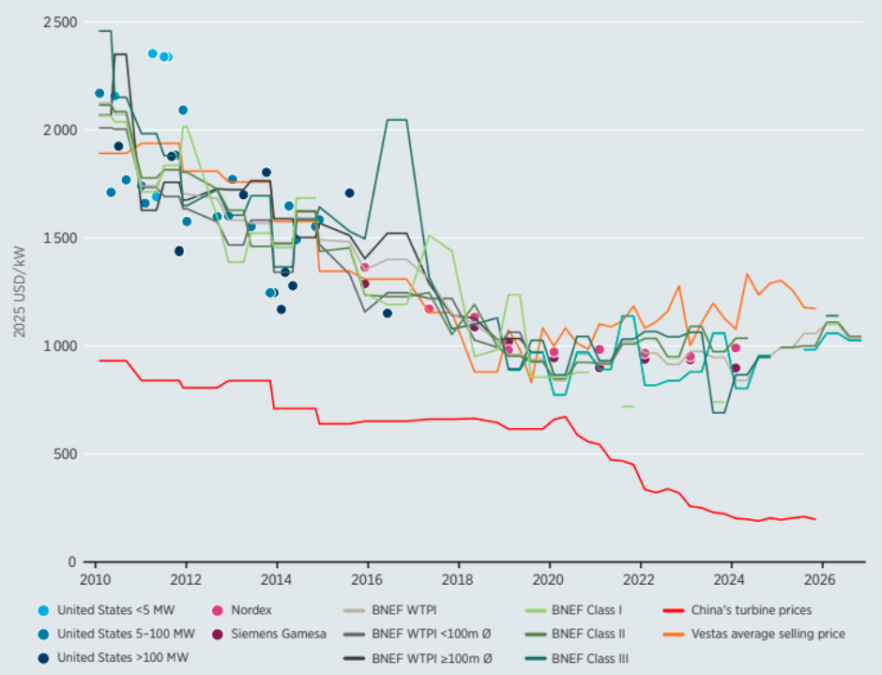
Outside mainland China, manufacturers increased turbine prices during the first half of 2025 to recover from several years of weak profitability. According to BloombergNEF’s Wind Turbine Price Index (WTPI), turbine prices increased 14 percent between 2024 and 2025.
Pricing differences across turbine classes also narrowed significantly. By the first half of 2026, Class I, II, III, and S turbines converged around an average selling price of approximately USD 1,104/kW.
Policy, Supply Chains, and AI Shape Future Cost Reductions
IRENA notes that continued cost competitiveness depends on several enabling factors, including stable government policies, predictable project pipelines, faster permitting, reliable grid access, resilient domestic manufacturing, and strong energy security strategies.
European manufacturers are increasingly prioritizing faster project execution and resilient supply chains rather than simply building larger turbines. Chinese manufacturers are pursuing similar goals while also improving turbine reliability, competing in liberalized electricity markets, and integrating artificial intelligence (AI) into wind farm operations and maintenance.
With installation costs nearly 60 percent lower than in 2010, larger turbine technologies, improving manufacturing efficiencies, and AI-enabled operations are expected to further strengthen onshore wind’s position as one of the world’s lowest-cost sources of new electricity generation.
BABURAJAN KIZHAKEDATH