


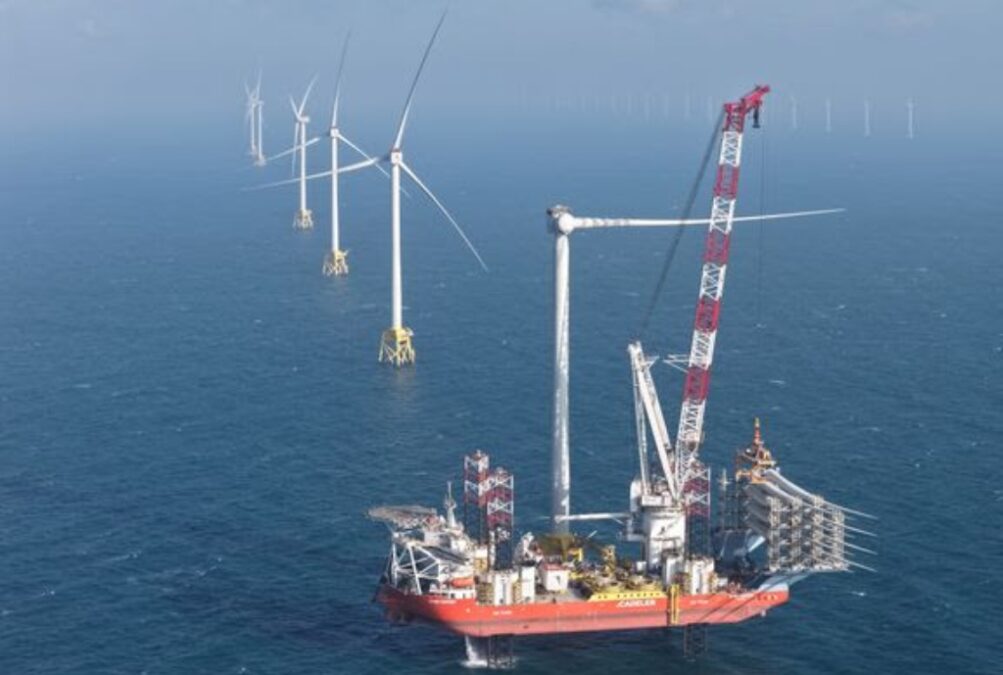
The global offshore wind industry is poised for unprecedented growth, with investments expected to exceed $980 billion over the next decade as countries accelerate renewable energy deployment to strengthen energy security, reduce fossil fuel dependence, and support decarbonization goals, according to the Global Offshore Wind Report 2026 from the Global Wind Energy Council (GWEC).
Global offshore wind capacity reached 92.5 GW by the end of 2025, accounting for 7.1 percent of total global wind capacity. The sector added 9.3 GW of new offshore wind installations during 2025, making it the third-highest year on record and representing a 16 percent increase compared with 2024. China remained the dominant market, commissioning 6.6 GW of new offshore wind capacity and accounting for more than 70 percent of global additions for the eighth consecutive year.
GWEC forecasts a major acceleration in offshore wind deployment between 2026 and 2035. More than 327 GW of new offshore wind capacity is expected to be installed globally during this period, driving total installed offshore wind capacity to approximately 420 GW by 2035, more than four times the current level. The industry is expected to surpass the 100 GW installed capacity milestone in 2026, while annual offshore wind installations are forecast to double in 2026, triple by 2030, and exceed 50 GW annually by 2035.
The scale of investment required is equally significant. GWEC estimates that developing 1 GW of offshore wind capacity requires approximately $3 billion in capital expenditure. Based on the projected 327 GW of new capacity additions, offshore wind investments could exceed $980 billion worldwide over the next decade, positioning the sector among the largest clean energy investment opportunities globally.
The report highlights the contrast between renewable energy investments and fossil fuel subsidies. Governments across 82 economies spent approximately $1.5 trillion on fossil fuel subsidies during the 2022 energy crisis. According to GWEC, that amount could have financed around 500 GW of offshore wind capacity in emerging and developing economies, significantly accelerating the global energy transition.
Offshore wind development activity remains strong, with around 50 GW of capacity currently under construction worldwide. GWEC describes the industry as approaching a major “take-off” phase, supported by expanding project pipelines, improving policy frameworks, and increasing demand for domestic energy sources.
China continues to play a central role in the industry’s growth trajectory. The country has announced a target of 100 GW of offshore wind capacity by 2030, implying more than 50 GW of additional offshore wind installations over the next five years. Meanwhile, nine North Sea countries have committed to deploying 300 GW of offshore wind capacity by 2050, including 100 GW of cross-border offshore wind projects designed to strengthen regional energy security and grid integration.
The United Kingdom has also reinforced its leadership position through a record offshore wind procurement program. The UK’s latest renewable energy auction secured 8.4 GW of offshore wind capacity, the largest offshore wind auction globally. The projects are expected to deliver consumer savings of approximately £1.79 billion, equivalent to $2.41 billion, compared with alternative energy technologies.
Australia is emerging as another significant offshore wind market. A GWEC-cited study found that deploying 7 GW of offshore wind capacity in Gippsland by 2040 could generate AUD 2.9 billion ($2.1 billion) in total system cost savings, reduce transmission capital expenditure by AUD 4.9 billion ($3.55 billion), lower fuel operating costs by AUD 2.5 billion ($1.8 billion), and cut annual wholesale electricity costs by AUD 5.2 billion ($3.8 billion).
Beyond project development, offshore wind is driving one of the fastest industrial expansion cycles in modern energy history. Significant investments are flowing into steel manufacturing plants, shipyards, offshore fabrication yards, specialized installation vessels, turbine manufacturing facilities, ports, and transmission infrastructure. Future offshore wind turbines are expected to exceed 20 MW in capacity, while floating offshore wind foundations may require between 4,000 and 8,000 metric tons of fabricated steel per unit, creating substantial opportunities for heavy industry and supply chain companies.
GWEC argues that offshore wind should be treated as critical national infrastructure requiring continued investment in offshore generation assets, transmission networks, energy storage systems, port facilities, manufacturing capacity, workforce development, and supply chain expansion. With projects capable of generating electricity for up to 30 years without fuel costs, offshore wind is increasingly viewed as a strategic asset that can enhance energy security, stabilize power prices, and support long-term economic growth.
As governments seek to shield their economies from oil and gas market volatility while meeting climate commitments, offshore wind is rapidly emerging as one of the most important pillars of the global clean energy transition and one of the largest investment opportunities in the renewable energy sector.
BABURAJAN KIZHAKEDATH