


Chinese wind turbine manufacturers have won the global scale race, but Vestas remains the world’s most international wind OEM. That contrast defines the wind turbine market in 2026.
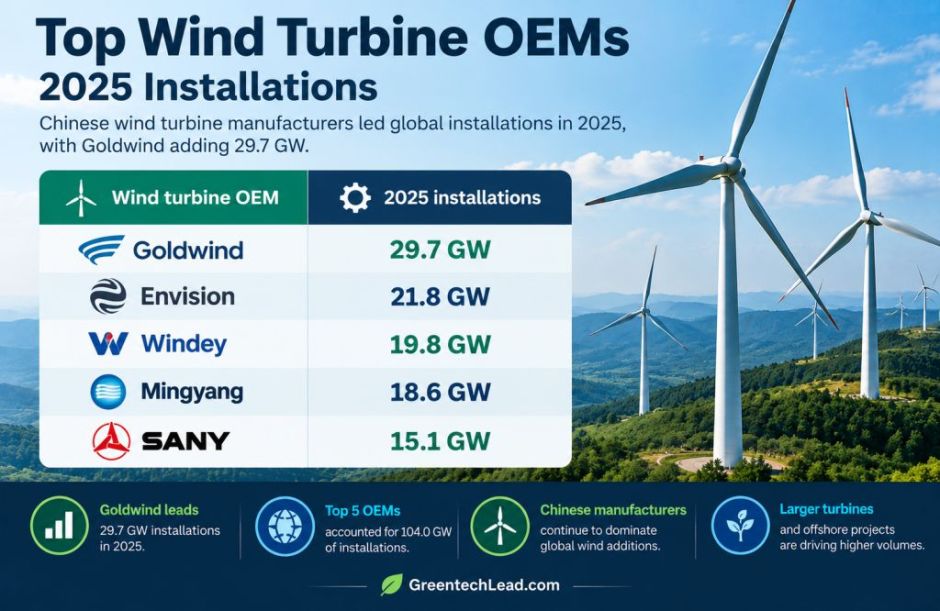
Goldwind installed 29.7 GW in 2025 and Envision 21.8 GW, making them the world’s two largest suppliers by annual installations. Vestas, meanwhile, installed 12.9 GW outside mainland China and retained the cumulative global lead with more than 201 GW installed.
The next battle is therefore not simply about manufacturing more turbines. Goldwind, Envision and other Chinese OEMs must convert scale, lower costs and rapidly advancing technology into bankable international projects, local manufacturing and decades of service revenue.
Chinese OEMs Capture Top Five Global Wind Turbine Rankings
The scale shift in wind manufacturing is dramatic.
A record 178 GW of wind turbines was mechanically installed globally in 2025, up 40 percent, according to GWEC’s global wind turbine market data.
For the first time, the five largest suppliers by annual installations were all Chinese:
China accounted for 67 percent of global installations.
But international rankings tell a different story. Outside mainland China, Vestas installed 12.9 GW, followed by Nordex with 7.7 GW, GE Vernova with 5.8 GW, Siemens Gamesa with 5.4 GW and Envision with 4.2 GW.
Vestas installed turbines across 36 countries, compared with 23 for Goldwind.
That gap shows why China’s dominance in manufacturing does not yet equal dominance of the global wind market.
Goldwind Takes Chinese Wind Technology to Saudi Arabia
Goldwind provides one of the strongest examples of Chinese OEMs moving from exports toward large-scale international execution.
Its overseas orders reached 9.27 GW at the end of 2025, up 31.83 percent, while international revenue increased 50.95 percent to RMB18.04 billion.
Saudi Arabia’s 3 GW PIF5 project demonstrates the next stage of this strategy.
The development combines the 1 GW Shaqra and 2 GW Starah wind projects and is being developed by ACWA Power, Saudi Arabia’s Public Investment Fund and Saudi Aramco.
Goldwind began shipping equipment for the project in June 2026. It is supplying GWH204-10 MW turbines, designed for Saudi Arabia’s high temperatures and dusty conditions.
Goldwind has also established a local wind tower manufacturing facility at Shaqra, demonstrating how Chinese OEMs can combine turbine exports with localization.
Once operational, PIF5 is expected to generate around 11.3 billion kWh annually.
Envision Crosses 100 GW of Global Installations
Envision has also reached significant scale.
Envision’s installations reached 103 GW by the end of 2025, making it one of only five wind OEMs worldwide to exceed 100 GW.
Unlike a pure turbine manufacturer, Envision is building a broader clean-energy platform incorporating wind turbines, energy storage and digital energy technologies.
International financing is becoming part of that expansion.
In March 2026, Envision completed a $600 million-equivalent sustainability-linked syndicated loan, expanded from an initial $500 million following investor demand.
Access to international financing matters because wind developers assess more than turbine specifications. They need confidence that an OEM can provide warranties, components, technical support and maintenance throughout an asset’s operating life.
Vestas Answers with Two 1.38 GW UK Offshore Projects
Vestas demonstrates the advantage established OEMs retain in mature international markets.
In February 2026, Vestas secured a firm 1.38 GW order for RWE’s Vanguard West offshore wind project in the UK. The project will use 92 V236-15.0 MW turbines.
One month later, RWE ordered another 92 V236-15.0 MW turbines for the 1.38 GW Vanguard East project.
Together, the two projects represent 2.76 GW and 184 offshore turbines.
The agreements also highlight a major Vestas advantage: turbines are accompanied by service and operational-support arrangements.
Vestas’ 2026 global wind turbine orders show how this model extends across offshore and onshore markets.
Brazil, Canada and Bulgaria Show Vestas’ Geographic Reach
Vestas’ competitive advantage is particularly visible when individual projects are examined.
In Brazil, Equinor and Rio Energy ordered 51 V163-4.5 MW turbines for the 230 MW Esquina do Vento project. Vestas will also provide O&M services for 30 years.
In Canada, EDF power solutions ordered turbines for the 186 MW Forêt Domaniale project in Québec. Combined with the earlier Madawaska and Haute-Chaudière projects, Vestas’ EnVentus orders with EDF in Québec approach 600 MW.
In Bulgaria, Tessa Green Energy selected 11 V162-6.4 MW turbines for the 70 MW Strazhitsa project.
Vestas has also secured 2026 orders in Germany, France, Italy, Japan, South Korea, New Zealand and Peru.
This geographic diversification reduces dependence on any single national market.
Offshore Wind Could Reshape the OEM Competition
Offshore wind will be one of the toughest tests for Chinese manufacturers.
China had 48.4 GW of cumulative offshore wind capacity at the end of 2025, providing Chinese OEMs with a huge domestic testing and deployment base.
Manufacturers are rapidly developing turbines above 15 MW, while Vestas is commercializing its V236-15.0 MW internationally.
Larger offshore turbines can reduce the number of foundations, cables and installation operations required per GW. But the economics depend on much more than nameplate capacity.
Developers need proven availability, blade and drivetrain durability, installation capability, warranty support and rapid access to replacement components.
A turbine failure offshore is significantly more difficult and expensive to address than a similar problem onshore.
Low Chinese Turbine Prices Are Not Enough
Chinese manufacturers benefit from huge domestic volumes, integrated supply chains and high factory utilization. These advantages can translate into lower equipment costs.
But turbine price represents only part of wind-project economics.
Developers must consider foundations, transportation, construction, electrical infrastructure, financing, insurance, capacity factor, availability and lifetime O&M.
The important metric is therefore risk-adjusted levelised cost of electricity, rather than turbine purchase price alone. IRENA’s renewable power cost analysis provides a broader benchmark for understanding how equipment, financing and generation performance influence wind economics.
Chinese OEMs will gain a durable international advantage only if cheaper turbines translate into competitive lifetime electricity costs.
Europe Remains the Hardest Market for Chinese OEMs
Europe illustrates the barriers to international expansion.
European OEMs supplied 94.5 percent of turbines installed in Europe during 2025, while Chinese manufacturers supplied only 446 MW, including 278 MW within the EU-27.
Regulation adds another challenge. The European Commission opened an in-depth Foreign Subsidies Regulation investigation involving Goldwind in February 2026. The investigation is ongoing and does not constitute a finding of wrongdoing.
Chinese OEMs must therefore compete on technology and price while addressing localization, cybersecurity, supply-chain resilience and regulatory requirements.
Vestas’ 201 GW Installed Base Creates a Service Moat
Vestas’ biggest advantage may be its existing fleet.
It became the first wind OEM to exceed 200 GW of cumulative installations, reaching more than 201 GW by the end of 2025.
Vestas also reported €18.82 billion of 2025 revenue and a record €71.9 billion combined Power Solutions and Service backlog.
The installed fleet creates decades of potential revenue from maintenance, software, spare parts, upgrades and repowering.
This is difficult for competitors to reproduce quickly. Vestas’ 2025 annual results demonstrate how turbine manufacturing and lifecycle services increasingly operate as a single business.
Goldwind vs Envision vs Vestas: Who Is Winning?
Goldwind is currently winning on annual installation volume. Envision has also achieved enormous manufacturing scale. Vestas remains ahead in international reach, cumulative installations and service infrastructure.
The 3 GW Saudi PIF5 project demonstrates that Goldwind can translate Chinese manufacturing capabilities into major overseas projects. Envision’s 103 GW installed base and international financing show similar globalization potential.
But Vestas’ projects tell the other side of the story. Two 1.38 GW UK offshore orders, a 230 MW Brazilian project with a 30-year service agreement and projects across Canada, Europe, Asia-Pacific and Latin America demonstrate a global operating platform Chinese OEMs are still building.
The global wind OEM battle in 2026 is consequently shifting from who can manufacture the most turbines to who can deliver the lowest-risk electricity over 20-30 years.
Chinese OEMs have already achieved global manufacturing leadership. Their next challenge is considerably harder: converting that scale into international bankability, localized manufacturing, reliable project execution and recurring lifecycle service revenue.
SHAFANA FAZAL