



Municipal waste operations are becoming more complex as municipalities and waste companies face growing service demands, stricter regulations and rising operational costs. Many organizations still rely on disconnected systems and manual processes that reduce efficiency and increase reporting errors.
Municipal waste management software helps centralize operations by improving routing, billing, reporting and operational visibility. However, choosing the right platform requires careful evaluation of scalability, compliance capabilities, integrations and long-term value.
Why Municipal Waste Management Software Matters
Waste management operations involve far more than collection scheduling. Municipalities and private operators must coordinate vehicle fleets, manage service requests, monitor disposal and recycling activities, track environmental reporting requirements and maintain accurate customer billing systems. Without integrated software, these responsibilities often become fragmented across departments and disconnected systems.
Modern municipal waste management software can help organizations:
- Reduce manual administrative work
- Improve route efficiency and fuel usage
- Automate regulatory reporting
- Track waste streams and recycling diversion rates
- Improve billing accuracy
- Increase operational transparency
- Support long-term sustainability initiatives
- Scale operations as communities grow
For municipalities managing multiple service zones or facilities, centralized visibility becomes especially important. Decision-makers need real-time operational data to improve planning and respond quickly to service disruptions or compliance issues.
Key Challenges Municipalities Face Without Modern Software
Before evaluating software vendors, it’s important to understand the operational problems these systems are designed to solve.
Regulatory Compliance Becomes Difficult to Manage
Environmental regulations continue to evolve at the municipal, state and federal levels. Reporting requirements for waste disposal, recycling, emissions and diversion rates can be difficult to track manually. Software platforms with built-in compliance reporting tools help municipalities maintain accurate records and generate required reports more efficiently.
Manual Data Entry Creates Errors
Paper-based systems and spreadsheets increase the likelihood of duplicate records, inaccurate invoices and reporting inconsistencies. Automated workflows reduce human error while improving data consistency across departments.
Vehicle Routing and Dispatching Inefficiencies
Inefficient routes increase fuel costs, overtime expenses and vehicle wear. Poor route planning can also lead to missed pickups and customer complaints. Waste management software with route optimization capabilities can improve operational efficiency while reducing operational costs.
Limited Visibility Across Operations
Municipalities often struggle to consolidate information from transfer stations, recycling facilities, customer service departments and collection operations. Centralized dashboards and reporting tools provide leadership teams with a clearer understanding of operational performance.
Difficulty Tracking Diversion and Sustainability Metrics
As sustainability goals become more important, municipalities need better ways to measure recycling rates, landfill diversion and waste stream composition. Modern systems provide analytics tools that support long-term environmental planning and reporting.
Essential Features to Look for in Municipal Waste Management Software
Not every software platform offers the same capabilities. Organizations should prioritize solutions that align with both current operational requirements and future growth plans.
Regulatory Compliance Reporting
Compliance management should be one of the first evaluation criteria. The best systems automate environmental reporting requirements and maintain detailed audit trails for inspections and regulatory reviews. Look for software that can adapt to changing reporting standards without requiring extensive manual customization.
Scalability for Community Growth
Municipalities evolve over time. Population growth, service expansion and changing recycling initiatives can quickly outgrow older systems. Scalable platforms allow organizations to add users, service areas, vehicles and facilities without replacing the entire system.
Integration With Existing Systems
Waste management software should integrate with existing systems such as accounting platforms, GIS mapping tools, fleet management software, billing systems and weigh scales. Strong integrations improve data accuracy, streamline workflows and reduce operational silos.
Operational Efficiency Tools
Automation tools help improve productivity across waste operations. Features like route optimization, automated dispatching, mobile driver apps, digital work orders, and real-time fleet tracking can reduce delays and improve coordination between office staff and field teams.
Data Accuracy and Reporting
Accurate reporting helps municipalities improve planning, budgeting and operational oversight. Look for software with real-time dashboards, custom reporting tools, waste stream tracking, recycling analytics and financial reporting capabilities.
Customization for Local Needs
Every municipality operates differently. Some focus heavily on residential collection, while others manage complex industrial or regional waste operations. Flexible software platforms allow organizations to customize workflows, reporting structures, service categories and operational processes without extensive redevelopment.
User-Friendliness and Training
Software should be easy for teams to adopt and use daily. Features such as intuitive interfaces, mobile access, onboarding support and staff training resources can improve adoption across departments.
Total Cost of Ownership
Software costs should be evaluated beyond the initial purchase price. Organizations should also consider implementation, training, integration, maintenance and future upgrade costs when evaluating long-term value.
Best Municipal Waste Management Software Companies
The following companies are commonly considered by municipalities and waste management organizations evaluating software solutions.
Paradigm Software L.L.C.
Paradigm Software L.L.C.® is a specialized provider of end-to-end weighing and transaction management solutions for municipal solid waste, transfer stations, landfills and volume-based operations.

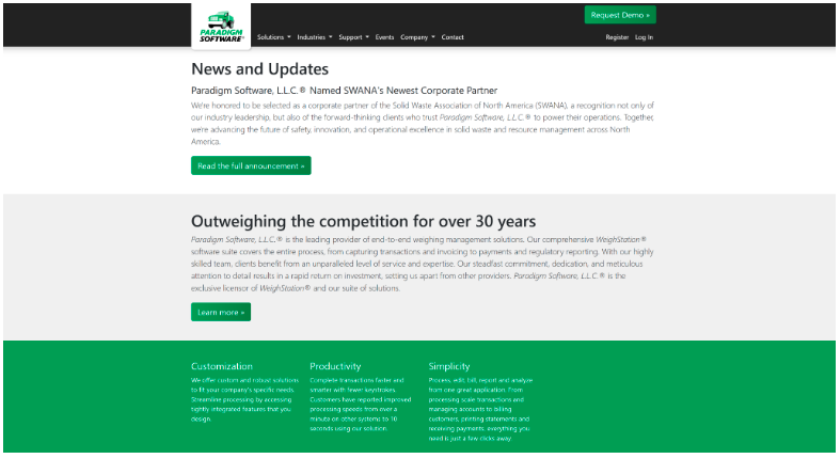
Built around its flagship WeighStation® platform, the company focuses on delivering highly configurable systems that connect weighing, routing, billing, reporting and regulatory compliance into a single streamlined workflow. Its solutions are designed for high-speed processing, operational visibility across multiple sites, and strong customization capabilities that adapt to the unique needs of both public and private waste operations.
The company is widely used by municipalities and large infrastructure operators that require accurate, real-time transaction handling and flexible reporting tools. It also emphasizes ease of use, automation and robust operational control, making it a strong fit for organizations seeking to modernize or fully digitize their waste management processes.
Key Features
Proven adoption across municipal agencies and large-scale waste authorities requiring reliable compliance and audit readiness
Highly configurable software tailored to specific operational workflows, including custom ticketing and processing structures
End-to-end transaction management covering weighing, invoicing, payments and regulatory reporting
Real-time operational visibility across multiple sites with centralized data synchronization
High-speed processing designed to reduce transaction times and improve throughput efficiency
Advanced reporting tools capable of generating customized operational, financial and compliance reports
Support for unattended or fully automated operations in high-volume environments
Strong system simplicity with unified access to processing, billing and analytics functions in one platform
Integration of automation tools for ticketing, billing workflows and reporting efficiency
Built-in disaster recovery and performance optimization for operational continuity
Flexible deployment supporting complex municipal and industrial waste environments such as landfills, transfer stations, recycling centers, mining and aggregate operations
Dedicated support structure with standard weekday coverage and emergency support options for operational continuity
AMCS
AMCS supplies integrated waste and resource management software that helps municipalities and service providers digitize, automate and optimize complex operations. It stands out as a highly configurable, cloud-based platform that unifies waste collection, recycling, street services and public maintenance into a single, connected system. The result is improved visibility, efficiency and sustainability.


The platform is widely recognized for supporting data-driven municipal operations that need stronger control over service delivery, regulatory compliance and environmental performance. It also enables organizations to reduce operational inefficiencies, improve resource allocation and transition from manual, fragmented processes to fully connected digital workflows.
By combining operational management, analytics and real-time field connectivity, it supports more reliable service delivery and helps municipalities meet rising expectations for transparency, cost control and environmental responsibility.
Key Features
Scalable architecture designed to support expanding service areas, growing populations and evolving municipal needs
Unified municipal operations platform that connects waste, recycling, street cleansing, winter maintenance and public space services in one system
Advanced automation tools that streamline scheduling, dispatching and operational workflows to reduce manual coordination
Real-time visibility across office, depot, and field teams to improve service tracking and decision-making
Configurable workflows and service structures that allow municipalities to adapt the system to local regulations and operational requirements
Built-in reporting and analytics tools that support compliance tracking, environmental, social and governance (ESG) reporting, and performance measurement
Mobile workforce functionality that enables field crews to update job status, report issues and access live operational data
Optimization features that support route planning efficiency, reduce missed collections and improve resource allocation
Integrated data environment that consolidates operational, financial, and service data for more accurate planning and billing
Sustainability-focused tools that help municipalities reduce emissions, improve recycling outcomes and meet environmental targets
Rubicon
Rubicon is a cloud-based waste and recycling management platform that helps enterprises, municipalities and multisite organizations coordinate services, improve cost visibility and strengthen sustainability performance. It stands out as a digital-first solution that combines service management software with a marketplace of waste vendors, enabling organizations to simplify procurement, standardize operations across locations, and gain clearer insight into waste generation and disposal.

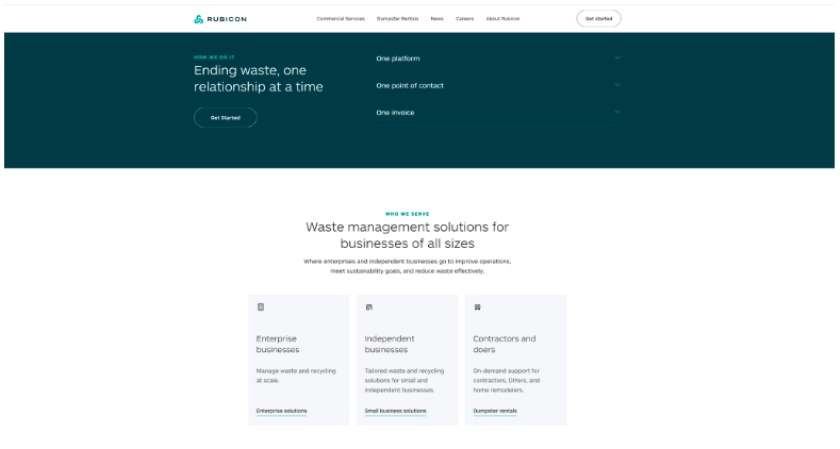
Rather than focusing only on collection logistics, Rubicon emphasizes data transparency, reporting and centralized control for distributed operations. Founded in 2008, it has positioned itself as a technology-driven alternative to traditional waste brokerage and fragmented service management models.
It is widely used by organizations managing complex, multilocation waste networks that require consistent reporting, better vendor coordination, and stronger alignment with sustainability and cost-reduction goals. By combining operational oversight with analytics and a connected service ecosystem, Rubicon supports more informed decision-making and improved efficiency across large-scale waste programs.
Key Features
- Centralized waste and recycling management system for multi-site organizations and municipalities
- Digital marketplace that connects users with a broad network of waste haulers and recycling providers
- Cost visibility tools that consolidate invoices and service data to identify inefficiencies and savings opportunities
- Waste tracking and categorization features that monitor materials by type, stream and location
- Analytics dashboards that measure diversion rates, waste volumes and operational performance over time
- Compliance and documentation support to assist with regulatory reporting and internal governance requirements
- Service scheduling and vendor coordination tools that streamline waste operations across multiple locations
- Workflow automation that reduces manual coordination and improves operational consistency
- Target-setting and tracking tools that support sustainability and waste reduction goals
- Integration capabilities with enterprise procurement, finance and reporting systems for unified data management
- Multisite scalability designed for large enterprises managing complex, distributed waste operations
- Support for circular economy initiatives through improved visibility into waste streams and recycling outcomes
How to Select a Suitable Municipal Waste Management Software
Choosing the right municipal waste management software requires more than comparing features. Municipalities and waste operators should evaluate how well a platform supports their operational goals, long-term growth and reporting requirements by doing the following:
- Define operational priorities first: Identify key pain points such as billing accuracy, route optimization, compliance or growth before evaluating vendors.
- Include multiple departments in the decision process: Operations, finance, customer service, fleet management and compliance teams should all help evaluate the platform.
- Request real-world case studies: Ask vendors for examples from municipalities or waste companies with similar service sizes, waste volumes or operational models.
- Evaluate implementation and support services: Review onboarding, data migration assistance, staff training and long-term customer support before making a decision.
- Prioritize long-term flexibility: Choose software that can support future needs such as expanded recycling programs, smart city initiatives and advanced reporting capabilities.
- Compare reporting tools carefully: Look for platforms that can generate operational, financial, environmental and customer service reports tailored to local requirements.
Municipal Waste Software Comparison
Municipal waste software platforms vary in structure and purpose. For municipalities and waste operators, the key differences center on operational control, scalability, vendor management and data visibility. Below is a simplified comparison of the three platforms to help decision-makers quickly assess fit.
| Feature | Paradigm Software L.L.C.® | AMCS | Rubicon |
| Core Focus | Municipal waste operations ERP system | End-to-end municipal and enterprise waste platform | Digital waste marketplace and analytics platform |
| Main Strength | Routing, billing and weighbridge-based operations | Full operational control, automation and optimization | Vendor network and cost transparency |
| Routing & Dispatch | Strong routing and scalehouse management | Advanced route optimization | Basic scheduling and coordination |
| Compliance Reporting | Strong municipal compliance and documentation tools | Strong regulatory and ESG reporting | Good compliance documentation support |
| Analytics & Reporting | Operational dashboards and transaction tracking | Real-time analytics and AI insights | Strong waste and cost analytics dashboards |
| Vendor / Marketplace | Not included | Not included | Core feature (hauler marketplace) |
| Integrations | ERP, GIS, accounting and weigh systems | ERP, IoT and finance systems | Procurement, finance, enterprise systems |
| Best For | Municipal departments, landfill and transfer stations | Large municipalities and smart city operations | Multisite enterprises with outsourced waste services |
FAQs
Selecting municipal waste management software is a significant operational investment. The following questions address some of the most common concerns municipalities and waste operators evaluate during the research process.
How much does waste management software cost?
Pricing varies based on organization size, number of users, required integrations, customization needs and deployment scope. Some vendors offer subscription-based pricing, while others use enterprise licensing models.
How long does implementation usually take?
Implementation timelines vary depending on system complexity and data migration requirements. Smaller deployments may take several weeks, while enterprise municipal implementations can take several months.
What integrations are most important?
Common integrations include accounting software, GIS systems, fleet management platforms, billing systems, weigh scales and customer service applications.
Choosing the Right Platform
The best municipal waste management software improves efficiency, simplifies compliance and supports long-term growth. By choosing a scalable and user-friendly platform, municipalities and waste operators can build more reliable, data-driven operations for their communities.