


Battery energy storage is entering the multi-gigawatt-hour era, transforming BESS from a supporting component of renewable-energy projects into a major infrastructure asset.
Developers in India and Australia are now building battery projects containing several GWh of storage, while individual developments are attracting hundreds of millions — and collectively billions — of dollars in investment.
The clearest evidence comes from Adani Green Energy’s 6.63 GWh battery installation at Khavda in India and a new generation of long-duration storage projects in Australia’s New South Wales.
These projects reveal an important change in the battery-storage market. Scale is increasingly being measured not simply by MW of power but by GWh of energy, discharge duration, renewable-energy integration, grid location and contracted revenue.
Australia Awards 12 GWh of Long-Duration Battery Storage
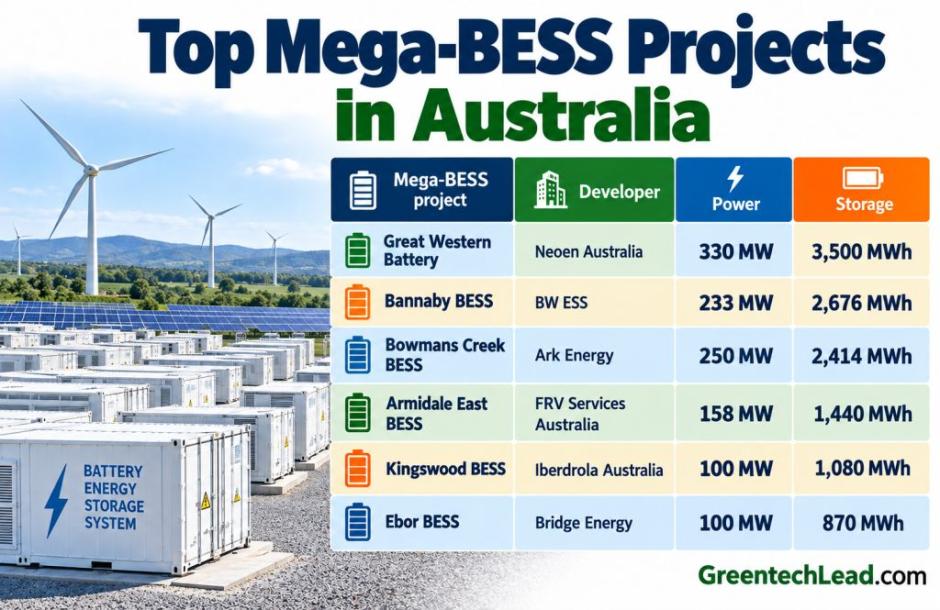
New South Wales awarded Long-Term Energy Service Agreements to six long-duration BESS projects in February 2026 representing approximately 12 GWh of combined storage.
The six projects are expected to secure at least A$4.82 billion of investment, with each capable of providing more than eight hours of continuous discharge. The project specifications demonstrate how battery-storage architecture is changing.
The 330 MW/3.5 GWh Great Western Battery, for example, has more than ten hours of energy capacity relative to its maximum power rating. Bannaby and Bowmans Creek similarly combine relatively moderate MW output with several GWh of storage.
These are fundamentally different assets from shorter-duration batteries primarily designed for frequency response or brief peak-demand periods.
The emergence of the world’s largest battery storage projects demonstrates how BESS is evolving into large-scale electricity infrastructure capable of shifting renewable generation across much longer periods.
Adani Green Scales Khavda Battery Storage to 6.63 GWh
India provides an even larger operational example.
Adani Green Energy expanded its operational battery-storage capacity at Khavda, Gujarat, to 6.63 GWh by October 2026, up from 3.55 GWh in June.
The company says the installation represents more than 50 percent of India’s approximately 12.6 GWh of operational BESS capacity and is the world’s largest operational battery-storage installation at a single location.
The pace of expansion has been particularly significant.
Adani Green had 1.38 GWh installed at the end of FY2026. Capacity increased to 3.37 GWh in May, 3.55 GWh by June and 6.63 GWh by October 2026.
The company is targeting more than 10 GWh of battery-storage additions during FY2026-27 and 50 GWh over the next five years.
More importantly, the battery capacity is being integrated with the Khavda renewable-energy development, where Adani Green is building a 30 GW renewable-energy complex across 538 square kilometres.
This illustrates one of the most important emerging uses of mega-BESS: combining very large solar and wind portfolios with storage capable of shifting electricity supply and improving the dispatchability of renewable generation.
The expansion also reflects the accelerating energy storage investment boom in India.
Mega-BESS Projects Represent Hundreds of Millions in Investment
The rapid increase in storage capacity is creating a new infrastructure investment category.
Ember estimates that a large, long-duration utility-scale BESS outside China and the United States costs approximately $125/kWh all-in, although actual project costs vary substantially according to equipment, power rating, duration, EPC requirements and grid connection.
Using that benchmark purely as an indication of investment scale:
| Storage capacity | Indicative CAPEX at $125/kWh |
| 1 GWh | $125 million |
| 2 GWh | $250 million |
| 3 GWh | $375 million |
| 5 GWh | $625 million |
| 10 GWh | $1.25 billion |
These are illustrative benchmarks rather than estimates for individual projects.
For investors seeking a detailed breakdown of equipment, installation, grid-connection and project economics, GreentechLead’s analysis of battery storage costs in 2026 examines why the final investment can differ substantially from headline battery prices.
The larger point is that moving from hundreds of MWh to several GWh turns battery storage into an infrastructure investment measured in hundreds of millions of dollars.
Long-Duration Storage Is Driving the Next Phase
The Australian projects also show that the mega-BESS race is not simply about installing the largest possible battery capacity.
Duration is becoming increasingly important.
The six NSW projects provide approximately 12 GWh of storage against combined maximum power capacity of around 1.17 GW. Each selected battery can continuously discharge for more than eight hours.
That architecture allows storage to perform a broader role in electricity systems.
Instead of responding primarily to short-term price movements or frequency requirements, long-duration batteries can shift large quantities of renewable electricity from periods of abundant generation into evening peaks and other periods when electricity supply is tighter.
This becomes increasingly valuable as solar and wind account for larger shares of electricity generation.
Stoney Creek Shows the Importance of Long-Term Revenue Contracts
Energy Vault’s 125 MW/1 GWh Stoney Creek BESS in New South Wales illustrates another important feature of the emerging mega-storage market: long-term revenue visibility.
The eight-hour project received New South Wales State Significant Development approval in September 2026.
Site mobilization is expected to start in the fourth quarter of 2026, with commercial operations targeted for the first half of 2028.
The project has a 14-year Long-Term Energy Service Agreement. Contracted support combined with anticipated merchant-market earnings is expected to generate approximately $25 million-$30 million in annual project revenue once operational.
Rather than attempting to derive a generic ROI from these figures, the project is more useful as evidence of how large BESS developments can combine long-term contracted income with merchant-market opportunities.
That revenue visibility can be particularly important when developers seek financing for storage projects requiring substantial upfront capital.
Mega-BESS Revenue Is Moving Beyond Energy Arbitrage
The business model for large-scale storage is also broadening.
Mega-BESS projects do not necessarily depend exclusively on purchasing electricity when prices are low and selling it when prices rise.
Depending on the electricity market, batteries can generate or support revenue through long-term storage agreements, renewable-energy firming, energy arbitrage, ancillary services, grid-support services, capacity payments and merchant electricity-market participation.
Revenue stacking becomes increasingly important as project size grows.
For a multi-GWh battery requiring hundreds of millions of dollars in investment, predictable contracted revenue can improve bankability, while exposure to merchant electricity markets can provide additional upside.
The NSW program demonstrates how policy and long-term contracting mechanisms can mobilize investment at scale. Its six selected projects alone are expected to secure at least A$4.82 billion of energy-system investment.
Grid Access Could Determine Mega-BESS Winners
As battery projects become larger, grid connection and location become increasingly strategic.
A multi-GWh project needs more than inexpensive battery cells. Developers require sufficient transmission capacity, suitable substations, land, permitting and the ability to charge and discharge very large quantities of electricity.
This gives projects located near major renewable-energy developments or strong transmission infrastructure a potential advantage.
Adani Green’s Khavda strategy demonstrates this integration. Instead of treating storage as an isolated asset, the company is deploying BESS alongside one of the world’s largest renewable-energy developments.
Australia’s projects similarly show how large batteries can become integral components of broader electricity-system planning.
The implication is that the mega-BESS race may increasingly be determined by access to grids and renewable generation, rather than battery procurement costs alone.
Falling BESS Costs Support Larger Projects
The shift toward multi-GWh storage would have been far more difficult without the dramatic decline in battery costs.
Global battery energy storage system costs have fallen 95 percent since 2010, substantially strengthening the economics of increasingly large projects.
Lower equipment costs allow developers to consider storage capacities that would previously have required prohibitive capital investment.
But falling battery prices alone do not guarantee attractive projects.
As installations move into several GWh, transmission access, project duration, financing, utilization and long-term revenue arrangements become increasingly important to investment decisions.
Mega-BESS Is Emerging as a New Infrastructure Asset Class
The most important development in battery storage is therefore not simply that individual batteries are becoming larger.
Their role in the electricity system is changing.
Smaller batteries can provide frequency regulation, peak management and short-duration renewable-energy shifting. Multi-GWh projects can potentially move enormous quantities of renewable electricity between different periods of the day and provide longer-duration support to power systems.
Australia’s latest projects will provide more than eight hours of continuous storage. Adani Green has already reached 6.63 GWh at a single location while targeting tens of GWh of additional capacity. Energy Vault’s Stoney Creek project combines 1 GWh of eight-hour storage with a 14-year revenue-support mechanism.
At Ember’s indicative $125/kWh benchmark, every additional 1 GWh represents roughly $125 million of investment before project-specific variations.
The transition from hundreds of MWh to tens of GWh therefore represents a multi-billion-dollar opportunity for developers, battery suppliers, EPC companies, utilities and infrastructure investors.
The winners in the mega-BESS era are unlikely to be determined solely by who purchases batteries at the lowest $/kWh.
Increasingly, competitive advantage will depend on how much energy a project can shift, how long it can discharge, where it connects to the grid, which renewable resources it supports and how much future revenue can be secured through long-term contracts.
SHAFANA FAZAL